Most guides to UK company registration focus on the private LTD, and for good reason: it's fast, cheap, and low-maintenance. A PLC is a different animal entirely, with its own capital thresholds, governance rules, and filing obligations. Dutch founders coming from the NV/BV system face an extra layer of cross-border planning on top of that.
This guide covers what a UK PLC actually involves, whether it fits your business, the exact registration steps, the requirements and costs to expect, and how VJM Global supports Dutch businesses through the process.
Key Takeaways
- Register a UK PLC remotely from the Netherlands—Companies House imposes no nationality bar
- Meet the PLC floor: £50,000 share capital (25% paid up), two directors, plus a qualified company secretary
- Use a UK registered office only; a Dutch address will not satisfy Companies House
- Choose a UK LTD instead unless public capital-raising is the explicit goal
- Build dual UK–Netherlands tax compliance into the plan from day one
Understanding a UK PLC and How It Compares to a Dutch NV
Dutch founders often assume UK PLC rules mirror the Dutch NV, since both are "public" capital-raising structures. They don't. The legal mechanics differ in ways that catch people off guard mid-registration.
What Is a UK Public Limited Company (PLC)?
Under the Companies Act 2006, a PLC is a limited liability company whose shares can be freely offered to the public. Two things set it apart immediately:
- It must carry the "PLC" or "plc" suffix (or the Welsh equivalent) in its name
- It needs allotted share capital of at least £50,000, with a quarter paid up, before it can start trading or borrowing
A private LTD uses neither the PLC suffix nor the £50,000 capital floor. It also can't offer shares to the public or list on a stock exchange. Those limits explain most of the extra compliance a PLC carries.
Can a Netherlands-Based Individual or Company Register a UK PLC?
Yes. Companies House places no nationality or residency restriction on who can be a director, secretary, or shareholder of a UK company. Dutch individuals and Dutch companies can own and run a UK PLC without relocating or holding UK residency.
There's one practical catch: you need a genuine UK registered office address. A Dutch business address won't be accepted for this purpose. VJM Global provides UK registered office and company secretarial support for founders managing the process from abroad.
UK PLC vs Dutch NV: Key Differences
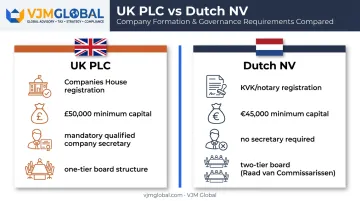
| Factor | UK PLC | Dutch NV |
|---|---|---|
| Registering authority | Companies House | KVK, via a civil-law notary |
| Minimum capital | £50,000 | €45,000 |
| Company secretary | Mandatory, qualified | Not required |
| Governance model | One-tier board (common) | Two-tier board (common; "Raad van Commissarissen") |
Neither entity maps neatly onto the other. The closest Dutch equivalents to the UK's two main structures are the NV for public capital-raising and the BV for private limited companies. Don't assume a 1:1 match between the two systems. Map each intended UK structure against its actual Dutch counterpart before deciding.
Step-by-Step Process to Register a UK PLC from the Netherlands
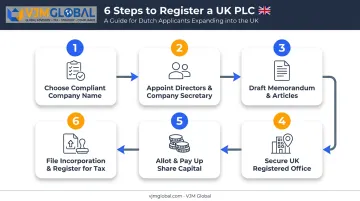
Once you've decided a PLC is the right fit, registration follows a fixed sequence.
Step 1: Choose a Compliant Company Name and Confirm Structure
Search the Companies House register before you file. Your name must meet these rules:
- End in "PLC" or "plc" (or the Welsh equivalent)
- Stay unique on the register and not too like an existing name
- Get prior approval if it uses restricted or sensitive words
Step 2: Appoint Directors, a Qualified Company Secretary, and Confirm Shareholders
A PLC needs more officers than a private company:
- At least two directors
- One qualified company secretary (chartered secretary, solicitor, or equivalent)
- Confirmed shareholders for the allotted share capital
An LTD, by contrast, needs only one director and no secretary. Dutch directors and shareholders can be appointed on Dutch ID and proof of address—no UK-resident director is required.
Step 3: Draft the Memorandum and Articles of Association
These documents set out the company's objects, share structure, and internal governance rules. You can adopt Companies House model articles, though custom articles usually fit PLC governance needs better.
Step 4: Secure a UK Registered Office Address
Every UK PLC must maintain a registered office inside the UK for statutory correspondence. Dutch applicants typically use a UK registered office and secretarial service. A Dutch address will not meet this requirement.
Step 5: Allot and Pay Up the Minimum Share Capital
Allot shares with a nominal value of at least £50,000, and pay up at least 25% (£12,500) before the company trades or borrows. Companies House will not issue a trading certificate until this capital position is evidenced.
This capital gate—and the notarial or legal work around it—has no equivalent in a standard LTD registration.
Step 6: File Incorporation Documents and Register for Tax
Submit Form IN01 and the governing documents to Companies House, directly or through a formation agent. Online filing is faster than paper.
After incorporation, apply for the trading certificate so the PLC can lawfully trade or borrow. Then register for Corporation Tax with HMRC (due within three months of starting to trade).
What You Need and the Key Factors That Affect Your PLC Registration
Outcomes for Dutch applicants depend heavily on preparation quality. A handful of controllable variables determine whether registration takes two weeks or two months.
Documentation and eligibility requirements
Every director, secretary, and shareholder needs:
- A valid passport or national ID
- Proof of residential address (typically your Dutch home address)
- Certified translations for any documents not already in English
Key parameters that influence cost and timeline
- Share capital size: larger allotments increase legal and notary costs proportionally
- Registered office choice: a basic address service versus a full secretarial package affects ongoing compliance quality, not just price
- Filing method: electronic filing can process in hours; paper filing stretches into weeks
Common mistakes Dutch entrepreneurs make
- Assuming PLC formation mirrors LTD formation step-for-step
- Underestimating the £50,000/25%-paid-up capital rule until it's too late to fund quickly
- Omitting the mandatory qualified company secretary
- Trying to use a Dutch address as the UK registered office
- Overlooking parallel Dutch tax and reporting obligations for resident directors and shareholders
UK PLC vs UK LTD: Which Should a Dutch Business Choose?
For most Dutch businesses entering the UK market, a PLC is not the right first step. The capital and governance demands are steep for a structure most companies never actually need.
A PLC makes sense when you plan to:
- Raise capital from the public
- Pursue a future stock exchange listing
- Operate at a scale where PLC status carries real weight with investors and partners
An LTD is the better fit for most Dutch SMEs, startups, and trading subsidiaries. It offers:
- Lower share capital requirement
- Single-director option
- No mandatory company secretary
- Lighter ongoing filing burden
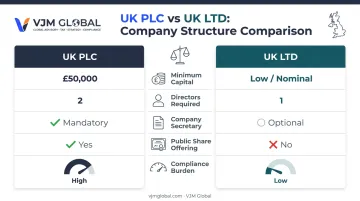
| Consideration | UK PLC | UK LTD |
|---|---|---|
| Minimum capital | £50,000 (25% paid up) | Any value, often set nominally low |
| Directors | 2 minimum | 1 minimum |
| Company secretary | Mandatory, qualified | Optional |
| Can offer shares publicly | Yes | No |
| Compliance burden | High | Comparatively low |
The trade-off is straightforward: PLC status buys public capital access and prestige. It costs you significantly more in compliance, reporting, and governance overhead to keep it running.
Conclusion
Registering a UK PLC from the Netherlands is achievable without relocating, as long as you plan around three things: the £50,000 capital rule, the qualified company secretary requirement, and the UK registered office obligation. Skip any of these in your planning, and the process stalls fast.
Most of the registration friction Dutch founders hit doesn't come from the cross-border element itself. It comes from underestimating what a PLC actually demands compared to a standard LTD.
VJM Global supports Dutch businesses with UK company registration, registered office and secretarial services, and ongoing UK–Netherlands tax compliance. If you're still weighing a PLC against an LTD, get in touch for guidance tailored to your situation.
Frequently Asked Questions
Can I set up a UK limited company if I live in the Netherlands?
Yes. There's no residency or nationality restriction, and the process is fully remote. You'll still need a UK registered office address and standard identity and address documentation.
Is it better for a Dutch business to operate as a UK PLC or a UK LTD?
Most Dutch businesses are better served by an LTD, given the lower capital and governance requirements. A PLC only makes sense if you're planning to raise public capital or pursue a listing.
What is a public limited company (PLC) in the UK?
A PLC is a limited liability company that can offer shares to the public. It requires at least £50,000 in allotted share capital and must carry the "PLC" suffix in its name.
What is the Dutch equivalent of a UK limited company?
The Dutch BV is the closest match to a UK LTD, while the Dutch NV is the closest match to a UK PLC. Minimum capital and governance rules still differ between each pair.
How long does it take to register a UK PLC from the Netherlands?
Electronic filing with Companies House can be completed in as little as 24 hours once your documents are ready. Preparing capital, governance documents, and a qualified secretary usually stretches the realistic timeline to several weeks.
Do I need a UK bank account to register a UK PLC as a Dutch applicant?
No, a UK bank account isn't legally required to incorporate. You'll generally need one to operate and receive paid-up share capital. Remote account opening can take longer for non-resident directors.