A PLC can raise capital from the public and, eventually, list on the Nairobi Securities Exchange. A private company can't do either. A PLC also needs at least two directors and, if it plans to list, upward of KES 6.75 million in share capital, figures worth understanding before you commit to a structure.
This guide covers what a Kenyan PLC actually is, why some Singapore businesses choose it, how registration works, and the compliance factors that decide whether it fits your Kenya expansion.
TL;DR
- Kenyan PLCs can offer shares to the public, need 2+ directors, and have no shareholder cap (private companies max out at 50)
- Best for Singapore firms raising large capital, entering regulated sectors, or listing on the Nairobi Securities Exchange
- Certificate of incorporation takes 3–5 working days; tax, licensing, and banking add more time
- Most Singapore SMEs should use a Private Limited Company; reserve the PLC for capital-intensive or regulated ventures
What Is a Public Limited Company (PLC) in Kenya?
A PLC is a company limited by shares that's legally permitted to offer those shares to the general public, typically through the Nairobi Securities Exchange, under Kenya's Companies Act, 2015.
It's built for one outcome: raising capital from a broad pool of investors while shareholders keep the protection of limited liability.
Compare that with a Private Limited Company, and the differences show up fast:
- Shareholder ceiling: A private company's articles must cap membership at 50; a PLC has no such ceiling.
- Directors: A PLC needs at least 2 directors; a private company needs just 1.
- Share transfer: PLC shares must be freely transferable. Private company articles typically restrict transfers and require member consent before adding a new shareholder.
- Capital: A public company intending to list needs at least KES 6.75 million in allotted share capital under Section 518 of the Act. Private companies face no statutory minimum.
The compliance load is heavier too. PLCs must:
- Publish audited financial statements
- File accounts within 6 months of their accounting reference date (versus 9 months for private companies)
- Hold an AGM within 6 months of year-end
A private company under KES 50 million in turnover and KES 20 million in net assets can often claim audit exemption. A PLC can't claim that exemption for any year it was public.
The Nairobi Securities Exchange lists companies such as Absa Bank Kenya PLC and Jubilee Holdings Ltd, but registering as a PLC doesn't mean you have to list immediately. Listing itself is a separate, later step regulated by the Capital Markets Authority.
Why Singapore Businesses Choose the PLC Structure in Kenya
Kenya isn't just a market of roughly 55 million people. It's a gateway to the wider East African Community bloc, which the EAC Secretariat puts at a combined population of over 331 million people as of 2023. For businesses planning to raise capital locally rather than shipping every shilling of funding from Singapore, that scale matters.
Kenya's position as East Africa's financial and logistics hub adds to the appeal. Nairobi hosts regional headquarters for multinationals, a functioning stock exchange, and a banking sector deep enough to support corporate financing beyond equity alone.
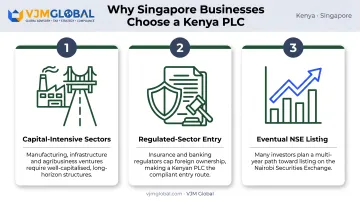
Singapore businesses typically consider a PLC in Kenya for one of three reasons:
- Capital-intensive sectors: Infrastructure, manufacturing and large-scale agribusiness ventures often need funding beyond what a Singapore parent wants to commit alone. A PLC opens the door to local investors and, eventually, public markets.
- Regulated-sector entry: Insurance rules reserve at least one-third of controlling interests for EAC citizens, capping foreign ownership at about two-thirds. Banking caps any single shareholder at 25%, though foreign firms already licensed as financial institutions at home are generally exempt.
- Eventual NSE listing: Businesses with a multi-year plan to list often incorporate as a PLC from day one, rather than converting later.
Outside these scenarios, Kenya is refreshingly open to foreign investors. General foreign ownership of up to 100% is permitted across most sectors, and telecommunications dropped its 30% local-shareholding requirement back in August 2023. Choosing a PLC is usually a capital-strategy decision, not a legal requirement.
Get the entity choice wrong, and the costs show up later. A business that undercapitalises through a private structure can struggle to raise funds publicly down the line; one that defaults into a PLC without a real capital-raising need ends up carrying audit and disclosure obligations it never actually needed.
How to Register a PLC in Kenya: Step-by-Step
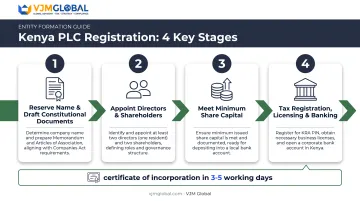
Registration runs through Kenya's Registrar of Companies via the eCitizen platform, under the Business Registration Service. Once your documents and capital arrangements are in order, the Companies Registry issues a certificate of incorporation in around 3 to 5 working days. Getting fully operational, though, takes longer.
Step 1: Reserve the Company Name and Draft Constitutional Documents
Submit up to three proposed names for approval, since your first choice may already be taken. Alongside name reservation, prepare a Memorandum and Articles of Association compliant with the Companies Act, 2015. You also file standard incorporation forms at this stage, including CR1, CR2 and CR8.
Step 2: Appoint Directors and Shareholders
A Kenyan PLC needs a minimum of 2 directors. There is no upper limit on shareholders and no 50-member cap that applies to private companies. A resident director isn't a legal requirement, but appointing one tends to smooth out early administrative steps, including registering with the Kenya Revenue Authority.
Step 3: Meet Minimum Share Capital Requirements
A public company intending to list its shares must hold at least KES 6.75 million (roughly S$68,000) in allotted share capital, under Section 518 of the Act.
Shares must be denominated in Kenyan Shillings, though foreign currency can count as cash consideration when shares are paid up. There's no prescribed unit price, so structure the share denomination to suit your capitalisation table and future fundraising plans.
Step 4: Complete Tax Registration, Licensing and Banking
Once incorporated, the company needs:
- A KRA PIN, applied for online through the iTax portal
- A trade licence from the relevant county government
- KenInvest investment registration, if the entity is foreign-owned
- A corporate bank account, opened with supporting incorporation and KYC documents
None of Kenya's regulators publish a combined official timeline for these steps. In practice, bank KYC checks and beneficial ownership documentation can add several weeks beyond the incorporation certificate.
VJM Global supports Singapore businesses through this full sequence, coordinating with Kenya's local regulators so the process doesn't stall at any single step.
Key Requirements, Compliance & PLC vs Private Limited: Which Fits Your Kenya Expansion
Once registered, a PLC carries more ongoing compliance than a private company.
| Requirement | PLC | Private Limited Company |
|---|---|---|
| Minimum directors | 2 | 1 |
| Shareholder cap | None | 50 |
| Statutory minimum capital | KES 6.75M (if listing) | None |
| Audit exemption available | No | Yes, if under KES 50M turnover / KES 20M net assets |
| Accounts filing deadline | 6 months | 9 months |
| Share transferability | Free | Restricted |
Tax obligations apply the same way regardless of structure:
- Corporate tax: 30% for Kenya-resident companies and for a foreign company's Kenyan branch or permanent establishment, plus 15% on profits repatriated from that branch.
- Withholding tax on dividends: Standard non-resident rate is 15%; Kenya–Singapore treaty rate is 8% for Singapore-resident companies.
The Kenya–Singapore DTA, signed in September 2024 and in force from 20 April 2026, sets that 8% dividend rate under Article 10—useful when repatriating profits to Singapore.
Work passes matter if you relocate Singaporean staff:
- Special Pass: Temporary business activity for up to six months
- Class D permit: Longer secondments, tied to a specific employer
Even short assignments usually need a permit before staff can legally work in Kenya.
For most Singapore SMEs, trading operations, or holding structures that don't need to raise capital publicly, a Private Limited Company is the more practical choice. Lower director overhead, no statutory capital requirement, and a lighter audit and disclosure burden mean faster setup and lower ongoing cost.
The mistake to avoid: choosing a PLC because it "looks" more established. Without an actual public capital-raising need, that decision locks you into audit and disclosure obligations most private ventures never need to carry.
Conclusion
A Kenyan PLC is a company limited by shares built to raise capital from public investors—and it carries the disclosure and audit obligations that come with that. That is a different tool from Kenya's Private Limited Company, which most foreign investors default to for good reason.
The right choice depends on your capital strategy, sector, and long-term growth plans in Kenya, not on which structure sounds more established. Before you commit, speak with a cross-border entity formation specialist who knows both Singapore's and Kenya's statutory requirements.
VJM Global works across both jurisdictions and can walk you through which structure actually fits your Kenya expansion.
Frequently Asked Questions
What is a Singapore Ltd company?
A Singapore Ltd (private company limited by shares) is a locally incorporated entity offering limited liability, where shares aren't sold to the public. Unlike a Kenyan PLC, it has no statutory capital minimum and limits shareholders to 50.
What is an example of a public limited company?
Classic examples are exchange-listed firms open to public share ownership, such as major banks or manufacturers. In Kenya, that includes names like Absa Bank Kenya PLC and Jubilee Holdings Ltd in banking, insurance, and large-scale manufacturing.
How many directors and shareholders are required for a PLC in Kenya?
A Kenyan PLC needs a minimum of 2 directors, with no upper cap on shareholders. A private company needs just 1 director and 1 shareholder, but its shareholder count is capped at 50.
What is the minimum share capital for a PLC in Kenya?
A public company intending to list its shares must hold at least KES 6.75 million (roughly S$68,000) in allotted share capital. Private companies face no statutory minimum capital requirement.
Is there a double tax treaty between Kenya and Singapore?
Yes. A new DTA, signed in September 2024, enters into force on 20 April 2026, reducing the withholding tax on dividends paid to Singapore-resident companies to 8%, down from Kenya's standard 15% non-resident rate.
Can a Kenyan PLC be 100% foreign-owned by a Singapore company?
Generally, yes. Full foreign ownership is permitted in most sectors. Restricted sectors like insurance and banking carry specific ownership conditions, and telecommunications dropped its local-shareholding requirement in 2023.