This guide covers the universal documents required across all structures, structure-specific variations, the additional documentation Singapore-registered entities must prepare, and the authentication process for Singapore-origin documents.
Key Takeaways
- Three document categories are required: personal identity, company legal records, and regulatory approvals
- Corporate shareholders from Singapore must submit ACRA-certified records, board resolutions, and company constitution
- Mainland, freezone, and offshore structures each carry different document requirements
- Singapore-origin documents need four-step attestation before UAE authorities will accept them
- Mismatched ownership details and incomplete attestation are the top causes of registration delays
Documents Every Singapore Business Needs for Dubai Company Registration
Regardless of which structure you choose, all applicants must submit a core set of personal and corporate documents:
Passport copies: Valid passports for all shareholders, directors, and managers with at least six months' remaining validity. UAE residents among the shareholders must also provide Emirates ID and visa copies.
Trade Name Reservation Certificate: Issued by the Department of Economic Development (DED) for mainland companies or the relevant Freezone Authority for freezone structures. This certificate confirms your business name is unique and compliant with UAE naming regulations. Singapore businesses should prepare two to three name options, as restrictions prohibit:
- Religious terms or God's names in Arabic or English
- Names resembling government organisations
- Names starting with "International," "Middle East," or "Global"
- UAE city names, Emirates, or airport codes
- Names that don't reflect the legal form (e.g., LLC, FZE)
Memorandum of Association (MOA) and Articles of Association (AOA): The MOA defines business activities, ownership structure, and shareholder responsibilities and must be notarised. Under Federal Decree-Law No. 32 of 2021, the MOA must be in Arabic (or accompanied by a certified Arabic translation) and include the company name, registered office, share capital distribution, and shareholder details.
For Singapore corporate shareholders, the MOA must reflect correct ownership percentages that align with the parent company's own constitutional documents.
Lease Agreement: A registered physical or virtual office address is mandatory:
- Mainland: Requires an Ejari-registered tenancy contract
- Freezone: Flexi-desk or virtual office agreement from the freezone authority
- Offshore: No physical lease required, but must maintain a registered agent address
No Objection Certificate (NOC): Required only when a shareholder or manager is currently sponsored or employed in the UAE. This rarely applies to Singapore-based shareholders who hold no UAE residency.
Beyond these core documents, some applications require one additional submission worth preparing in advance.
When a Business Plan Is Required
Most standard applications don't require a formal business plan. Authorities do request one for regulated activities — healthcare, education, and financial services — and for select freezone applications. When required, your plan should cover:
- Company objectives and value proposition
- Target market analysis and competitive positioning
- Operational overview and organisational structure
- Financial projections covering three to five years, including revenue forecasts and cost assumptions
Structure-Specific Document Requirements: Mainland, Freezone, and Offshore
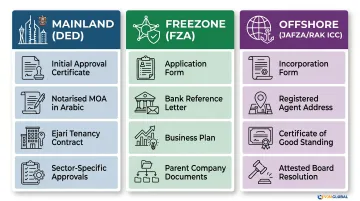
The document set differs significantly across the three structures available to Singapore businesses. Mainland companies are regulated by the DED, freezone companies by their respective Free Zone Authority, and offshore companies by dedicated authorities — primarily JAFZA or RAK ICC. Each structure has its own document checklist, and preparation gaps at any stage can delay registration.
Mainland Company Documents
Mainland registration requires:
- Initial Approval Certificate from DED confirming no objection to the company type
- Notarised MOA in Arabic or with certified translation
- Registered Ejari tenancy contract for business premises
- Sector-specific approvals from external regulatory bodies:
- Dubai Health Authority (DHA) for healthcare activities
- Knowledge and Human Development Authority (KHDA) for educational services
- Central Bank approval for financial services
- Notarised and attested Board Resolution for Singapore corporate shareholders
Freezone Company Documents
Freezone registration typically requires:
- Completed Freezone Application Form (each authority has its own format)
- Passport copies with minimum six months' validity
- Bank reference letter to confirm financial credibility (required by DAFZA; optional but often requested by others)
- Business plan for certain licence types
- Proof of residential address for shareholders
- Parent company documents if establishing a subsidiary (notarised and attested)
Requirements vary by freezone. For example, DMCC has different requirements than DIFC or DAFZA. Singapore businesses should confirm the exact checklist with their specific authority.
Offshore Company Documents
Offshore structures are typically used for holding assets, international trading, or IP ownership — not for conducting business directly in the UAE. Because Singapore corporate shareholders are involved, both JAFZA Offshore and RAK ICC require additional corporate documents beyond what individuals provide.
Offshore registration requires:
- Company Incorporation Application Form
- Shareholder and director details (passport copies, proof of residential address dated within three months)
- Proof of registered UAE agent/office address
- Letter of Appointment of Registered Agent
For Singapore corporate shareholders, JAFZA requires additional documents:
- Certificate of Registration/Formation (notarised and attested)
- Certificate of Good Standing (dated within six months)
- Parent company's MOA/AOA (notarised and attested)
- Board Resolution authorising the offshore setup (notarised and attested)
- Power of Attorney if applicable (notarised and attested)
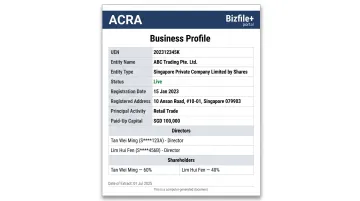
Additional Documents Required for Singapore Corporate Shareholders
When a Singapore-registered company (Pte. Ltd.) acts as shareholder rather than an individual, Dubai authorities require proof of the Singapore company's legal existence and structure.
ACRA Business Profile (Bizfile Extract)
This certified document must be dated within three to six months and confirms the company's registration status. According to ACRA's official portal, the Business Profile includes:
- Unique Entity Number (UEN) and registration date
- Entity type and status
- Principal activities (SSIC codes)
- Registered office address
- Share capital and issued shares
- Directors, Company Secretary, and Auditors
- Shareholder details
- Compliance history (last AGM and Annual Returns filed)
Singapore Company Constitution
Under the Companies (Amendment) Act 2014 (effective 3 January 2016), the Memorandum and Articles of Association were merged into a single Constitution document. A certified true copy must show the company's governance structure, authorised signatories, and powers.
Board Resolution
The Singapore parent company must pass a formal board resolution authorising the Dubai company formation, naming the authorised representative, and confirming the investment decision. Under Section 184A of the Singapore Companies Act, private companies may pass resolutions by written means.
The resolution must be notarised and undergo full attestation before submission to UAE authorities.
Financial Statements and Bank Reference
Beyond the core corporate documents, certain UAE free zone authorities and banks require audited financial statements or a bank reference letter to verify the corporate shareholder's financial standing. DAFZA is one authority that commonly requests this additional proof.
How to Authenticate Singapore Documents for Dubai Registration
UAE authorities don't accept foreign documents at face value. Singapore-origin corporate documents must undergo a four-step authentication process:
- Notarisation in Singapore by a Singapore Commissioner for Oaths or Notary Public
- Attestation by Singapore Academy of Law (SAL) which affixes an Apostille Certificate (serving as the MFA verification step)
- Attestation by UAE Embassy in Singapore confirming document authenticity for UAE use
- Final attestation by UAE Ministry of Foreign Affairs and International Cooperation (MOFAIC) upon arrival in the UAE
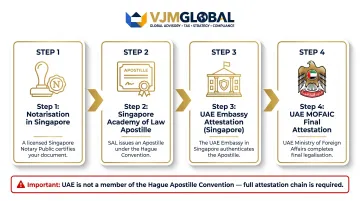
This full chain is necessary because the UAE is not a member of the Hague Apostille Convention, meaning a Singapore Apostille alone is insufficient. According to UAE MOFA, the final attestation costs AED 150 per document, with processing times of 1–3 working days for courier-based attestation or approximately two hours for digital attestation.
Translation is also part of the process. Any document containing Mandarin, Malay, or Tamil must be legally translated into Arabic by a UAE Ministry of Justice-certified translator before submission.
VJM Global's business setup professionals can help Singapore companies determine which documents require attestation for their specific structure and jurisdiction. This is particularly important for corporate shareholders with complex ownership chains, where authentication errors are a common cause of registration delays.
Common Mistakes Singapore Businesses Make During Dubai Registration
Three errors account for most document rejections Singapore businesses face during Dubai registration:
- Incomplete attestation on ACRA documents. Notarisation alone is not enough. UAE authorities require the full four-step authentication chain — missing any step is one of the most common reasons submissions are rejected outright.
- Ownership details that don't match across documents. If the shareholding percentages in your UAE Memorandum of Association differ from your ACRA Bizfile or Singapore shareholder register, the application stalls. Cross-check every document before submission.
- Board resolutions that are vague or expired. Resolutions must name the specific jurisdiction, business structure, and authorised signatory — and must fall within the UAE's accepted validity window. Generic templates drafted for other purposes rarely meet this standard; have these prepared with local counsel.
Frequently Asked Questions
What documents are required to register for corporate tax in UAE?
Corporate tax registration requires the trade licence, certificate of incorporation, MOA, Emirates ID or passport of the authorised signatory, and proof of business address. Registration is done through the Federal Tax Authority (FTA) portal and must be completed within three months of incorporation for entities established after 1 March 2024; late registration carries a penalty of AED 10,000.
Can a Singapore company own 100% of a Dubai company?
Yes, 100% foreign ownership is permitted in all UAE freezones and, following the 2021 Companies Law amendment, in most mainland activities as well. Singapore shareholders can hold full ownership without a local sponsor, except in restricted sectors such as security, telecommunications, and banking.
Do Singapore documents need to be attested before submission to UAE authorities?
Yes, Singapore-origin documents must go through the four-step attestation process: notarisation in Singapore, Singapore Academy of Law attestation, UAE Embassy in Singapore attestation, and UAE MOFAIC attestation. This full chain typically takes 3-5 working days excluding courier transit times.
What is the difference in documents required for mainland vs freezone registration in Dubai?
Mainland registration (via DED) requires an Ejari-registered tenancy contract and sector-specific regulatory approvals from bodies like DHA or KHDA. Freezone registration requires a freezone-specific application form and may also require a bank reference letter.
Is a physical presence in Dubai required to register a company as a Singapore business?
No — many freezones, including DMCC, support fully digital registration from application to licence issuance. A Power of Attorney can authorise a UAE-based representative to act on behalf of shareholders who cannot travel.
How long does company registration in Dubai typically take for a Singapore business?
Freezone registration typically takes 7-10 days for authorities like DMCC, while mainland registration may take 2-4 weeks depending on business activity and whether external regulatory approvals are required. Document authentication delays—particularly incomplete attestation—are the most common cause of delays, often adding 2–4 weeks to the overall timeline.