Introduction
Scaling internationally starts with a paperwork decision most founders don't think hard enough about: which entity structure actually fits their business.
Get it wrong, and the fallout shows up later as unexpected tax bills, personal liability exposure, spooked investors, or a bank that won't open an account.
Delaware alone is home to more than 2 million business entities, including 67.6% of Fortune 500 companies. Jurisdiction choice carries real weight in the corporate world.
This guide compares a US Inc, a UK Ltd, and a Cayman LLC side by side, then gives you a practical framework for picking the right one based on where your revenue and investors actually sit.
Key Takeaways
- US Inc, UK Ltd, and Cayman LLC come from three different legal traditions each built for a distinct purpose
- Taxation, liability defaults, and investor perception separate these structures more than anything else
- The right choice depends on revenue location, investor base, and how much compliance your team can handle
- Structures can be converted later, but restructuring always costs time and money
- Upfront multi-jurisdiction guidance prevents expensive corrections later
Understanding the Three Structures
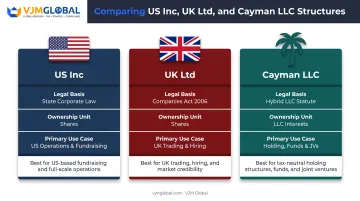
These three entities don't sit on the same legal foundation. A US Inc follows state corporate law, a UK Ltd operates under the UK Companies Act 2006, and a Cayman LLC runs on a hybrid statute borrowed partly from US LLC law. Treating them as interchangeable is where most structuring mistakes begin.
US Inc (Domestic US Corporation)
A US Inc is a corporation formed under state law—most often Delaware—with a legal identity separate from its owners. By default it pays corporate-level tax; an S-Corp election (if available) can pass income through to owners' returns. A state-law LLC is the usual domestic alternative when founders want pass-through taxation without a corporate election.
This is the default structure for anything happening inside the US:
- Signing US contracts and leases
- Opening US business bank accounts
- Accessing payment processors like Stripe or Square
- Hiring US-based employees
UK Ltd (Private Limited Company)
A UK Ltd is a private company limited by shares, registered under the Companies Act 2006. It has its own legal personality. A UK-resident Ltd pays UK corporation tax on its worldwide profits, with relief available for tax paid overseas.
You need one if you're planning to:
- Hire UK employees directly
- Sign contracts governed by UK law
- Open a UK business bank account
- Build local credibility with UK customers and suppliers
Cayman LLC
A Cayman LLC is a hybrid vehicle. It combines the limited liability of a company with the flexible profit-sharing of a partnership. There's no share capital; members hold "LLC interests" rather than shares. That setup lets founders and investors set custom economic terms without a rigid share structure.
Common uses include:
- Investment funds pooling capital from multiple countries
- Holding companies sitting above operating subsidiaries
- Joint ventures where partners want tax-neutral treatment
- Special purpose vehicles (SPVs) built for a single transaction
Cayman LLCs aren't designed for day-to-day trading. They're built for holding, investing, and structuring — not running a storefront or signing customer contracts.
Key Differences at a Glance: How the Three Structures Compare
Legal differences translate into real financial and operational outcomes. Here's where US entities, UK Ltds, and Cayman LLCs diverge in practice.
Taxation and Treaty Access
| Structure | Tax Treatment |
|---|---|
| US Inc (C-Corp) | Flat 21% federal rate plus applicable state tax |
| US LLC | Pass-through by default; can elect corporate treatment via Form 8832 |
| UK Ltd | 25% main rate above £250,000 profit; 19% below £50,000, with marginal relief between |
| Cayman LLC | No income, corporate, or capital gains tax at the entity level |
That last point matters, but it's easy to misread. Cayman's zero-tax status applies only in Cayman. It doesn't exempt a US owner from US tax on that entity's income — a trap for first-time structurers.
Liability Protection and Fiduciary Defaults
Each of these structures shields owners from personal liability for business debts. Where they differ is in what directors or managers legally owe to the business.
- US (Delaware) directors owe fiduciary duties of loyalty and care, protected by the business-judgment rule when they act in good faith
- UK directors carry seven statutory duties under Sections 171-177 of the Companies Act, including the broad duty to promote the company's success
- Cayman LLC managers owe only a statutory duty of good faith by default — nothing more, unless the LLC agreement specifically expands it
Cayman's lighter default helps fund managers and JV partners negotiate governance in the LLC agreement instead of inheriting full statutory fiduciary standards.
Cost of Formation and Ongoing Compliance
Formation fees are modest next to ongoing compliance, but they still differ by jurisdiction:
- Delaware Inc: $109 filing fee, plus $50 annual report and franchise tax starting at $175
- Delaware LLC: $110 filing fee, plus a flat $400 annual tax (no annual report required)
- UK Ltd: £100 standard digital incorporation, plus a £50 annual confirmation statement fee
- Cayman LLC: roughly $1,097 to register, plus an annual fee near $1,341
None of these numbers are prohibitive on their own. The real cost driver is ongoing compliance: registered agents, local filings, and professional support add up faster than the incorporation fee itself.
Banking, Investor Perception, and Fundability
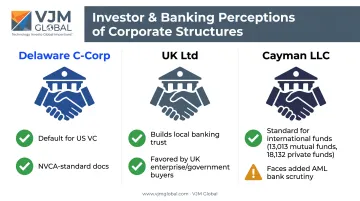
Investor expectations differ sharply by structure and audience:
- Delaware C-Corp is the default for US venture capital. NVCA's model legal documents are built around it, and most accelerators won't fund anything else
- UK Ltd builds banking relationships and customer trust inside the UK market, particularly for anyone selling to UK enterprise or government clients
- Cayman LLC is standard for international fund structures. Cayman-based vehicles reported 13,013 mutual funds and 18,132 private funds in recent CIMA data, but offshore entities can draw extra scrutiny from banks running anti-money-laundering checks
Regulatory Reporting and Substance Requirements
Cross-border structures come with reporting obligations that don't disappear just because the entity is offshore.
- FATCA/CRS: Cayman financial institutions and UK financial institutions both file automatic exchange-of-information reports annually
- Economic substance: Cayman entities conducting relevant activities must file an ES Return within 12 months of their financial year-end
- Beneficial ownership: Cayman's Beneficial Ownership Transparency Act requires in-scope companies and LLCs to disclose beneficial owners to their corporate services provider
- US disclosure: US owners of foreign entities, including Cayman LLCs, generally must file Form 5471 once ownership crosses the 10% threshold
Skipping these filings isn't a minor paperwork gap. Penalties for missed Form 5471 filings start in the thousands of dollars per year, per entity.
Which Structure Fits Your Business Scenario
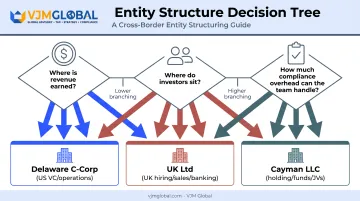
Structure choice should follow three questions:
- Where is revenue earned?
- Where do investors sit?
- How much compliance overhead can the founding team realistically manage?
US Startup Raising Venture Capital
Go with a Delaware C-Corp. It's the structure US VCs and accelerators expect, built around standardized documents like NVCA's model Certificate of Incorporation. Trying to raise a US Series A through a foreign entity creates friction that isn't worth the fight.
Expanding Sales or Operations into the UK
Set up a UK Ltd subsidiary once you need to:
- Hire locally
- Sign UK contracts
- Register for VAT
- Open a UK bank account
If you're only shipping product to UK customers without a local presence, you likely don't need one yet — more on that in the FAQ below.
International Holding Company, Fund, or Joint Venture Vehicle
A Cayman LLC works well for tax-neutral holding structures, fund vehicles, and JV arrangements with multiple international partners.
US owners still need to navigate controlled foreign corporation (CFC) rules and file the required US disclosures. Before relying on any Cayman entity in a deal, verify its registration status directly with the Cayman Islands General Registry rather than taking a counterparty's word for it.
How VJM Global Can Help
Structuring across borders creates ongoing accounting, tax, and payroll obligations in every jurisdiction you touch. VJM Global supports US businesses through that full lifecycle, not just the initial filing.
What that looks like in practice:
- CPAs, Chartered Accountants, and multi-jurisdiction compliance professionals with hands-on US and UK entity experience
- Direct work with 500+ American businesses and 250+ UK businesses, with formation handled through each market's own regulators
- EAI International membership, linking clients to vetted professionals beyond VJM Global's direct footprint
- US LLC and Corp formation (EIN, registered agent, Articles, BOI) and UK Ltd registration (Companies House, HMRC Corporation Tax, confirmation statements)
If you want to test a market like the UK before committing to a full subsidiary, VJM Global's Employer of Record service lets you hire local employees without incorporating first. That gives you a real presence before you lock in a structure.
Conclusion
The right structure is the one that matches where your revenue lands, where your investors are based, and how much compliance your team can realistically handle.
Structures aren't permanent. An exempted company can convert to an LLC, a UK branch can become a subsidiary, and a foreign holding structure can be reorganized as the business grows. But every conversion carries real switching costs, so getting closer to the right answer early saves money later.
Revisit the decision as you scale into new markets or raise new capital. What worked at seed stage rarely fits at Series B, so re-check tax residency, investor expectations, and ongoing filing load before you incorporate or convert.
Frequently Asked Questions
What is an LLC in the Cayman Islands?
A Cayman LLC is a hybrid entity combining company-style limited liability with partnership-style flexible profit allocation. It's commonly used for investment funds, holding companies, and joint ventures that need custom economic terms.
How do you check if a company is registered in the Cayman Islands?
You submit a search request to the Cayman Islands General Registry, which provides a report confirming registration status. A fee applies; the registry does not publish the current amount on its site.
Can a US LLC and a Cayman LLC be treated the same for US tax purposes?
Both can elect pass-through treatment under US check-the-box rules using Form 8832. However, a Cayman LLC still triggers foreign entity reporting obligations that a domestic US LLC doesn't face.
Do I need a UK Ltd if I just want to sell to UK customers online?
Usually not. Pure cross-border sales rarely require a UK entity, but local hiring, warehousing, or opening a UK bank account typically does.
Is a Cayman LLC legal for US citizens to own?
Yes, it's legal. US owners must file the right disclosure forms (typically Form 5471 if classified as a corporation, or Form 8865 if treated as a partnership) and may face CFC rules when the entity is a corporation.
Which structure is easiest and cheapest to set up?
A US Inc is generally the fastest and cheapest to form, especially in Delaware. UK Ltd and Cayman LLC formations involve additional registered office and filing requirements that add cost and time.