What that filing actually requires depends heavily on your structure. A sole proprietorship has almost no state paperwork. An LLC or corporation does. And if you're a foreign national or non-resident founder, you'll hit extra hurdles around tax IDs that a Michigan-based entrepreneur never sees.
This guide walks through the exact steps, the documents you'll need on hand, the mistakes that trip up first-time filers, and when it makes sense to bring in outside help.
Key Takeaways
- Michigan registration involves three agencies: LARA for formation, Treasury for taxes, and UIA for employer registration
- Sole proprietors and general partnerships skip state filings unless using a DBA
- LLCs pay $50 to file; corporations pay a $60 minimum based on authorized shares
- Online filings through LARA, Michigan Treasury Online, and MiUI move faster than paper submissions
- Foreign founders without an SSN can still obtain an EIN, though processing takes longer
How to Register Your Business in Michigan
The specifics shift depending on whether you're forming an LLC, a corporation, or something simpler. LLCs and corporations both move through the same four-stage sequence: pick your structure and name, file with LARA, register for taxes and unemployment insurance, then lock down your EIN and any licenses.
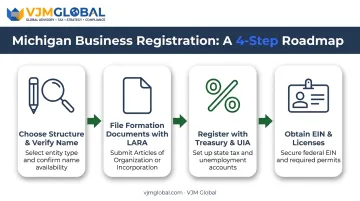
Step 1: Choose Your Business Structure and Name
Your entity type drives your liability exposure, your tax treatment, and how much paperwork you'll file every year. Sole proprietorships are simplest but offer zero personal asset protection. LLCs and corporations shield your personal assets but come with formation fees and ongoing filings.
Once you've picked a structure, check name availability using LARA's Business Entity Search. Michigan enforces naming rules that vary by entity type:
- LLCs must include "Limited Liability Company," "LLC," or "LC"
- Corporations must include "Corporation," "Company," "Incorporated," "Limited," or an abbreviation like "Corp." or "Inc."
- Your name must be distinguishable from every other registered entity in LARA's records
Not ready to file yet? You can reserve a name for 180 days through Form 540, the Application for Reservation of Name. It costs $25 for an LLC reservation and $10 for a corporation reservation (covering six months from the filing month).
Step 2: File Formation Documents with LARA
This is the step that actually creates your legal entity. LLCs file Articles of Organization (Form 700); corporations file Articles of Incorporation (Form 500 for profit corporations). Both can be submitted online through LARA's MiBusiness Registry, by mail, or in person.
Here's what the current fees look like:
| Entity Type | Filing Fee | Notes |
|---|---|---|
| Domestic LLC | $50 | Flat fee, Form 700 |
| Domestic Profit Corporation | $60 minimum | $10 base fee + share-based organization fee, Form 500 |
| LLC name reservation | $25 | 180 days |
| Corporation name reservation | $10 | Six months |
Your corporation's organization fee scales with authorized shares. It's $50 for up to 60,000 shares, climbing to $500 for 5 million to 10 million shares. Check LARA's current filing fee schedule before you submit, since these figures get revised periodically.
You'll also need a Michigan registered agent with a physical in-state street address (a P.O. box alone won't cut it as the registered office). This person or entity receives lawsuits, state notices, and other legal correspondence on your company's behalf.
Standard review can take up to 10 business days. If you need it faster, LARA offers expedited tiers ranging from a 24-hour turnaround for $50 up to a 1-hour turnaround for $1,000.
Step 3: Register with Michigan Treasury and the Unemployment Insurance Agency
Once your entity exists, you need to register it for taxes. Head to Michigan Treasury Online (MTO) and select "Start a New Business (E-Registration)." This covers state tax accounts, including a sales tax license if you're selling taxable goods (no license fee applies).
Processing moves quickly:
- MTO submissions are recognized within 15 minutes
- Full processing can take up to 48 hours
- Sales tax licenses can arrive in as little as 7 business days online, or 4-6 weeks if you mail Form 518
If you plan to hire employees, you also need an Unemployment Insurance Agency (UIA) account through the Department of Labor and Economic Opportunity. Registration currently begins in the MiUI system, which generates your Employer Account Number (EAN) upon successful registration.
Allow about 4 days for that account information to sync over to MiWAM, the portal you'll use for ongoing wage reporting.
Step 4: Obtain an EIN and Required Licenses/Permits
Your Federal Employer Identification Number (EIN) is free and comes directly from the IRS. You'll need it to open a business bank account, file federal taxes, and hire employees. US-based applicants with a valid SSN typically get their EIN immediately through the IRS online application.
Foreign founders face a different path. If your responsible party doesn't have an SSN or ITIN, you'll:
- Enter "Foreign" or "N/A" on Form SS-4, line 7b
- Submit by fax (roughly 4 business days turnaround) or mail (about 4 weeks)
- Call the IRS's international line if your principal business is located outside the US
International entrepreneurs applying for a US EIN often turn to cross-border business advisory firms, such as VJM Global, for guidance on completing this paperwork correctly and avoiding delays from incomplete submissions.
Beyond the EIN, check Michigan's State License Search tool and your local city or county offices for industry-specific permits. Also worth flagging: 24 Michigan cities, including Detroit, Grand Rapids, and Lansing, levy local income taxes, so your obligations may vary depending on where your employees actually live and work.
When Should You Register Your Business in Michigan?
Not every business owner needs to file with the state. If you're running a sole proprietorship or general partnership under your own legal name, you're exempt from LARA registration entirely.
Registration becomes necessary the moment you:
- Form an LLC or corporation to gain liability protection
- Adopt a DBA (assumed name) different from your legal name
- Plan to hire employees
- Want to separate personal and business assets for legal or tax reasons
Outside these triggers, early-stage testing (freelancing on the side, testing a product idea) doesn't demand urgency. But once you're signing contracts, opening a storefront, or bringing on staff, unregistered operation exposes you to unnecessary personal risk.
If you're using your own name and haven't hired anyone, you can wait. Everything else, register first.
What You Need Before Registering Your Business
Gathering the right information before you start filing prevents rejected applications and speeds up approval across every agency involved.
Business and Ownership Information
Before filing anything, finalize:
- Your confirmed business name (verified against LARA's database)
- Your chosen entity structure
- A principal business address
- Your registered agent's name and Michigan street address
Identification Numbers
Your EIN unlocks federal tax filing and business banking. US founders typically get one in minutes. Foreign founders without a US SSN can still apply, though processing runs longer through the fax or mail route described earlier. If you're filing from outside the US, a tax advisor familiar with cross-border documentation can walk you through what the IRS expects before you submit.
Internal Compliance Documents
LLCs and corporations aren't treated equally here:
- LLC Operating Agreements are recommended by LARA but not legally mandated
- Corporate Bylaws are legally required under MCL § 450.1231, adopted by incorporators, shareholders, or the board
Skipping bylaws isn't optional if you're incorporating; skipping an operating agreement is a choice, though not always a wise one once you have multiple members.
Common Mistakes to Avoid When Registering in Michigan
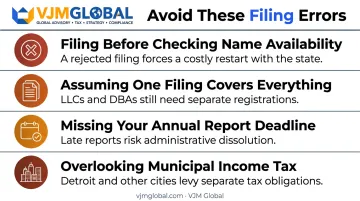
Most rejected filings and compliance headaches trace back to a handful of avoidable errors:
- Filing before checking name availability — LARA rejects Articles of Organization or Incorporation that conflict with an existing registered name
- Assuming one filing covers everything — LARA formation, Treasury tax registration, and UIA employer registration are three separate processes, not one bundled step
- Missing your Annual Report deadline — an LLC loses good standing after two consecutive missed years, while a corporation faces automatic dissolution 60 days later if uncured
- Overlooking municipal income tax — 24 Michigan cities tax income tied to where your business or employees are located
Alternatives to DIY Registration
Self-filing works fine for a straightforward, single-owner LLC with no employees and no complicated ownership structure. Other situations call for outside help.
Hiring a Registered Agent or Formation Service
When it's better: You want to keep a personal address off public records, or you simply can't guarantee you'll be available to receive legal correspondence during business hours.
Key trade-offs: You'll pay an ongoing service fee, but you reduce the risk of missing a lawsuit notice or a state deadline that could cost you good standing.
Outsourcing Ongoing Tax and Accounting Compliance
When it's better: Foreign-owned businesses, NRIs, and founders juggling operations across borders often need support that extends well past initial registration.
For NRIs and founders managing ties to India alongside their US business, firms like VJM Global, which specializes in cross-border accounting, tax compliance, and business setup, can coordinate bookkeeping, tax filings, and payroll across both countries, so you're not learning two tax systems from scratch.
Key trade-offs: Outsourcing costs more than doing your own bookkeeping, but it saves time and cuts the error risk that comes with unfamiliar tax rules, especially for founders managing entities in multiple countries.
Frequently Asked Questions
Do I have to register my business with the state of Michigan?
Sole proprietors and general partnerships operating under their own legal names are exempt from state formation filings. LLCs, corporations, and any business using a DBA must register with LARA.
How much does it cost to register a business in Michigan?
An LLC's Articles of Organization cost $50. A profit corporation's Articles cost a $60 minimum, scaling up with authorized shares. Name reservations run $10-$25, and counties handle DBA filings separately.
What is one requirement for registering a business in the US?
Most states, including Michigan, require a unique, distinguishable business name. LLCs and corporations must also designate a registered agent with a physical in-state address.
How long does it take to register a business in Michigan?
LARA formation review takes up to 10 business days, though expedited filing is available. Treasury's MTO registration completes within 48 hours, and MiUI issues your UIA account number immediately.
Do I need a registered agent in Michigan?
Yes, this is required for both LLCs and corporations. Your agent receives legal correspondence and state notices on your company's behalf and must maintain a physical Michigan address.
Can I register my business online in Michigan?
Yes. LARA's MiBusiness Registry handles entity formation, Michigan Treasury Online manages tax registration, and MiUI covers unemployment insurance employer registration, all fully online.