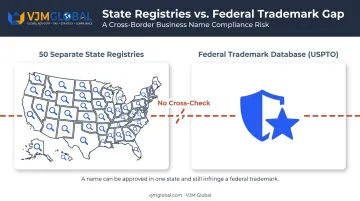
This confusion is common, and it stems from how the United States handles business names. There's no single national registry. Instead, each state runs its own system, the federal government runs a separate trademark system, and the two rarely talk to each other.
The short answer: it depends on whether you're colliding with a state business registration, a DBA, or a federally registered trademark. Each carries different rules and different risks.
This guide breaks down what US law actually says, how to check name availability the right way, and what to do if your first-choice name is already spoken for.
Key Takeaways
- State registration doesn't guarantee nationwide protection—only a federal trademark does
- Two businesses can share a name across states until trademarks or interstate commerce intervene
- Check three sources before finalizing a name: state registry, USPTO database, and domain/social handles
- If a name is taken, modify it, negotiate with the holder, or trademark something new
Can You Register a Business Name That Already Exists in the US?
Business name registration happens at the state level, filed with the Secretary of State or an equivalent agency. Formation documents and periodic reports go through the Secretary of State in 40 states, and through a different agency in the remaining 10 states. Each state keeps its own separate database, and these systems generally don't cross-check one another.
That means a name can be actively registered in Ohio and simultaneously registered by an entirely unrelated company in Arizona. Neither state knows about the other's filing.
Why Your Filing Might Get Rejected Anyway
Most states won't let you register a name that's identical or "deceptively similar" to an existing active entity in that same state. California, for example, requires names to be "distinguishable in the records" from other entities of the same type, and this rule has been in effect since January 2021.
Common reasons for rejection include:
- Identical wording, even with different punctuation or spacing
- Reordered words that create the same commercial impression
- Adding only "LLC" or "Inc." without any other distinguishing term
Here's the part that trips people up: your state might approve your filing, and you could still get sued for trademark infringement. State clerks typically check only their own entity database. California explicitly confirms its name-availability review doesn't check trademark, service-mark, or fictitious-name records at all.
Name overlaps aren't rare edge cases, either. The Census Bureau reported 531,423 seasonally adjusted business applications in a single month (June 2026 alone). With that volume of new businesses forming every month across 50 separate state systems, some naming overlap is close to inevitable.
Business Name vs. Trademark vs. DBA vs. Legal Name: What's the Difference?
These four terms get used interchangeably, but they mean very different things legally. Mixing them up is how businesses end up with false confidence about their name's protection.
- Legal name: The name on your formation documents (LLC or corporation) filed with your state. It only needs to be unique within that state.
- DBA (Doing Business As): A fictitious name you operate under that isn't your legal entity name. Registering one creates no exclusive rights to that name.
- Trademark: A federally registered mark through the USPTO that protects your brand nationwide, within your specific goods or services category.
- EIN: A federal tax ID number. It has nothing to do with name protection.
As the U.S. Small Business Administration explains in its guide to naming a business, an entity name protects you at the state level, while a trademark protects you federally. A DBA, by itself, offers no legal protection whatsoever.
How the Systems Actually Compare
| Feature | State Business Name | Federal Trademark |
|---|---|---|
| Scope | One state | United States and territories |
| Governed by | Secretary of State | USPTO |
| Base filing fee | Varies, often $50-$300 | $350 per class |
| Renewal | Annual/biennial report | Every 10 years (with use filings) |
| Legal remedy | State-level dispute only | Injunctions, damages, attorney fees |
The Delta Faucets Problem
USPTO itself uses Delta faucets and Delta air travel as the textbook example of two companies legitimately owning identical marks. It works because plumbing fixtures and airline tickets aren't related goods or services, so no customer would confuse one for the other.
That logic breaks down for famous marks. Under the Trademark Dilution Revision Act, owners of marks "widely recognized by the general US consuming public" can block later use that dilutes their brand, even without any direct competition or confusion. You couldn't launch "Coca-Cola Consulting," regardless of industry.
How to Check If a Business Name Is Already Taken in the US
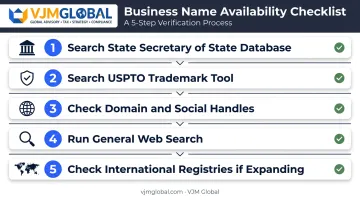
Skipping this step is how businesses end up rebranding six months after launch. Run through these five checks before you file anything.
- Search your state's Secretary of State database. Confirm no active entity in your state already holds the name or something confusingly close to it.
- Search USPTO's Trademark Search tool at tmsearch.uspto.gov (the tool that replaced TESS in late 2023). Look for exact matches and marks that sound alike, look alike, or create a similar overall impression.
- Check domain availability and social media handles. An established online presence can create real business friction even without formal legal registration.
- Run a general web search. Unregistered or "common law" businesses using a similar name in their local market can still have enforceable rights there.
- Check separately in each country if you're expanding internationally. A clear US name says nothing about clearance elsewhere:
- India: Clear the name against the Ministry of Corporate Affairs registry and existing trademarks, then file a RUN (Reserve Unique Name) application with the Registrar of Companies. VJM Global's business setup team helps US companies navigate this step, since a name that's clean at home can still get flagged during Indian incorporation.
- UK or Australia: Run the same check against each country's national company registrar and trademark office before filing.
For anything beyond a quick DIY check, consider a professional trademark search. These catch phonetic and visual similarities that a basic keyword search misses entirely, which matters since likelihood-of-confusion analysis considers sound and meaning, not just spelling.
What Happens If You Register or Use an Already-Existing Business Name
Two very different risks show up here, depending on which system you collide with.
State-level collision: Your filing gets rejected outright. Most Secretary of State offices catch identical or confusingly similar names during processing, and you'll need to resubmit with a different name.
Federal trademark collision: This one's more serious. Even with an approved state filing in hand, you could still face:
- A cease-and-desist letter from the trademark holder's attorney
- Forced rebranding, including new signage, packaging, and marketing materials
- Legal costs, and in some cases, the trademark owner's lost profits and attorney fees
Enforcement typically starts with a cease-and-desist letter before escalating to litigation, and forced rebranding costs can threaten a small business's survival.
Beyond the legal exposure, you'll also face an operational mess:
- Customer confusion between your business and the established one
- Lost web traffic to whoever ranks higher in search results
- Social handles or domains already taken, forcing awkward workarounds like random numbers in your handle
What to Do If Your Desired Business Name Is Taken
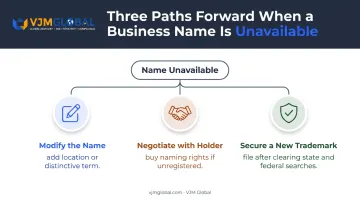
Finding out your ideal name is unavailable isn't the end of the road. You've got three realistic paths forward.
- Modify the name. Add a location, a descriptive term, or a distinctive spelling. Just know that close variations can still trigger disputes if you're operating in overlapping industries. "Modified" doesn't automatically mean "safe."
- Negotiate with the current holder. If they haven't secured a trademark, they may be open to selling naming rights, particularly if their business is small or inactive.
- Secure your own federal trademark once cleared. After confirming availability through both state and federal searches, file for trademark protection so a competitor can't claim the name out from under you later.
If you're planning to carry the same brand into new markets, naming rules don't travel with you automatically.
VJM Global helps US businesses expanding into India confirm that their name clears the corporate registry and existing trademark records before filing, so your brand stays protected across jurisdictions.
Frequently Asked Questions
Can you register a company name that already exists?
It depends on jurisdiction and industry. State-level registration may work if there's no conflict within that specific state, but an identical in-state registration or an existing federal trademark will block you.
How do I register a business name if I already have an EIN?
An EIN is just a federal tax ID and doesn't register your business name. You still need to file a formal entity name or DBA with your state, since an EIN doesn't reserve or protect that name.
Is a business name the same as a trademark in the US?
No. A business name is an administrative registration with your state. A trademark is a separate, broader federal protection covering your brand identity nationwide.
Can two businesses in different states have the same name?
Usually yes, since state registries operate independently of each other. This changes if one business holds a federal trademark, which extends protection nationwide regardless of state lines.
What's the difference between a DBA and a registered business name?
A DBA lets you operate under a name different from your legal entity name. It offers no exclusivity and no trademark-level protection against other users.
How much does it typically cost to register a trademark in the US?
The current USPTO base filing fee is $350 per class for electronic applications, with surcharges possible for incomplete information. Costs climb quickly if oppositions or legal disputes arise.