Introduction
UK entrepreneurs face a significant opportunity across the Atlantic. With the United States recording a GDP of approximately $29.3 trillion in 2024 and ranking as the UK's largest trading partner, the business case for expansion is compelling. Yet many UK founders hesitate, uncertain about the mechanics of registering a US company remotely.
UK citizens can register a company in the USA remotely — no relocation, no visa, no in-person visit required. The process is legally straightforward and typically completes in 2–8 weeks.
The challenge is that UK entrepreneurs often stumble on entity selection, state choice, EIN applications, and ongoing compliance. These missteps create costly delays, trigger penalties, and sometimes force expensive restructuring later.
This guide walks through each step: choosing between an LLC and C-Corp, picking the right state, and opening a US business bank account from your UK home office.
Key Takeaways
- UK citizens can legally register a US company (LLC or C-Corp) without travelling or holding a US visa
- LLCs offer pass-through taxation and simpler compliance; C-Corps suit venture capital funding despite double taxation
- Delaware and Wyoming are the top state choices due to investor appeal, low taxes, and privacy protections
- Key steps include choosing a structure and state, filing formation documents, obtaining an EIN, and opening a US bank account
- Ongoing compliance (annual reports, franchise taxes, federal/state filings) is critical and routinely underestimated
Why UK Entrepreneurs Are Expanding to the USA
The United States represents the world's largest single consumer market, with a GDP of $29.3 trillion in 2024. For UK businesses, this scale creates unmatched growth potential—the US accounted for £202.8 billion in UK exports in the four quarters ending Q3 2025, making it the UK's largest single export destination.
Beyond market size, the US offers UK businesses:
- Sector-specific hubs – Silicon Valley for tech startups, New York for fintech and finance, Austin for creative industries
- Deep talent pools – access to specialized skills across technology, marketing, and operations
- Robust investor ecosystems – venture capital networks concentrated in major metros, with investor familiarity around US entities (particularly Delaware C-Corps)
- Pro-business regulatory environment – no residency requirement to form a company, making it one of the most accessible major economies for foreign founders
UK foreign direct investment into the US stood at £529.9 billion at end-2024, representing 28.5% of all UK outward FDI. That level of commitment reflects a mature, well-supported expansion corridor—one backed by established legal frameworks, cross-border advisory networks, and decades of precedent. The practical question, then, is how to register your company and get started.
Choosing the Right Business Structure: LLC vs. C-Corp for UK Nationals
As a UK non-resident, only two entity types are available: Limited Liability Company (LLC) and C-Corporation (C-Corp). S-Corps are restricted to US citizens and permanent residents, barring non-resident aliens under IRS regulations.
LLC (Limited Liability Company)
An LLC offers pass-through taxation, meaning profits flow directly to the owner's personal tax return without corporate-level tax. This avoids the double taxation inherent in C-Corps. Key advantages include:
- Limited personal liability protection
- Simpler compliance requirements (no board meetings, fewer filing obligations)
- Flexible ownership—members can be non-residents with no limit on number
- Member anonymity in Delaware, Wyoming, and New Mexico (members' names don't appear on public formation documents)
LLCs suit small UK-owned businesses, freelancers, consultants, and service providers entering the US market without immediate plans for venture capital funding.
One filing obligation catches many UK owners off guard: a single-member LLC is treated as a disregarded entity by the IRS, requiring annual submission of Form 5472 with a pro-forma Form 1120 — even with zero taxable income.
C-Corp (C-Corporation)
A C-Corp faces corporate-level taxation on profits, and shareholders are taxed again on dividends—creating double taxation. Despite this, C-Corps remain the preferred structure for startups seeking venture capital because they allow:
- Unlimited shareholders, including non-residents
- Multiple classes of stock (common and preferred shares), enabling complex cap table structures
- Straightforward equity fundraising that institutional investors expect
Delaware C-Corps are the de facto standard for venture-backed startups. The state's Court of Chancery — a specialized business court with decades of established case law — gives investors and founders predictable legal ground.
LLC vs. C-Corp Comparison
| Factor | LLC | C-Corp |
|---|---|---|
| Taxation | Pass-through (no corporate tax) | Double taxation (corporate + dividends) |
| Complexity | Simpler compliance, minimal formalities | Board meetings, minutes, stricter record-keeping |
| Best Use Case | Bootstrapped businesses, service providers, freelancers | Venture-funded startups, businesses planning to raise equity |
| Investor Appeal | Limited (many VCs prefer C-Corps) | High (standard structure for institutional investment) |
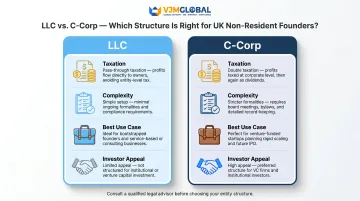
For most service businesses, e-commerce operations, and consultancies without near-term funding plans, an LLC is the simpler and more tax-efficient choice. If you're building a tech startup or expect to raise institutional capital, a C-Corp — specifically a Delaware C-Corp — is worth the additional compliance overhead from day one.
Getting this decision right before filing avoids expensive restructuring down the line. A cross-border tax advisor familiar with both UK and US obligations can confirm which structure fits your specific business model.
How to Register a Company in the USA from the UK: Step-by-Step
The full registration process typically takes 2–8 weeks depending on the state chosen and whether you use professional assistance. Here's how it works.
Step 1: Choose Your State of Incorporation
UK entrepreneurs can register in any US state—you're not required to register where you operate. The two most popular choices for non-residents are:
Delaware
- Strong corporate legal protections and business-friendly Court of Chancery
- No state income tax for out-of-state companies earning income outside Delaware
- Fast processing (24-hour expedited service available for $50)
- Preferred by venture-backed startups due to investor familiarity
Wyoming
- Low fees and no franchise tax (annual report costs just $60 vs. Delaware's $300 franchise tax)
- Strong privacy protections (member names not disclosed on public filings)
- No corporate or personal state income tax
- Ideal for bootstrapped LLCs
When to choose a different state: If you'll have physical presence (employees, office, inventory) in a specific state, consider registering there to avoid dual state compliance obligations.
Step 2: Choose and Verify Your Business Name
Your business name must be unique within the chosen state and comply with US naming rules—it must include "LLC" or "Inc." as applicable.
Three verification checks required:
State business name registry
- Delaware entity search
- Wyoming business search
USPTO trademark database – Search the Trademark Center to ensure your name doesn't infringe existing trademarks
Domain and social media availability – Check that matching domain names and social handles are available for brand consistency
Optional: Reserve your chosen name with the state (Delaware charges $75 for 120-day name reservation; Wyoming offers similar services).
Step 3: Appoint a Registered Agent
A registered agent—either an individual or a registered service—is legally required in every US state. Their role is to receive official legal and government documents on behalf of your company.
As a UK resident, you must use a registered agent service with a physical US address in your state of registration. The agent must maintain a physical office (not a PO Box) during business hours.
Popular registered agent services include:
- Northwest Registered Agent: $125/year
- Registered Agents Inc.: $200/year
Delaware and Wyoming require all entities to maintain a registered agent with a physical address in-state.
Step 4: File Formation Documents with the State
For an LLC: File Articles of Organization with the Secretary of State For a C-Corp: File Articles of Incorporation
Both Delaware and Wyoming offer online filing portals. Current filing fees:
| State | LLC Fee | C-Corp Fee |
|---|---|---|
| Delaware | $110 | $109 (base fee, varies with authorized stock) |
| Wyoming | $100 | $100 |
Delaware offers expedited processing at additional cost: 24-hour ($50), Same Day ($100), 2-hour ($500), or 1-hour ($1,000).
Once approved, you'll receive a stamped Certificate of Formation (LLC) or Certificate of Incorporation (C-Corp) from the state.
Step 5: Obtain an Employer Identification Number (EIN)
The EIN is your US tax ID number (equivalent to the UK's Company Registration Number). It's required to open a US bank account, hire employees, and file taxes.
Critical for UK nationals: You cannot use the IRS online EIN application without a US Social Security Number or ITIN. Instead, you must apply via:
- Phone (international applicants only): Call 267-941-1099 (not toll-free), Monday–Friday, 6:00 a.m.–11:00 p.m. Eastern Time. Your EIN is assigned during the call.
- Fax: Submit Form SS-4 to 304-707-9471 (international fax line). Receive your EIN by fax within 4 business days.
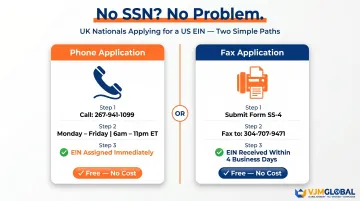
On Form SS-4 line 7b, enter "foreign" or "N/A" if you don't have and are ineligible for an SSN or ITIN.
Cost: Free when applied directly with the IRS. Third-party services charge $50–$150 for EIN application assistance.
Step 6: Open a US Business Bank Account and Register for Taxes
A US business bank account keeps your finances separate and maintains corporate formality—both critical for limited liability protection.
Most major US banks require in-person visits, but several digital banks now support non-resident account opening remotely:
- Mercury: Publicly supports US companies founded by people outside the US
- Wise Business: Offers US business accounts for US-registered entities (the entity must be US-registered; you cannot open an account for a foreign entity)
Both require your EIN before account opening.
Once banking is in place, assess your state tax obligations. If you hire US employees or establish economic nexus in any state—typically exceeding $100,000 in annual sales or 200 transactions—you must register with that state's tax authority and obtain the relevant state tax IDs.
Cost of Setting Up and Running a US Company
Here's what to budget for in year one and beyond, broken down by the two most popular states for UK-based founders registering a US company.
Initial Setup Costs
| Cost Item | Delaware LLC (USD) | Wyoming LLC (USD) |
|---|---|---|
| State filing fee | $110 | $100 |
| Registered agent (annual) | $125–$200 | $125–$200 |
| EIN application | Free (DIY) or $50–$150 (service) | Free (DIY) or $50–$150 (service) |
| Name reservation (optional) | $75 | Similar |
| Estimated first-year total | $310–$535 | $300–$525 |
Annual Recurring Costs
| Cost Item | Delaware LLC (USD) | Wyoming LLC (USD) |
|---|---|---|
| Franchise tax / Annual report | $300 (due June 1) | $60 (due on anniversary of formation) |
| Registered agent renewal | $125–$200 | $125–$200 |
| Federal tax filing (professional) | $300–$800 | $300–$800 |
| State tax filing (if applicable) | $200–$500 | $200–$500 |
| Estimated annual total | $925–$1,800 | $685–$1,560 |
Wyoming saves approximately $240/year on state franchise tax compared to Delaware — a real difference for bootstrapped businesses. Delaware's higher costs make sense mainly for C-Corps pursuing venture capital.
Beyond registration, budget for:
- Federal tax returns (Form 1120 for C-Corps, Form 5472 + pro-forma 1120 for foreign-owned LLCs)
- State tax filings in any state where you establish economic nexus
- Sales tax registration and remittance if you exceed thresholds in individual states
Common Challenges UK Entrepreneurs Face When Registering in the USA
EIN Application Without a US Social Security Number
This is the most frequent roadblock. UK nationals cannot use the IRS online portal, which surprises many first-time founders and delays the process by 1–2 weeks.
Apply instead via Form SS-4 — by phone at 267-941-1099 or fax at 304-707-9471. Phone applications receive immediate EIN assignment; fax applications typically process within 4 business days.
Multi-Layered US Tax System
The US has federal tax, state-level corporate tax, and local taxes that differ by city. Sales tax obligations vary by state and sometimes by county—creating layers of compliance complexity UK entrepreneurs often underestimate.
Tax nexus is particularly confusing. Following the Supreme Court's South Dakota v. Wayfair decision (2018), states can require sales tax collection from remote sellers based on economic activity alone. The standard threshold is $100,000 in sales or 200 transactions per state annually.
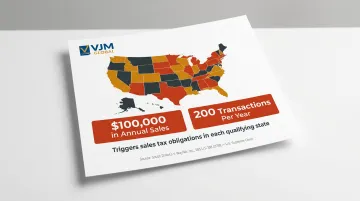
In practice, a UK-owned e-commerce business selling across 10 US states may trigger obligations in all 10 — each with different rates, filing frequencies, and exemption rules.
Simultaneous Entity Selection, Compliance, and Tax Navigation
Navigating entity selection, state compliance, annual filings, and cross-border tax obligations simultaneously overwhelms many UK founders. An experienced cross-border advisor helps you sequence these steps correctly and avoid costly missteps.
VJM Global has worked with over 250 UK businesses on international setup and compliance. The team covers entity formation, US tax filings, and multi-state nexus analysis — so UK founders can meet their US obligations from day one.
Frequently Asked Questions
Can a UK citizen start and own a company in the USA?
Yes. UK citizens can fully own a US LLC or C-Corp without needing US residency or citizenship, and no visa is required to register or own the company. That said, owning a US company doesn't permit you to physically work in the US — a work visa such as the E-2 Treaty Investor visa is required for that.
How to register a company in the USA from the UK?
Choose a state and entity type (LLC or C-Corp), appoint a registered agent, file formation documents with the Secretary of State, obtain an EIN from the IRS, and open a US business bank account. The entire process can be completed remotely in 2–8 weeks.
Do I need a US visa to register and run a company in the USA from the UK?
No visa is required to register or own a US company from the UK. If you intend to physically work or manage the business from within the US, a valid work visa (such as the E-2 Treaty Investor visa) is required. The UK qualifies as an E-2 treaty country.
What is the best US state for a UK entrepreneur to register a company in?
Delaware and Wyoming are the most popular choices for non-resident UK entrepreneurs. Delaware is preferred for its business-friendly legal system, dedicated Court of Chancery, and strong investor appeal. Wyoming suits cost-conscious founders, with low filing fees, no franchise tax, and robust privacy protections.
How can I avoid double taxation between the US and UK?
The US-UK Income Tax Treaty (2001) helps reduce or eliminate double taxation on the same income. Choosing an LLC structure (which uses pass-through taxation) can also help avoid corporate-level US tax. Consulting a tax advisor familiar with both jurisdictions is strongly recommended.
Is £5,000 enough to register and start a US company from the UK?
Yes. £5,000 comfortably covers US LLC formation costs — filing fees, registered agent, and EIN. It's a practical starting point for service-based businesses, consulting, freelancing, e-commerce, or digital product ventures that don't require physical infrastructure.