Filing from Dubai or Abu Dhabi, though, isn't the same as filing locally. UAE applicants have to work through the IPOS Digital Hub, satisfy a mandatory Singapore address-for-service rule, and decide between a direct filing and a Madrid Protocol designation.
This guide walks through eligibility, the exact filing steps, the direct-versus-Madrid decision, fees, and the mistakes that trip up UAE applicants most often.
Key Takeaways
- File on the IPOS Digital Hub via Form TM4; non-residents need a Singapore address for service via a local agent.
- Choose direct national filing with IPOS or a Madrid Protocol designation through the UAE Ministry of Economy.
- Official fees are S$280 per class (pre-approved) or S$410 per class (non-standard); Madrid uses a separate fee structure.
- Registration lasts 10 years from filing, renews indefinitely, and takes about 9 months if uncontested.
- Run a clearance search before filing to cut objection and opposition risk that can add months.
How to Register a Trademark in Singapore from the UAE: Step-by-Step Process
Step 1: Confirm Eligibility and Run a Clearance Search
A registrable mark needs to be a distinctive sign capable of being represented graphically, whether that's a word, logo, shape, colour, or sound. Marks that are purely descriptive or generic for the goods or services in question won't pass examination.
Before spending anything, search for conflicts:
- Run IPOS' Similar Mark Search tool on the Digital Hub to check the Singapore register.
- Cross-check the WIPO Global Brand Database for marks registered elsewhere that could still create a conflict in ASEAN markets.
- Look for identical, phonetically similar, and visually similar marks, not just exact duplicates.
Official filing fees in Singapore are non-refundable once submitted. A thorough search now saves a wasted application later.
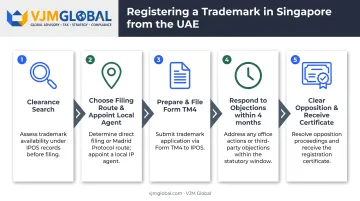
Step 2: Decide Your Filing Route and Arrange a Singapore Address for Service
Every application needs a Singapore address for service. UAE applicants generally can't supply this themselves, so the practical route is to:
- Appoint a Singapore-based trademark agent to transact directly with IPOS, or
- Work with a firm that coordinates with a Singapore associate on your behalf.
Lock in your filing strategy here as well: direct national filing or a Madrid Protocol designation. That choice shapes your documents, fees, and long-term risk, so settle it before you touch Form TM4. We break down the options in the next section.
Step 3: Prepare Application Details and File Form TM4
Once your route is confirmed, gather everything needed for the form:
- Applicant's legal name and address, matching your UAE trade licence or company records exactly.
- A clear representation of the mark file (word mark, logo, or combination).
- Goods and services classified under the Nice Classification system.
- Any UAE priority claim details, if applicable.
Select your goods/services descriptions from IPOS' pre-approved classification database wherever possible. It locks in the lower S$280 per class fee and tends to move through examination faster than custom-worded descriptions.
Step 4: Respond to Examination Objections Within the Deadline
Once filed, IPOS runs a formalities check followed by substantive examination against distinctiveness and conflicting marks. If an examiner raises concerns, they issue an objection report.
You get exactly four months to respond, extendable with Form CM5 if needed. Your options include:
- Written submissions with evidence
- An amendment via Form TM27
- A hearing request through Form HC4
According to IPOS, miss the deadline and the application is treated as withdrawn—you'd start again from scratch.
Step 5: Clear the Opposition Window and Receive the Registration Certificate
Once accepted, your mark is published in the Trade Marks Journal for a two-month opposition period. Any third party who believes they'd be harmed by your registration can file a notice of opposition during this window.
No opposition filed? Registration follows shortly after, and IPOS issues the certificate. Your rights are backdated to the original filing date, not the certificate date, which matters if a dispute ever arises over who used the mark first.
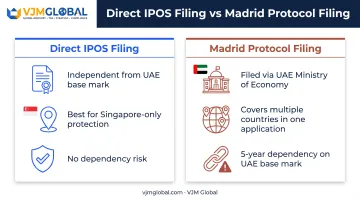
Direct IPOS Filing vs Madrid Protocol: Which Route Should UAE Applicants Choose?
The UAE deposited its instrument of accession to the Madrid Protocol on 28 September 2021, with the system becoming usable for UAE brand owners from 28 December 2021, per WIPO's official announcement. That gives UAE applicants a genuine choice today, where previously direct filing was the only option.
Direct filing with IPOS means your Singapore application stands independently from day one. It suits you if:
- You only need protection in Singapore, not a wider portfolio.
- Your UAE base mark is new, still under review, or hasn't been filed yet.
- You want a registration that's insulated from anything happening back home.
Madrid Protocol filing goes through the UAE Ministry of Economy as your office of origin, letting you designate Singapore alongside other member countries in one international application. It's efficient for multi-country rollouts, but it comes with a catch.
The international registration stays dependent on your UAE base application or registration for five years from the international registration date. If your UAE mark gets successfully attacked or cancelled within that window, every designated country falls with it, including Singapore.
Priority claims matter here too. If you filed a UAE trademark application within the last six months, you can claim that filing date in Singapore under the Paris Convention, provided you supply the right documentation. Delay past six months, and that priority window closes for good.
| Scenario | Recommended route |
|---|---|
| Only Singapore protection needed | Direct IPOS filing |
| UAE mark still facing objections | Direct IPOS filing |
| Rolling out across multiple countries at once | Madrid Protocol |
| UAE registration is stable and several years old | Madrid Protocol |
What You Need Before Filing: Documents, Local Agent, and Preparation
Form TM4 requires a specific set of details, and getting them wrong causes avoidable delays.
Core requirements:
- Applicant name and address, matching your UAE trade licence or company registration precisely.
- A clean file of the mark itself, whether a wordmark, logo, or composite.
- Goods and services sorted correctly under Nice Classification.
- A declaration of use or genuine intention to use the mark in Singapore.
Address for service is the practical bottleneck for UAE applicants. Without Singpass or Corppass, you cannot transact directly with IPOS, so a local agent must file and receive correspondence on your behalf.
Cross-border firms operating in both the UAE and Singapore, such as VJM Global, can coordinate that local agent alongside related Singapore entity or compliance work.
Non-English or Arabic-script marks need extra attention. If your mark includes Arabic script, transliteration and translation may be required so examiners can assess distinctiveness and check for conflicting marks. Sort this out before filing rather than in response to an examination query.
Fees, Costs and Timeline for UAE Applicants
Budgeting accurately means separating official government fees from the professional costs layered on top.
IPOS official fees:
| Fee type | Amount |
|---|---|
| Form TM4, pre-approved descriptions | S$280 per class |
| Form TM4, non-standard descriptions | S$410 per class |
| Renewal (Form TM19, on time) | S$480 per class |
If filing via Madrid Protocol, add WIPO’s fees on top of IPOS charges:
- Basic fee: CHF653 (black-and-white) or CHF903 (colour)
- Singapore designation: CHF265 per class
WIPO’s fee calculator gives an exact total for your filing.
Beyond official fees, UAE applicants should budget for:
- Local agent or coordination charges for the mandatory address for service.
- AED-to-SGD currency conversion costs on international payments.
- Any advisory fees for classification review or clearance searches.
Timeline: IPOS states that an uncontested application, meaning no deficiencies, objections, or opposition, typically registers in about 9 months. Contested applications run considerably longer once examination responses and opposition proceedings are factored in.
One caveat: IPOS' acceleration programme, SG Trade Marks Fast, has had periods where new requests were suspended pending review. Confirm current acceptance status before building your project timeline around it.
Common Mistakes UAE Applicants Make and Keeping the Mark Protected
Most problems with cross-border filings trace back to a handful of avoidable errors.
Frequent mistakes:
- Skipping the clearance search and discovering a conflict only after paying non-refundable fees.
- Missing the six-month priority window from a UAE filing, losing the earlier filing date entirely.
- Letting the four-month objection response deadline pass, causing the application to lapse.
- Assuming a Singapore registration covers the wider Gulf or ASEAN region.
It doesn't. A Singapore registration protects Singapore only—sales into other GCC or ASEAN markets need separate national filings or Madrid coverage for those countries.
Keeping the registration alive long-term means tracking two dates:
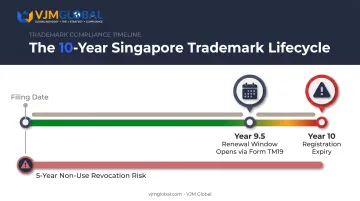
- Renewal — file Form TM19 starting six months before the 10-year term expires. Late renewal costs more (S$700 per class); restoration after lapse costs more and adds extra steps.
- Non-use exposure — a mark can be revoked if it goes unused in Singapore for five continuous years without proper reason.
If you are coordinating entity, tax, and compliance work across the UAE and Singapore, a firm such as VJM Global can help align renewal deadlines with your wider market-entry obligations as the brand grows.
Frequently Asked Questions
How do I register a trademark in Singapore from the UAE?
You file Form TM4 through the IPOS Digital Hub, either directly or via a Madrid Protocol designation. UAE applicants usually need a Singapore agent for the address for service, since they typically lack Singpass or Corppass access.
How long does a trademark registration last in Singapore?
Registration is valid for 10 years from the filing date and can be renewed indefinitely for further 10-year terms using Form TM19, filed from six months before expiry.
Can a UAE business file directly with IPOS without a Singapore agent?
Only if you hold a Singpass or Corppass account and a Singapore address for service. Without both, you must appoint a Singapore agent to transact with IPOS on your behalf.
Is the Madrid Protocol a good filing route for UAE businesses targeting Singapore?
Yes, if you plan to file in several countries at once—the UAE joined Madrid in December 2021. It does carry a five-year dependency on your UAE base mark staying intact.
How much does it cost to register a trademark in Singapore from the UAE?
Official IPOS fees run S$280 to S$410 per class depending on the description type. Filing via Madrid adds WIPO's basic and designation fees, plus separate agent and coordination charges.
What happens if someone opposes my Singapore trademark application?
You'll receive a copy of the opposition notice and must file a counter-statement within the specified period. Failing to respond may result in the application being refused.