Here's the catch most guides skip: US businesses can't just log in and file. Direct self-filing requires a Singpass or Corppass login, both of which are only issued to Singapore residents and entities. Without one, and without a Singapore address for service, you need a locally appointed agent to file on your behalf.
This guide walks through the exact filing steps, what you need to arrange before you start, real costs in Singapore dollars, the direct-filing versus Madrid Protocol decision, and the mistakes that waste a non-refundable filing fee.
Key Takeaways
- US applicants without Singpass/Corppass need a Singapore-registered agent
- Official fees: S$280/class (pre-approved) or S$410/class (custom), plus agent charges
- File direct with IPOS, or designate Singapore via Madrid from a USPTO application
- Uncontested marks typically register in 9–18 months; protection lasts 10 years, renewable
- File within 6 months of a US application to claim that priority date in Singapore
How to Register a Trademark in Singapore from the USA: Step-by-Step
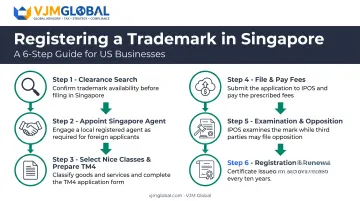
Step 1: Run a Clearance Search Before You File
Don't file blind. Search two databases first:
- IPOS Similar Mark Search – checks for identical or confusingly similar marks already filed in your Nice classes
- WIPO Global Brand Database – covers internationally protected marks, appellations of origin, and related records beyond Singapore alone
One thing trips up almost every first-time filer: registering a business name with ACRA (Singapore's company registrar) or securing a matching domain name does not create trademark rights.
IPOS is explicit that an ACRA business name registration is not trademark protection. Plenty of US founders assume it is, then discover the gap only after a competitor files first.
Step 2: Appoint a Singapore-Registered Trademark Agent
As a foreign applicant, you're legally required to appoint an agent with a Singapore address for service. That agent files the application and receives all IPOS correspondence, so every deadline runs through their office.
Before signing on, confirm the engagement scope in writing. Ask specifically:
- Does the fee cover responding to examination reports, or is that billed separately?
- Who handles an opposition notice if one is filed?
- What's the turnaround time for forwarding IPOS communications to you?
US firms often coordinate this through a cross-border services partner rather than a standalone IP boutique, since the same firm can also handle related Singapore entity and compliance needs alongside the filing itself.
Step 3: Select Nice Classes and Prepare Form TM4
Choose every Nice class covering your current goods and services, plus any you realistically expect to enter within the next few years. This matters because the scope of an application cannot be widened after filing. You'd need a fresh application (and fresh fee) to add classes later.
Gather these before your agent starts drafting:
- Your US entity's legal name, exactly as it appears on incorporation documents
- A clear representation of the mark (wordmark text, logo file, or description for sound/color marks)
- Priority claim details, if filing within 6 months of an earlier USPTO application on the same mark
Step 4: File Form TM4 on the IPOS Digital Hub and Pay Fees
Your agent submits Form TM4 through the IPOS Digital Hub or the IPOS Go app. Choosing goods and services descriptions straight from the IPOS Classification Database locks in the lower S$280 per class fee and generally moves faster through examination. Custom or non-standard descriptions cost S$410 per class and invite more scrutiny.
Here's the part that makes Step 1 non-negotiable: IPOS application fees are not refundable if the mark is later refused. There's no exception for a rejection based on a prior conflicting mark you could have caught with a search.
Step 5: Handle Examination, Publication, and Any Opposition
If IPOS raises an objection during examination, you have 4 months to respond. Form CM5 extends that deadline, but repeated extension requests need documented reasons and remain subject to Registry approval. Miss the deadline entirely, and the application is treated as withdrawn. No fee refund.
Once accepted, the mark publishes in the Trade Marks Journal for a 2-month opposition window. Any third party who believes the mark conflicts with their rights can file Form TM11 during that window.
Step 6: Registration and Ongoing Compliance
Once the opposition window closes without incident, IPOS issues a registration certificate. Rights are backdated to your original filing date, and protection runs for 10 years.
Two dates deserve calendar reminders:
- Renewal – File Form TM19 up to 6 months before the 10-year mark expires
- Non-use exposure – A mark unused in Singapore for 5 consecutive years after registration can be revoked on that basis alone
What US Applicants Need Before Filing in Singapore
Before your agent can submit anything, have these ready:
- A Singapore address for service through a licensed local trademark agent (required for foreign applicants)
- Your US entity's legal name and details, matching incorporation records exactly, since mismatches trigger IPOS queries and delay examination
- A submission-ready mark representation meeting IPOS format rules, whether that's a wordmark, logo file, or written description for sound or color marks
- Priority documentation, if you're claiming the 6-month Paris Convention window from an earlier USPTO filing
- A clear budget split between official IPOS fees (in SGD), agent professional charges, and any bank conversion costs
That last point catches people off guard more than any other—the government fee is only one line item. If you also need a Singapore entity or ongoing local compliance, a cross-border partner such as VJM Global can handle formation and statutory support while your licensed agent manages the IPOS filing.
Singapore Trademark Registration Costs for US Businesses
IPOS fees are billed in Singapore dollars, and they're straightforward once you know the two fee bands.
| Fee Type | Cost | Notes |
|---|---|---|
| TM4 application (pre-approved specification) | S$280/class | Descriptions pulled directly from IPOS Classification Database |
| TM4 application (custom specification) | S$410/class | Non-standard wording, more examination risk |
| Opposition notice (Form TM11) | S$420/opposed class | Filed by a third party challenging your mark |
| Counter-statement (Form HC6) | S$360/opposed class | Your response to an opposition |
| Specification/priority amendment (Form TM27) | S$60/amended class | |
| Renewal, on time (Form TM19) | S$480/class | Filed before the 10-year term expires |
| Late renewal | S$700/class | |
| Restoration | S$770/class | If renewal deadline is fully missed |
These figures come directly from the IPOS forms and fees schedule; confirm current numbers there before filing, since IPOS updates them periodically.
Agent fees are extra. IPOS amounts above exclude your Singapore agent's professional fees, which are billed separately and vary by firm and scope. Because IPOS bills in SGD, US applicants also absorb the prevailing USD/SGD rate, plus any international wire or remittance charges their bank tacks on.
If you need faster examination, confirm whether SG Trade Marks Fast is open. IPOS has offered this acceleration route at an added per-class fee, but new-request intake has been suspended before—verify availability before you build it into your budget.
Direct IPOS Filing vs. Madrid Protocol: Which Route for US Businesses?
You have two ways to get a Singapore registration. The right one depends on how many countries you're targeting and how solid your US mark is.
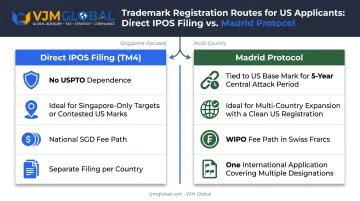
Direct national filing is independent of your USPTO status. File Form TM4 straight with IPOS. This suits you if:
- Singapore is your only international target right now
- Your US application is still facing office actions or hasn't cleared examination
- You want a registration that isn't tied to what happens with any other filing
Madrid Protocol filing builds on a qualifying USPTO base application. You file one international application through WIPO and designate Singapore (and other member countries) in the same filing. WIPO's fees are paid in Swiss francs: a basic fee of roughly CHF 653 to CHF 903, plus CHF 265 per class for the Singapore designation.
Madrid suits you if:
- Your US base mark is already clean and registered
- You plan to protect the mark in several Madrid member countries at once
- You want one filing and one renewal cycle to manage internationally
Central attack risk: your Singapore registration depends on that US base mark for 5 years from the international registration date. If the US mark is cancelled or successfully challenged in that window, the Singapore registration can fall with it.
| Factor | Direct IPOS (TM4) | Madrid Protocol |
|---|---|---|
| USPTO dependence | None | Tied to US base mark for 5 years |
| Best when | Singapore-only or US mark still contested | Multi-country expansion, clean US registration |
| Fee path | IPOS national fees | WIPO basic fee + per-designation fees (CHF) |
| Admin load | Separate filing per country | One international application, multiple designations |
Simple decision rule: choose direct filing if Singapore is your only market or your US mark is still contested. Consider Madrid if your US base mark is clean and registered, and you're expanding into several countries at once.
Common Mistakes US Businesses Make When Filing in Singapore
Most filing problems trace back to one of three mistakes.
Assuming US rights travel automatically. Trademark protection is strictly territorial. A federal USPTO registration, or even an LLC name registered with your state, gives you zero enforceable rights in Singapore. You need a separate Singapore filing.
Skipping the Singapore-specific search. Filing fees aren't refunded on refusal. A clearance search costs nothing compared to the S$280 to S$410 per class you lose if IPOS or a third party flags a conflicting mark after you've already paid.
Missing deadlines due to distance. Two deadlines matter most:
- The 6-month priority window from an earlier USPTO filing: miss it, and you lose the earlier filing date
- The 4-month examination response window: time-zone lag with a distant agent can eat weeks of that window before you even see the objection
Overnight coordination models reduce this risk. A team already working while you sleep can answer your morning query the same day, which preserves more of the response window than agents who only handle correspondence during their own business hours.
Frequently Asked Questions
How much does it cost to register a trademark in Singapore?
Official IPOS fees run S$280 per class for pre-approved descriptions or S$410 per class for custom ones. US filers should add their agent's professional fees and currency conversion costs on top.
How much does it cost to register an international trademark?
A Madrid Protocol filing involves a WIPO basic fee (roughly CHF 653 to CHF 903) plus individual designation fees per country you select, all payable in Swiss francs. Total cost scales with how many countries you designate.
How do I register my brand internationally?
You have two broad paths: file a separate national application in each target country, or use the Madrid Protocol through your home trademark office to designate multiple countries in one filing.
Do I need a Singapore address to file a trademark application from the USA?
Yes. Without a Singpass or Corppass login, foreign applicants must appoint a Singapore-registered agent with a local address for service to file and receive correspondence.
How long does it take to register a trademark in Singapore from the USA?
An uncontested, deficiency-free application typically registers in about 9 to 18 months. Objections during examination or a third-party opposition will extend that timeline further.
Can I use the Madrid Protocol to register a trademark in Singapore from the USA?
Yes, provided you have a qualifying USPTO base application to build on. Keep in mind the Singapore registration stays dependent on that US mark for a 5-year central-attack period.