Introduction
Singapore businesses expanding into India often assume their company name is already protected once they've incorporated an Indian entity or registered a subsidiary. It's a costly misconception — and one that leaves brands exposed to squatting, infringement, and disputes that are expensive to unwind.
Registering a company with India's Ministry of Corporate Affairs (MCA) establishes your legal entity — it doesn't protect your brand in the marketplace. Brand protection requires a separate trademark registration process under the Trade Marks Act, 1999, administered by IP India's Controller General of Patents, Designs, and Trade Marks (CGPDTM).
The two systems operate independently. The MCA does not cross-check its corporate name database against the trademark registry, which means another party can legally register your brand name as a trademark even after you've incorporated.
This guide explains the exact steps, costs, timelines, and Singapore-specific considerations for registering your brand name as a trademark in India.
Key Takeaways
- Registering with India's MCA doesn't protect your brand—trademark registration with IP India is required
- India operates as a first-to-file jurisdiction; whoever files first typically wins priority rights
- Singapore businesses must appoint a local Indian trademark agent; foreign applicants cannot file directly
- Government fees range from ₹4,500 to ₹9,000 per class; the full process takes 12–24 months
- You can use the ™ symbol from the application date, but ® only after registration is complete
What "Registering a Brand Name" Actually Means in India: Company Name vs. Trademark
In India, company name registration and trademark registration are two entirely separate processes — governed by different laws, administered by different agencies, and serving fundamentally different purposes. Most Singapore businesses entering India need both, but they're commonly confused for the same thing.
What Each Registration Actually Does
Company name registration (Companies Act, 2013, administered by MCA) establishes your business as a legal entity. It allows you to operate, open bank accounts, hire employees, and enter contracts.
Trademark registration (Trade Marks Act, 1999, administered by IP India) protects your brand identity—your name, logo, slogan—in the marketplace. It prevents competitors from using confusingly similar marks on their products or services.
One does not substitute for the other. The MCA does not cross-check its corporate name database against IP India's trademark registry.
The Critical Risk for Singapore Businesses
A competitor can register your company name as a trademark even after your Indian subsidiary is incorporated. This blocks you from using that name commercially — on products, packaging, and marketing materials alike.
The Burger King case makes this concrete: a local Pune restaurant used "Burger King" since 1992. When the US-based Burger King entered India in 2014 without filing a trademark, the local restaurant successfully defended its use in court (Burger King Corp. v. Anahita & Shapoor Irani, 2024).
What Can Be Trademarked in India
India allows registration of:
- Word marks (brand names in English, Hindi, or regional languages)
- Device marks (logos, symbols, designs)
- Combined marks (word + logo together)
- Slogans and taglines
- Shape marks (distinctive product shapes)
- Colour combinations (specific to your brand)
- Sound marks (audio signatures like jingles)
Singapore businesses should consider registering both their word mark and logo as separate filings for maximum protection.
Comparison: MCA Registration vs. Trademark Registration
| Factor | MCA Company Registration | IP India Trademark Registration |
|---|---|---|
| Governing Law | Companies Act, 2013 | Trade Marks Act, 1999 |
| Administering Authority | Ministry of Corporate Affairs | CGPDTM (IP India) |
| What It Protects | Legal entity status | Brand identity in commerce |
| Prevents Misuse by Others | No | Yes |
| Duration | Ongoing (until dissolution) | 10 years, renewable indefinitely |
| Symbol | None (or Pvt Ltd, LLP suffix) | ™ (pending), ® (registered) |
| Commercial Exclusivity | No exclusive right to name | Exclusive right to mark in registered classes |
Why Singapore Businesses Must Register Their Brand in India Early
India operates primarily as a first-to-file system under the Trade Marks Act, 1999. The earliest application filing date establishes priority. A Singapore brand that is globally recognized but unregistered in India can be legally blocked by a local squatter who files first.
The Trademark Squatting Risk
Documented cases show this risk is real:
- Sony PS5: India launch delayed after a squatter filed for "PS5" covering specifications identical to Sony's PS4 registration
- Hengst SE v. Tejmeet Singh Sethi (Delhi HC): Defendants squatted on 378 well-known international marks
- Apple (China, comparative): Paid US$60 million in 2012 to reclaim the "iPad" trademark from a local squatter
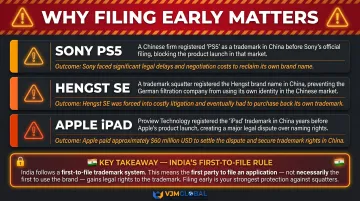
Global reputation offers no legal shield in India — only a registered trademark does. Filing early is the only reliable way to lock in your claim before someone else does.
Filing Date as Priority Date
Once you file, that date becomes your legal priority date. Even during the 12–24 month examination process, your filing date protects your claim ahead of any later applicant — squatter or competitor.
Registered Trademarks as Enforceable Assets
A registered Indian trademark creates:
- Block counterfeit imports at Indian ports through customs recordal rights
- Obtain court injunctions to stop infringers before damage compounds
- Takedown support on Amazon India and Flipkart for infringing listings
- License or franchise your brand across India with enforceable agreements
- Legal standing to sue for infringement under Section 29 of the Trade Marks Act
How to Register Your Brand Name as a Trademark in India: Step-by-Step
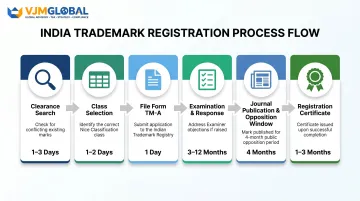
The process runs from clearance search → application filing → examination → publication → registration, administered by CGPDTM across five registries: Mumbai, Delhi, Kolkata, Chennai, and Ahmedabad. End-to-end, budget 18–36 months for a straightforward application — longer if opposition arises.
Step 1: Conduct a Trademark Clearance Search
Search the IP India public portal for identical or phonetically similar existing marks.
How to search effectively:
- Use the Wordmark search for exact matches
- Use the Phonetic search for similar-sounding marks
- Select the relevant Nice Classification class (required)
- Check Vienna Code if searching for device marks (logos)
This step isn't mandatory, but it reduces the risk of objections and opposition later. If your mark conflicts with an existing registration, the Registry will refuse your application during examination.
Step 2: Determine the Correct Nice Classification Class(es)
India follows the 45-class Nice Classification system: Classes 1–34 cover goods, Classes 35–45 cover services. Government fees apply per class, making accurate selection critical.
Common classes for Singapore businesses:
| Class | Coverage | Example |
|---|---|---|
| 9 | Computer software, electronics, scientific instruments | SaaS platforms, mobile apps |
| 25 | Clothing, footwear, headgear | Apparel brands |
| 29 | Preserved foods, dairy, oils | Food products |
| 30 | Coffee, tea, rice, confectionery | F&B brands |
| 35 | Advertising, business management, retail services | E-commerce, consulting |
| 36 | Financial services, insurance, real estate | Fintech, wealth management |
| 41 | Education, entertainment, sporting events | EdTech, media platforms |
You cannot change class selection after filing. Under-protection leaves your brand vulnerable; over-protection creates non-use vulnerability after 5 years.
Step 3: Appoint a Local Indian Trademark Agent and File Form TM-A
Foreign applicants cannot file directly with the Indian Registry. You must appoint a locally registered trademark agent or attorney.
Form TM-A application requirements:
- Applicant legal name, address, and incorporation details (ACRA Certificate of Incorporation, apostilled or notarised)
- Clear representation of the trademark (JPEG format, max 8×8 cm)
- Power of Attorney signed by an authorised company representative (Form TM-M)
- List of specific goods/services by class (general class headings are not accepted)
- Priority claim documentation (if claiming Paris Convention priority from a Singapore base application)
- Prior use affidavit under Rule 25(2) (if claiming use before application date; notarised, with evidence)
Filing is completed through the IP India portal using a Class 3 Digital Signature Certificate or eMudhra eSign.
Singapore businesses working with VJM Global can get support on Form TM-A filing, local agent appointment, and documentation preparation as part of India market entry.
Step 4: Examination and Responding to Objections
The Registry examines applications on:
- Absolute grounds (Section 9): Descriptiveness, lack of distinctiveness, deceptiveness, scandalous content
- Relative grounds (Section 11): Conflicts with existing marks, well-known trademarks, passing off
If objections are raised, you receive an Examination Report and have 30 days to respond (extensions available under Rule 33). Unaddressed objections lead to abandonment of the application.
Common objection categories include:
- Mark is too descriptive of the goods/services
- Mark is phonetically similar to an existing registration
- Mark lacks inherent distinctiveness
- Evidence of prior use is insufficient
Responses typically require legal arguments, evidence of acquired distinctiveness, or amendments to the goods/services description. Once the Registry accepts your response, the mark moves to publication.
Step 5: Publication in the Trade Marks Journal and Opposition Window
Accepted marks are published in the Trade Marks Journal for a 4-month opposition period. Any third party may file opposition during this window.
If opposed:
- You must file a counter-statement within 2 months of receiving the opposition notice
- Failure to file results in abandonment
- The matter proceeds to a hearing before the Registrar
- This can extend the process by 2–4 years
If no opposition is filed — or you win the hearing — the mark proceeds to registration.
Step 6: Certificate of Registration and Use of ® Symbol
Upon registration, the Registry issues a Trademark Registration Certificate valid for 10 years from the application date, renewable indefinitely in 10-year increments.
Symbol usage rules:
- ™ symbol: May be used from the date of filing (while application is pending)
- ® symbol: May only be used after the certificate is issued
Using ® before registration is a punishable offence under Section 107 of the Trade Marks Act, 1999 — imprisonment up to three years, fine, or both.
Costs, Timelines, and Filing Requirements for Singapore Businesses
Government Fee Structure
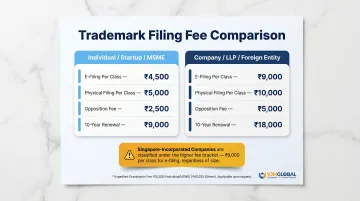
| Fee Type | Individual/Startup/MSME | Company/LLP/Others |
|---|---|---|
| Form TM-A (e-filing, per class) | ₹4,500 | ₹9,000 |
| Form TM-A (physical filing, per class) | ₹5,000 | ₹10,000 |
| Opposition (Form TM-O) | ₹2,700 | ₹2,700 |
| Counter-statement | ₹1,500 | ₹1,500 |
| 10-year renewal (per class) | ₹9,000 | ₹9,000 |
Singapore-incorporated companies filing as foreign entities fall under the "Company/LLP/Others" bracket, meaning the applicable rate is ₹9,000 per class for e-filing. The concessional ₹4,500 rate is reserved for entities with a valid Udyam or Startup India certificate — something foreign companies cannot obtain.
Professional agent fees are additional and vary by firm.
Timeline Expectations
Budget for these typical processing windows once fees are paid:
- Uncontested applications: 12–18 months
- Contested/opposed applications: 2–4 years
- Expedited examination: Available for an additional fee (₹20,000 for individuals, ₹40,000 for companies)
You can check estimated examination timelines using the Trademark Application Queue List on the IP India portal by entering your application number.
Key Documents Singapore Businesses Need
- ACRA Certificate of Incorporation — apostilled or notarised for Indian proceedings
- Power of Attorney signed by an authorised company representative
- Trademark representation in JPEG format (max 8×8 cm)
- List of goods/services classified by Nice Classification
- Prior use evidence (if applicable): invoices, marketing materials, dated screenshots
Foreign documents generally require legalisation or apostille before use in Indian IP proceedings.
Two Filing Routes for Singapore Businesses: Direct Filing vs. Madrid Protocol
Singapore businesses have two routes to register trademarks in India:
Direct National Filing with IP India
Process: File Form TM-A directly with IP India through an appointed Indian agent.
Advantages:
- More predictable timelines (12–18 months uncontested)
- Clearer examination feedback from Indian examiners
- Easier objection handling with local agent support
- No dependency on a base application
Recommended for: Businesses prioritising India as a primary expansion market.
Madrid Protocol Route via IPOS
Process: File an international application through IPOS (Singapore's IP Office) designating India as a target country.
Pre-requisites:
- A Singapore base application for the same mark
- Applicant must be a Singapore national, domiciled in Singapore, or have a real and effective establishment there
Fees:
- IPOS administrative fee: S$250 per international application
- WIPO fees (in Swiss francs) calculated via WIPO Fee Calculator
India's obligations under Madrid Protocol:
- India must communicate any provisional refusal within 18 months of WIPO notification
- Response windows for provisional refusals are short
- Opposition extension possible under Article 5(2)(c)
Central attack risk: For 5 years from the international registration date, the Indian registration depends on the Singapore base application. If the base is cancelled, withdrawn, or refused during this period, the Indian registration is cancelled.
Recommended for: Businesses filing across 5+ countries simultaneously, where a single application outweighs India-specific optimisation.
Which Route to Choose?
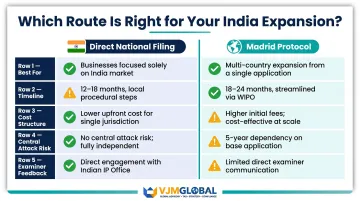
If India is a priority market, direct national filing is the stronger choice — it gives you clearer timelines, faster examiner feedback, and no central attack exposure. Madrid Protocol saves time and cost when registering across multiple countries simultaneously.
| Factor | Direct National Filing | Madrid Protocol |
|---|---|---|
| Best for | India-focused expansion | Multi-country filing (5+) |
| Timeline | 12–18 months (uncontested) | Subject to 18-month refusal window |
| Cost structure | Single-country fees via Indian agent | IPOS fee + WIPO fees in CHF |
| Central attack risk | None | Yes — 5 years from registration date |
| Examiner feedback | Direct and detailed | Routed through WIPO |
Common Mistakes Singapore Businesses Make When Registering Their Brand in India
Misconception: ACRA or MCA Registration Protects Your Brand
The most frequent mistake is believing that ACRA-registered company names (in Singapore) or MCA company registration (in India) automatically protects the brand commercially.
Neither prevents a third party from registering a similar name as a trademark and blocking you from using it on products, packaging, or marketing.
Timing Mistake: Delaying Trademark Filing Until After Launch
Many businesses delay filing until after India launch, product rollout, or initial growth. By this point:
- A squatter may have already filed
- Your priority date is later than necessary
- You may face opposition or refusal
Best practice: File trademark applications simultaneously with or before Indian company incorporation.
Class Selection Mistakes
Getting your class selection wrong cuts both ways:
- Too few classes: Adjacent categories stay unprotected. A software company registering only Class 9 (software) but skipping Class 35 (SaaS services) or Class 42 (cloud hosting) opens the door to competitor challenges in those spaces.
- Too many classes: Filing without genuine business intent creates non-use vulnerability. Under Section 47 of the Trade Marks Act, a registration can be cancelled if the mark goes unused for a continuous 5-year period.
Not Registering in Regional Language Scripts
Class coverage isn't the only gap to close — script coverage matters equally for brands targeting regional markets.
Rule 28 of the Trade Marks Rules, 2017 requires transliteration or translation for non-English/Hindi marks. Brands marketing to consumers in Tamil Nadu, West Bengal, or Maharashtra should file in Devanagari, Tamil, Bengali, and other scripts as separate applications.
The risk is concrete: in Amritdhara Pharmacy v. Satya Deo Gupta (1963), the Supreme Court held that phonetic similarity across scripts is enough to establish likelihood of confusion — meaning a local competitor can use a similar-sounding name in a regional script and claim it as distinct.
Frequently Asked Questions
How much does it cost to register a trademark (name or logo) in India?
Government fees are ₹4,500 per class for individuals/startups/MSMEs and ₹9,000 per class for companies via e-filing. Singapore-incorporated companies fall under the higher bracket. Professional agent fees are additional. Confirm current rates on the IP India portal.
How do I register my company brand name in India?
Brand name registration means filing a trademark application (Form TM-A) with IP India—not just incorporating a company with the MCA. Singapore businesses must appoint a local Indian trademark agent to file on their behalf.
How do I register my company logo as a trademark in India?
Logos are registered as "device marks" under the same Form TM-A trademark application process. Submit a clear JPEG representation (max 8×8 cm). It's advisable to register both the word mark and logo separately for broader protection.
Can I use the TM symbol without registering, or do I need to register to use ® in India?
The ™ symbol can be used from the date of filing a trademark application, even before registration is complete. The ® symbol can only be used after official registration — using it without registration is a punishable offence under Section 107 (imprisonment up to 3 years, fine, or both).
Can a logo be copyrighted in India, or should I register it as a trademark?
Logos may qualify for copyright protection in India as original artistic works under the Copyright Act, 1957 — automatic, with no registration required. However, trademark registration is strongly recommended for commercial brand protection, as it grants exclusive rights in commerce and a clearer mechanism to act against infringers. Dual protection is ideal.