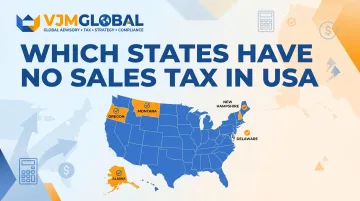
Five US states—New Hampshire, Oregon, Montana, Alaska, and Delaware—impose no statewide general sales tax. Collectively known as the NOMAD states (an acronym formed from their initials), these jurisdictions offer compelling advantages for certain business models. However, "no sales tax" doesn't mean "tax-free." Each state compensates through alternative revenue mechanisms that businesses must understand before making strategic location decisions.
This guide breaks down what each NOMAD state actually offers, what they tax instead, and what this means for businesses—especially those operating across multiple states.
Key Takeaways
- Five US states have no statewide sales tax: New Hampshire, Oregon, Montana, Alaska, and Delaware (the NOMAD states)
- Alternative taxes apply in each state—gross receipts taxes, corporate income taxes, excise taxes, and local sales taxes fill the revenue gap
- Businesses in NOMAD states still owe sales tax elsewhere once they cross economic nexus thresholds ($100,000 in most states)
- Oregon and Delaware are the most consistently tax-free states for general retail shopping
- Alaska allows 100+ local jurisdictions to impose their own sales taxes despite no state-level tax
- Understanding the full tax burden—not just the absence of sales tax—is critical before incorporating or expanding operations
What Is Sales Tax and Why Don't Some States Have It?
Sales tax is a consumption tax collected by businesses at the point of sale on goods and, in some jurisdictions, services. The seller remits this tax to state and local governments. In the US, sales tax is governed exclusively at the state level—there is no federal sales tax—which creates significant variation in rates and rules across the country.
According to the Tax Foundation's 2026 data, the population-weighted national average combined state and local sales tax rate is 7.53%. Retail sales taxes account for 32% of state tax collections and 13% of local tax collections nationwide.
Why do some states skip sales tax entirely?
States that forgo sales tax fund public services through alternative revenue sources instead. Common alternatives include:
- Income taxes on residents and businesses
- Property taxes on real estate holdings
- Natural resource extraction taxes (oil, gas, minerals)
- Gross receipts taxes on business revenue
Each NOMAD state has developed a distinct revenue model that compensates for the absence of transactional sales tax.
Only five states have made this choice permanently: the NOMAD states. Here's what sets each one apart.
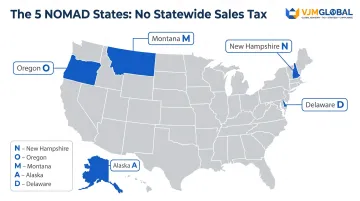
The 5 US States With No State Sales Tax (The NOMAD States)
These five states are collectively known as the NOMAD states—an acronym formed from their initials. While each is sales-tax-free at the state level, they all impose alternative taxes that businesses and consumers must navigate.
New Hampshire (N)
New Hampshire has no general state or local sales tax, making it fully sales-tax-free for most purchases. However, it imposes an 8.5% Meals and Rooms (Rentals) Tax on hotel stays, short-term rentals, and prepared food and beverages—a targeted tax on the hospitality sector.
Business taxes in New Hampshire:
- Business Profits Tax (BPT): 7.5% on businesses with gross income exceeding $109,000 (threshold effective January 1, 2025)
- Business Enterprise Tax (BET): 0.55% on the sum of compensation, interest, and dividends paid (enterprise value tax base), applicable when gross receipts or enterprise value exceed $298,000
Businesses operating in New Hampshire should account for both the BPT and BET when modeling their effective tax burden.
Oregon (O)
Oregon has no state or local sales tax of any kind, making it one of the cleanest no-sales-tax environments in the US. Businesses do face a corporate excise tax with a two-tier structure:
- 6.6% on Oregon taxable income of $1 million or less
- 7.6% on income exceeding $1 million (plus $66,000 flat tax on the first million)
Notable excise-style exceptions:
- Bicycle excise tax: $15 flat fee on bicycles with wheels at least 26 inches in diameter and retail prices of $200 or more
- Vehicle privilege and use taxes: 0.5% of the retail price of taxable vehicles
Oregon does require state income tax withholding from employees — worth noting for businesses with Oregon-based staff.
Montana (M)
Montana has no statewide general sales tax. That said, certain resort and tourism-heavy communities can levy a local resort tax on luxury goods, lodging, and prepared food — capped at 3%.
Ten authorized resort communities currently levy the maximum 3% rate, including:
- Big Sky
- West Yellowstone
- Red Lodge
- Whitefish
- Cooke City
- Gardiner
- Virginia City
- St. Regis
- Craig
- Wolf Creek
Additional Montana taxes:
- Lodging Facility Sales and Use Tax: 8% (4% use tax + 4% sales tax) on hotel stays and short-term rentals
- Corporate income tax: 6.75%
Hospitality businesses and those operating inside resort communities carry the heaviest tax obligations in Montana despite the statewide sales-tax exemption.
Alaska (A)
Alaska is the only NOMAD state with no statewide sales tax but significant local sales taxes. Over 100 municipalities levy their own sales taxes, with rates ranging from 1% to 7% and averaging 1.82% combined state and local (the lowest in the nation).
Key Alaska details:
- Some tourist communities implement seasonal sales tax rates that increase during summer months
- The Alaska Remote Seller Sales Tax Commission (ARSSTC) has established economic nexus rules for remote sellers
- As of January 1, 2025, the ARSSTC removed the 200 transaction threshold, leaving only a $100,000 gross sales threshold for economic nexus
Business taxes in Alaska:
- Corporate income tax: Graduated rates from 0% to 9.4% depending on income
For e-commerce sellers, Alaska's 100+ local tax jurisdictions are the primary compliance challenge — each with its own rules, rates, and filing requirements.
Delaware (D)
Delaware has no state or local sales tax and is notably popular as a state for business incorporation. However, it imposes a Gross Receipts Tax (GRT) on business revenues—not on consumers—with rates ranging from 0.0945% to 1.9914% depending on business type. (Petroleum products face a higher variable rate up to 2.4218%.)
Delaware GRT rates by business type:
| Business Type | GRT Rate |
|---|---|
| Automobile/Clean Energy Tech Manufacturers | 0.0945% |
| Farm Machinery Retailers | 0.0996% |
| General Manufacturers | 0.1260% |
| Grocery Supermarkets | 0.3267% |
| General Services/Professional | 0.3983% |
| Restaurant Retailers | 0.6472% |
| General Retailers | 0.7468% |
| Lessee of Tangible Personal Property | 1.9914% |
Critical detail: The GRT applies to total revenue with no deductions for cost of goods sold, material costs, or expenses. This can significantly impact lower-margin businesses.
Additional Delaware business taxes:
- Corporate income tax: 8.7%
- LLC/partnership franchise tax: $300 annually
Consumers pay no sales tax in Delaware, but businesses — particularly high-volume, low-margin retailers — need to factor the GRT into their cost structure before choosing Delaware as their incorporation state.
What Taxes Do NOMAD States Collect Instead of Sales Tax?
The absence of a general sales tax doesn't mean NOMAD states are revenue-light. Each compensates through a mix of income taxes, gross receipts taxes, excise taxes, and/or local taxes.
| State | Alternative Taxes | Notes on Local Taxes |
|---|---|---|
| Alaska | Corporate income tax (0–9.4%), local sales taxes | 100+ municipalities with rates from 1% to 7% |
| Delaware | Gross receipts tax (0.0945–1.9914%), corporate income tax (8.7%), franchise tax | No local sales tax |
| Montana | Corporate income tax (6.75%), 8% lodging tax | 3% resort tax in 10 communities |
| New Hampshire | Business Profits Tax (7.5%), Business Enterprise Tax (0.55%), 8.5% meals/rooms tax | No local sales tax |
| Oregon | Corporate excise tax (6.6–7.6%), payroll withholding | No local sales tax |
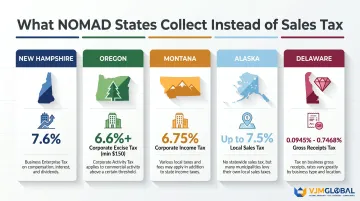
Beyond the taxes above, all five NOMAD states also collect excise taxes — charges levied per unit or by volume on specific products, rather than as a percentage of retail sales.
Excise taxes are applied across all five NOMAD states on select goods and activities:
- Alcohol, tobacco, and fuel excise taxes (all five states)
- Bicycle excise tax (Oregon: $15 per bike)
- Vehicle privilege and use taxes (Oregon: 0.5% of retail price)
For businesses evaluating NOMAD states, the total tax burden — income tax, payroll taxes, property taxes, gross receipts, and excise taxes — must be evaluated in full, not just the absence of sales tax. The Tax Foundation's State Tax Competitiveness Index provides comprehensive rankings.
Sales Tax Obligations for Businesses in NOMAD States
Critical misconception: Businesses located in NOMAD states are not automatically exempt from collecting sales tax everywhere.
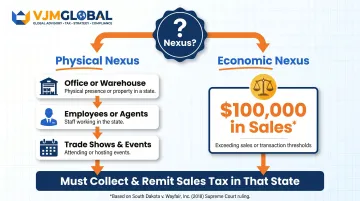
If a business has nexus—a legal connection to another state—it must collect and remit that state's sales tax. Nexus can be established through:
Physical nexus:
- Offices or warehouses
- Employees working in a state
- Attending trade shows or events
Economic nexus:
- Crossing a revenue or transaction threshold (typically $100,000 in sales in most states)
- Triggered by the 2018 South Dakota v. Wayfair Supreme Court ruling, which gave states authority to require remote sellers to collect sales tax once they cross nexus thresholds — even if the seller is based in a no-tax state
All 45 sales-tax states now have economic nexus laws. This means a business in Oregon selling to customers in Texas must collect Texas sales tax if it exceeds the Texas nexus threshold.
Alaska's Unique Local Sales Tax Situation
Since Alaska has no statewide sales tax but many localities do, the Alaska Remote Seller Sales Tax Commission (ARSSTC) was created to streamline collection for remote sellers. Businesses with $100,000+ in Alaska sales must comply with member jurisdiction requirements. (The 200 transaction threshold was removed January 1, 2025.)
Practical Guidance for Businesses
If you're based in a NOMAD state and sell to customers across multiple states, you need to:
- Track economic nexus in every state you sell into
- Register for sales tax permits in states where you've crossed thresholds
- File returns on the required schedule
Multi-state sales tax compliance is genuinely complex — and the penalties for missing nexus thresholds are real. If your business is navigating these obligations across multiple states, working with a qualified tax advisor can help you stay ahead of registration deadlines and filing requirements before exposure builds.
How NOMAD States Compare to the Lowest Sales Tax States
Not every state sits at the extremes. Several states land in a middle ground that still offers meaningful savings compared to the national average — useful context when weighing where to register a business or set up distribution.
States with the lowest combined state and local sales tax rates (after the five NOMAD states at 0%):
| State | Combined Rate |
|---|---|
| Hawaii | 4.50% |
| Maine | 5.50% |
| Wyoming | 5.56% |
| Wisconsin | 5.72% |
| Virginia | 5.77% |
States with the highest combined state and local sales tax rates:
| State | Combined Rate |
|---|---|
| Louisiana | 10.11% |
| Tennessee | 9.61% |
| Washington | 9.51% |
| Arkansas | 9.46% |
| Alabama | 9.46% |
These high-tax figures aren't just state-level rates — they reflect state rates of 6–7% layered with significant local add-ons, which together push combined rates past 9%.
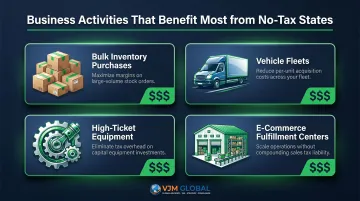
Business Activities That Benefit Most from Low-Tax States
- Bulk inventory purchases — higher volume means tax savings compound quickly at point of sale
- Vehicle fleets — commercial fleet acquisitions carry significant per-unit tax exposure in high-rate states
- High-ticket equipment — machinery, industrial tools, and capital equipment purchases amplify the rate difference in dollar terms
- E-commerce fulfillment centers — locating distribution hubs in no-tax or low-tax states can reduce ongoing operational costs
Frequently Asked Questions
How many states do not have a state sales tax?
Exactly five states have no statewide sales tax: Alaska, Delaware, Montana, New Hampshire, and Oregon—collectively known as the NOMAD states. Of these, only four are fully sales-tax-free at all levels, since Alaska permits local municipalities to impose their own sales taxes.
What are the 5 NOMAD states?
NOMAD stands for New Hampshire, Oregon, Montana, Alaska, and Delaware—the five US states with no statewide general sales tax. The acronym is standard shorthand in tax and accounting circles.
Why is there no sales tax in some states?
States forgo sales tax when they can fund government services through alternative sources—such as income taxes, gross receipts taxes, natural resource revenues, or property taxes. Each NOMAD state relies on a distinct mix of these to cover public spending.
Which state in the USA is tax-free for shopping?
Oregon and Delaware are the most consistently tax-free for general retail shopping, as neither has state nor local sales taxes on most goods. New Hampshire is also widely sales-tax-free except for restaurants, hotels, and prepared food (8.5% Meals and Rooms Tax).
Which US states have the lowest sales tax?
After the five NOMAD states (0% state sales tax), states with the lowest combined rates include Hawaii (4.50%), Maine (5.50%), Wyoming (5.56%), and Wisconsin (5.72%), according to the Tax Foundation's 2026 data.
What is the most tax-friendly state?
"Most tax-friendly" depends on which tax you're measuring. For overall competitiveness, the Tax Foundation's State Tax Competitiveness Index consistently ranks Wyoming, South Dakota, and Alaska at the top—though income tax, property tax, and corporate tax all factor into the full picture.
Conclusion
The five NOMAD states offer clear advantages for businesses seeking to reduce transactional tax overhead, simplify compliance, and lower the cost of large purchases. However, the full tax picture always requires full evaluation. No-sales-tax does not equal no-tax-burden.
Each NOMAD state compensates through alternative revenue mechanisms: gross receipts taxes in Delaware, local sales taxes in Alaska, hospitality taxes in New Hampshire and Montana, and corporate income taxes across all five. Businesses must assess the total tax obligation—not just the absence of sales tax—before making location decisions.
For foreign companies and international businesses evaluating US operations, understanding state-level tax structures is one piece of a larger compliance picture. Cross-border structuring, transfer pricing, and entity selection all interact with where and how you operate.
VJM Global advises foreign investors, NRIs, and multinational businesses on international tax compliance and cross-border structuring — including for clients operating between the US, UK, Australia, and India. With 30+ years of experience and a team of 100+ accounting professionals, the firm helps businesses understand their full tax obligations across jurisdictions.
Contact VJM Global at [email protected] to discuss your cross-border tax planning needs.