Introduction
Singapore businesses expanding to the United States encounter a fundamental shift in tax frameworks. Accustomed to Singapore's 9% GST and familiar with VAT regimes across the UK, EU, and Australia, these companies expect a similar consumption tax structure — VAT numbers, input tax credits, and uniform national rules.
Instead, they find no federal VAT, no VAT registration number, and a patchwork of state-level Sales Tax obligations that operate on entirely different principles.
This disconnect creates costly mistakes. Singapore businesses commonly:
- Provide their GST registration number when a US partner requests a "tax ID"
- Charge GST on US invoices when no such obligation exists
- Miss state-level Sales Tax obligations entirely
These errors delay payments, trigger compliance penalties, and expose businesses to tax liabilities.
This article covers what Singapore businesses actually need to know: the structural difference between VAT and the US Tax ID (EIN/TIN), what to provide when a US counterpart requests a "VAT number," and when US Sales Tax obligations kick in.
Key Takeaways
- The USA does not operate a VAT system and issues no VAT numbers; no US equivalent exists
- US businesses are identified by an Employer Identification Number (EIN), a 9-digit federal tax ID used for income tax and banking, not consumption tax
- Singapore businesses must never charge GST or VAT on invoices to US customers; the US applies state-level Sales Tax, not seller-location VAT
- When a US partner requests a "VAT number," Singapore entities should provide their GST registration number with context; US entities provide their EIN
- Digital services or e-commerce sales into the US can trigger state-level Economic Nexus obligations above $100,000 in annual sales
VAT vs US Tax ID: Quick Comparison
| Attribute | VAT/GST (incl. Singapore) | US Tax ID (EIN + Sales Tax) |
|---|---|---|
| Tax System Type | Multi-stage consumption tax applied at each supply chain step | Federal business identifier (EIN) + one-time end-consumer Sales Tax at state level |
| Administered By | National tax authority (IRAS in Singapore) | Federal: IRS issues EIN; State: Each state administers own Sales Tax |
| Collected At | Every transaction stage with input tax credits | Point of final sale only, no credit mechanism |
| Business Identifier | VAT/GST Registration Number (for example, Singapore's UEN-based GST number) | EIN (XX-XXXXXXX format) for federal purposes; separate state permits for Sales Tax |
| Input Tax Recovery | Yes — businesses reclaim input tax against output tax | No — Sales Tax is borne entirely by end consumer |
| Registration Requirement | Single national registration | No national registration; separate permits needed per state where nexus exists |
| Cross-Border Validation | EU: VIES portal validates VAT numbers | No equivalent system; EINs cannot be validated in VIES |
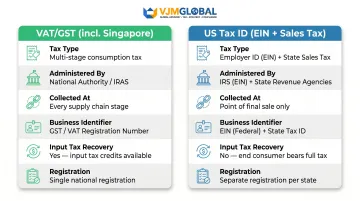
The table captures the headline differences — here's what each row means in practice for Singapore businesses.
Tax System
Over 170 countries worldwide operate VAT or GST systems, and Singapore's 9% GST follows the same staged collection model: each business in the supply chain charges tax on its value-added portion and can reclaim tax paid on purchases upstream.
The US works differently at a structural level. There is no national consumption tax. Sales Tax is applied once, at the point of final sale, and each state sets its own rules independently. The EIN is purely a federal business identifier — it has no role in tax collection.
Business Identifier
Singapore businesses are accustomed to a single national registration number. In the US, there are two separate layers:
- EIN — a 9-digit federal number (format: 12-3456789) issued by the IRS, used for income tax, payroll, and banking
- State Sales Tax permits — issued separately by each state where your business has nexus; no single national permit covers all states
This means a Singapore company selling into multiple US states may need to register in each one individually — a compliance requirement with no equivalent under Singapore's GST framework.
Input Tax Recovery
Under Singapore's GST, businesses reclaim input tax paid on purchases against output tax collected. If you're GST-registered, your net tax burden reflects only the value your business added — a familiar mechanism for most Singapore finance teams.
The US offers no equivalent. Sales Tax is a one-time cost absorbed entirely by the end consumer, with no credit or refund mechanism at any prior stage in the supply chain. For Singapore businesses selling B2B in the US, this distinction affects how you price, invoice, and account for US transactions.
What is VAT — and How Is It Different from Singapore's GST?
VAT is a multi-stage indirect tax charged at every stage of the supply chain. Each business charges tax on the value it adds and can reclaim tax paid on inputs. Singapore's GST operates identically at 9% (effective 1 January 2024), so Singapore businesses already understand the logic: input tax credits offset output tax, creating a net-zero burden for compliant businesses.
Approximately 170 countries operate VAT or GST systems, so when Singapore businesses expand to the UK, EU, or Australia, VAT registration requirements will feel familiar. The US is a deliberate exception.
VAT numbers are country-specific identifiers issued by national tax authorities:
- UK: GB + 9 digits (e.g., GB999999973)
- EU: 2-letter country code + 2-13 characters (e.g., DE123456789 for Germany)
- Singapore: UEN-based GST number (e.g., 200312345A)
These numbers enable cross-border validation. The EU's VIES system validates VAT numbers across member states, triggering the Reverse Charge rule for B2B transactions. The US has no equivalent system — US EINs cannot be validated through VIES, which is one reason US tax identification works so differently from VAT.
What is a US Tax ID? Understanding EIN, TIN, and State Sales Tax
The US federal tax system uses the Taxpayer Identification Number (TIN) as the umbrella term for all tax identifiers. For businesses, the primary TIN is the Employer Identification Number (EIN) — a unique 9-digit number (format: XX-XXXXXXX) issued by the IRS. Businesses use EINs for filing federal taxes, opening bank accounts, and identifying entities in all federal dealings.
Singapore companies operating in the US need an EIN if they establish a US legal entity (such as a Delaware LLC or C-Corp) or have US-sourced income requiring tax filings.
Key Types of US Tax IDs
- EIN (Employer Identification Number): For companies, LLCs, and partnerships
- SSN (Social Security Number): For US individuals
- ITIN (Individual Taxpayer Identification Number): For non-US persons with US tax obligations
Why the US Has No VAT: The Sales Tax Structure
Unlike Singapore's single national GST, US Sales Tax is administered at the state and local level, not federally. There is no single national registration: businesses may need separate Sales Tax permits in every state where they have nexus.
Five states have no state Sales Tax: Alaska (though local municipalities may impose it), Delaware, Montana, New Hampshire, and Oregon.
Economic Nexus: The Post-Wayfair Rule
The 2018 US Supreme Court ruling in South Dakota v. Wayfair established that businesses can trigger state Sales Tax obligations without physical presence.
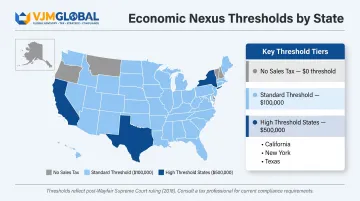
Once a remote seller exceeds a state's threshold — commonly USD 100,000 in annual sales — it must register, collect, and remit that state's Sales Tax.
Every state with a Sales Tax now enforces Economic Nexus rules. For Singapore e-commerce or SaaS businesses selling directly to US consumers, crossing these thresholds creates immediate compliance obligations in that state. Thresholds vary:
- Most common: USD 100,000 in sales (transaction count thresholds are declining)
- Higher thresholds: California (USD 500,000), New York (USD 500,000), Texas (USD 500,000)
EIN Is Not a VAT Number
Do not provide an EIN as a substitute VAT number for EU or UK compliance purposes. An EIN will not validate in systems like the EU's VIES portal and does not activate mechanisms like the Reverse Charge. However, when a US partner asks for a "Tax ID," the EIN is the correct response.
What Singapore Businesses Should Know When Trading with the USA
B2B Scenario: Services to US-Registered Businesses
If a Singapore company sells services to a US-registered business, it generally does not charge GST or VAT on the invoice — the US buyer operates in a non-VAT jurisdiction. Singapore businesses should issue a zero-rated export invoice under IRAS rules per Section 21(3) of the GST Act, which allows 0% GST for qualifying international services supplied to overseas persons.
Key conditions for zero-rating:
- Service must fall within Section 21(3) categories
- Customer must "belong" outside Singapore (main seat of economic activity is overseas)
- For certain services, the overseas customer must not be in Singapore when the service is performed
One common point of confusion: your GST registration number is submitted to IRAS for compliance purposes — not provided to the US buyer as a "VAT number."
B2C / Digital Services Scenario: Direct Sales to US Consumers
Singapore businesses selling digital products, SaaS, or online services directly to US consumers do not charge VAT or GST to those customers. The US has no federal VAT — so no equivalent output tax applies at the point of sale.
However, state-level Sales Tax is a different matter. If your sales volumes exceed Economic Nexus thresholds, you may need to register for Sales Tax in specific states and collect it on behalf of those state authorities. Monitor these thresholds closely — once you exceed USD 100,000 in annual sales to customers in a given state, nexus obligations typically apply.
When a US Company Asks for Your "VAT Number"
Provide your GST Registration Number and clarify in writing:
"Singapore operates a GST system (not VAT), currently at 9%. Our GST Registration Number is [your number]. This serves the equivalent identification function for tax compliance purposes."
Setting Up a US Entity: When You Need an EIN
If your Singapore company establishes a US entity (e.g., Delaware LLC or C-Corp), you must obtain a US EIN. This is required for:
- Opening US bank accounts
- Filing US federal tax returns
- Hiring US employees
- Entering contracts with US counterparties
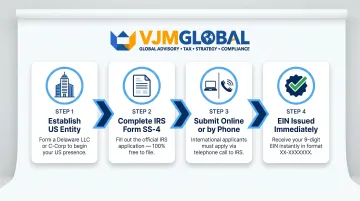
EIN Application Process:
- Form: IRS Form SS-4
- Cost: Free
- Method: Online application or telephone (international applicants only)
- Timing: Typically issued immediately for foreign entities
These requirements — Sales Tax nexus, GST zero-rating, and EIN obligations — each carry distinct deadlines and filing consequences. Consulting a qualified cross-border tax advisor before you scale US operations can prevent costly registration gaps or misfiling penalties.
Conclusion
The US does not issue VAT numbers. EINs and GST Registration Numbers serve fundamentally different purposes: one is a federal business identifier for income tax, the other is a consumption tax mechanism. They are not interchangeable.
Two distinct actions matter for Singapore businesses entering the US market:
- Correctly identify your business on US invoices using your GST registration number, classified correctly under IRAS Section 21(3) zero-rating rules
- Monitor whether your US sales volumes trigger state-level Economic Nexus obligations, requiring Sales Tax registration and collection in specific states
When complexity grows — multiple state registrations, treaty interpretations, or withholding tax questions — VJM Global's cross-border tax advisory team helps Singapore businesses stay compliant and avoid penalties across jurisdictions.
Frequently Asked Questions
Does the USA have VAT numbers?
No. The US does not operate a national VAT system and therefore no VAT numbers are issued by any US authority. The federal equivalent for business identification is the EIN, and consumption tax is handled through state-level Sales Tax, not a VAT mechanism.
Is a VAT number the same as an EIN, SSN, or other US tax ID?
No, these are entirely different systems. EINs are federal business identifiers used for income tax, payroll, and banking — not consumption tax collection. An EIN cannot be used in VAT validation systems like the EU's VIES portal.
How do I get or find a VAT number for a US business?
A VAT number for a US business does not exist. If an international partner requests one, a US business should provide its EIN instead, which serves as the federal tax identification equivalent for business transactions.
Do I charge VAT on an invoice to a US customer?
No. Singapore businesses do not charge GST or VAT on invoices to US customers. US sales are typically treated as zero-rated exports under Singapore's IRAS rules per Section 21(3). However, state-level Sales Tax obligations may apply depending on sales volume and business type.
What is a VAT invoice?
A VAT invoice is a formal document used in VAT-system countries that itemizes the tax charged, includes the seller's VAT registration number, and enables the buyer to reclaim input VAT. Since the US has no VAT system, this document type is not used in US domestic transactions.