For Indian and South Asian entrepreneurs, NRIs, and international investors, this combination of supply, port infrastructure, and export demand makes Dubai a genuinely attractive place to build a scrap trading business — not just in theory, but in practice.
This guide walks through what starting a scrap business in Dubai actually involves: the models, the licenses, the costs, and the compliance requirements.
Key Takeaways
- A scrap business in Dubai can be structured as pure trading, processing, or export-focused; most operators combine all three
- Legal setup requires a trade license (DED mainland or free zone), an approved facility, and environmental clearance for certain materials
- Free zone licenses (JAFZA: AED 5,000–15,000/year; DMCC: AED 20,285/year) are cost-effective for export-focused operators
- Non-ferrous metals — copper, aluminium, brass — consistently yield the highest margins
- Total startup investment for a small-to-medium operation typically falls in the AED 50,000–150,000 range, including working capital
What Is a Scrap Business in Dubai?
A scrap business sources recyclable or discarded materials — primarily metals — then sorts, processes, or resells them to manufacturers, recyclers, or export buyers. Scrap traders connect waste generators with material consumers, buying where supply is available and selling where demand is highest.
The three main operational formats:
- Pure trading — buy scrap from construction sites, factories, or dismantlers; resell to local recyclers or export buyers without significant processing
- Processing and recycling — add value through sorting, cutting, baling, or shredding before resale; higher margins but more equipment and approvals required
- Export-focused operations — aggregate, containerise, and ship to South Asian or East African buyers; suits businesses near Jebel Ali Port
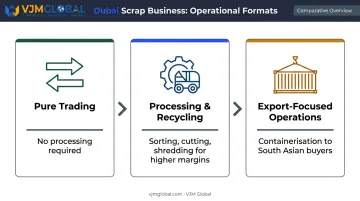
Most businesses in Dubai operate some mix of these — typically starting with trading and adding processing capability as volumes and capital grow.
Why Dubai Makes Sense for This Business
Three structural advantages set Dubai apart from other regional markets.
Export access to the world's largest scrap buyers. India imported 11.76 MMt of ferrous scrap in 2023. Pakistan and China are similarly active buyers. Dubai sits at the geographic midpoint, and Jebel Ali Port handled a record 1.4 million TEUs in July 2024 — the logistics infrastructure to move container-load shipments efficiently is already in place.
Growing domestic supply. Dubai Chamber recorded 7,434 new construction companies registering as members in 2024, a 33% increase year-on-year. More construction means more demolition, more metal offcuts, and more industrial waste — the raw material base for scrap trading keeps expanding.
Policy tailwinds. The Dubai Integrated Waste Management Strategy 2021–2041 and the UAE Circular Economy Policy 2021–2031 create a policy environment that actively supports recycling businesses. Together, they include:
- AED 74.5B total budget under the Dubai waste strategy
- AED 70.5B earmarked for private-sector participation
- A national mandate to expand circular economy activity through 2031
For a scrap trading business, this translates to real institutional incentives: government-backed demand, private capital flow, and a regulatory framework built to encourage exactly this kind of operation.
What to Know Before You Start
Many first-time entrants underestimate what the early phase involves. Set realistic expectations on these four points:
- Capital requirements: Warehousing, forklifts, weighing scales, cutting tools, worker safety gear, and working capital to buy materials before reselling can push total investment well above AED 100,000 before you've traded a single container.
- Price volatility: A business that buys at one price and sells at another faces real margin risk if markets shift during the holding period. LME benchmarks for copper, aluminium, and steel scrap are publicly available — track them before building your pricing model.
- Environmental clearance: Businesses handling e-waste, batteries, or hazardous industrial scrap need clearance from Dubai Municipality. The process takes time and adds cost — factor both into your setup plan.
- Sourcing timeline: Most businesses don't have steady supply from day one. Construction contractors and demolition firms prefer dealing with established, licensed operators. Plan your cash flow accordingly for the first 3–6 months.
How to Start a Scrap Business in Dubai — Step by Step
Step 1 — Choose Your Business Model and Scrap Type
Start by deciding what the business will actually do. The license type, location requirements, and approvals you need all depend on this.
Key scrap categories and their characteristics:
| Category | Price Point | Key Buyers | Notes |
|---|---|---|---|
| Ferrous (iron, steel) | Lower per kg | Indian/Pakistani smelters | High volume, strong local supply |
| Non-ferrous (copper, aluminium, brass) | Higher per kg | China, India, Pakistan | Best margins for export |
| E-waste | Variable | Specialist recyclers | Requires environmental clearance |
| Construction & demolition | Mixed | Local recyclers | Easy sourcing, lower value |
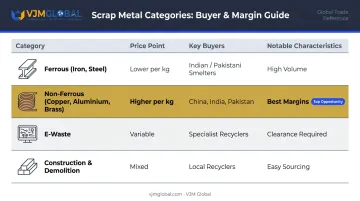
The most common mistake here is launching as a general scrap trader without a defined sourcing strategy or a buyer relationship in place. Businesses that gain traction quickly are those that have at least one anchor supplier or buyer lined up before they open.
Step 2 — Decide on Jurisdiction: Mainland or Free Zone
This decision shapes your operating flexibility and your costs.
Mainland (DED): Allows direct trading with UAE-based clients and government projects. Requires an approved industrial space and typically involves higher setup costs. Better suited for businesses targeting local construction and manufacturing buyers.
Free Zone (JAFZA or DMCC): Offers 100% foreign ownership, tax advantages, and streamlined export procedures. JAFZA is particularly relevant given its proximity to Jebel Ali Port. Limits direct local trading — you'll need a distributor arrangement to sell to UAE-based clients.
A practical rule: If your primary revenue will come from exporting to India, Pakistan, or China, a free zone setup often makes more commercial sense. If you're primarily selling to local manufacturers and recyclers, mainland gives you more flexibility.
The common mistake is defaulting to a free zone without checking where your actual revenue will come from — then discovering the distributor requirement adds cost and friction to your local sales.
Step 3 — Register Your Business and Obtain the Required License
Core registration steps:
- Reserve a trade name (DED guidelines prohibit offensive, religious, or duplicate names)
- Submit the license application with required documents
- Obtain initial approval
- Sign the Memorandum of Association if setting up as an LLC
- Pay license fees and collect the license
Documents typically required:
- Passport copies of all shareholders
- Tenancy or lease agreement for premises
- Trade name reservation certificate
- Initial approval certificate
- Dubai Municipality approval
- Environmental clearance (if handling hazardous or recyclable waste)
- Dubai Customs clearance for import/export activities
Current license fee ranges (verified official figures):
- JAFZA trading license: AED 5,000–8,500/year (up to 2 activity groups); General Trading: AED 15,000/year
- DMCC standard trading license: AED 20,285/year; General Trading: AED 50,265/year
- DED mainland fees: check current rates directly with DED eServices — scrap-specific schedules aren't published centrally
Step 4 — Secure Your Facility and Set Up Operations
Scrap businesses need industrial or warehouse space with zoning approval for scrap storage and processing — a standard office won't qualify. Common locations include Al Quoz, Ras Al Khor, and the Jebel Ali Industrial Area.
Warehouse rents in Al Quoz run approximately AED 25–40 per sq ft per year depending on size and amenities. For a meaningful operating yard, budget AED 30,000–100,000+ annually for the facility alone.
Minimum equipment for day-one operations:
- Certified weighing scales (mandatory for any trading operation)
- Basic sorting tools and safety gear
- Transportation — owned or contracted trucks for collection and delivery
Processing equipment (shredders, balers, cutting machines) can be added once volumes justify the investment. A used forklift runs AED 36,000–80,000 depending on type and age.
Critical: Don't rent warehouse space and begin operations before obtaining Dubai Municipality's location approval and any required environmental clearance. Doing so can delay or invalidate your license and force a costly relocation.
Step 5 — Build Supplier Networks and Find Buyers
Primary supply sources in Dubai:
- Construction and demolition contractors
- Manufacturing plants and industrial facilities
- Automobile dismantlers
- Waste management companies
Most of these suppliers prefer dealing with licensed, formally registered operators — another reason to get your paperwork in order before approaching them.
Buyer profiles:
- Local: smaller recyclers, manufacturers, fabrication shops
- Export: smelters and manufacturers in India, Pakistan, China, and East Africa who typically buy in container loads
Build buyer relationships in parallel with supplier development. Arriving at a buyer conversation with actual supply capability — even one regular source — is far more productive than pitching a business that exists only on paper.
Step 6 — Manage Compliance, Pricing, and Growth
Ongoing compliance requirements:
- Annual license renewal
- Environmental audit requirements (where applicable)
- Worker safety standards under UAE labor law
- Accurate customs documentation for all export shipments
For pricing, track LME benchmarks for copper, aluminium, and steel scrap regularly. Where possible, build contracts with both a base rate and a price adjustment clause so your margin isn't fully exposed to commodity swings.
For businesses trading between UAE and India — a significant share of Dubai's scrap export activity — the India-side compliance picture matters as much as the UAE side. FEMA regulations govern how foreign exchange is remitted and received, GST applies to import transactions, and customs documentation needs to be accurate at both ends.
This is where many UAE-based traders run into trouble. Getting the India-side structure right — FEMA compliance, GST registration, and cross-border tax treatment — requires separate attention from a firm that understands both jurisdictions. VJM Global supports NRI entrepreneurs and UAE trading businesses on exactly this, covering FEMA advisory, GST handling, and international tax structuring for India-side operations.
Costs, Licenses, and Legal Setup at a Glance
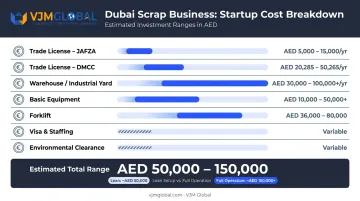
| Cost Category | Estimated Range | Notes |
|---|---|---|
| Trade license (JAFZA) | AED 5,000–15,000/year | Official published rates |
| Trade license (DMCC) | AED 20,285–50,265/year | Standard to General Trading |
| Warehouse / industrial yard | AED 30,000–100,000+/year | Varies by size and location |
| Basic equipment | AED 10,000–50,000+ | Scales, tools, safety gear |
| Forklift | AED 36,000–80,000 | New or used marketplace rates |
| Visa and staffing setup | Variable | Establishment card, medical, visas |
| Environmental clearance | Variable | Depends on materials handled |
Tax Obligations to Plan For
UAE corporate tax is 0% on taxable income up to AED 375,000 and 9% above that threshold, effective for financial years starting on or after 1 June 2023. VAT registration becomes mandatory once taxable supplies exceed AED 375,000. Factor both into your financial projections before you launch.
What to Budget Overall
A small-to-medium scrap trading operation — covering license, facility, equipment, visas, and working capital — typically requires between AED 50,000 and AED 150,000 to get off the ground. A lean free zone setup with contracted logistics sits at the lower end; a mainland operation with owned equipment and a full industrial yard pushes toward the higher end.
Frequently Asked Questions
Is scrap business profitable in Dubai?
Yes, particularly for non-ferrous metals like copper and aluminium where per-kg margins are notably higher. Profitability depends on sourcing efficiency, pricing discipline, and the strength of export buyer relationships — it requires active market monitoring, not passive management.
How much is 1 kg of scrap metal in Dubai?
Prices fluctuate with global commodity markets and vary significantly by material type. Fastmarkets publishes a UAE domestic ferrous scrap index; LME provides benchmarks for copper and aluminium. For current AED/kg rates, check directly with active Dubai scrap traders — published figures go out of date quickly.
Which scrap is most profitable in Dubai?
Non-ferrous metals — copper, aluminium, and brass — consistently command the highest prices due to industrial demand and recyclability. UAE copper scrap exports reached $868M in 2023, nearly 60% more than ferrous scrap by value. E-waste can yield high returns from recovered precious metals, but requires specialised handling and additional approvals.
What license is required to start a scrap business in Dubai?
A commercial trading license from the DED (mainland) or a relevant free zone authority such as JAFZA or DMCC. Scrap-specific activities may also require environmental clearance from Dubai Municipality, particularly for e-waste, batteries, or hazardous industrial materials.
Can a foreigner own 100% of a scrap metal business in Dubai?
Yes. Free zone registration (JAFZA, DMCC) provides 100% foreign ownership by design. Recent mainland reforms also allow full foreign ownership for many trading activities. Verify eligibility for specific scrap-related activity codes with DED before committing to a jurisdiction.
How long does it take to set up a scrap metal business in Dubai?
DMCC registration typically takes around 10 working days once documents are in order; JAFZA estimates 3–14 business days. Businesses requiring environmental approvals or warehouse location clearance should allow 4–8 weeks total.