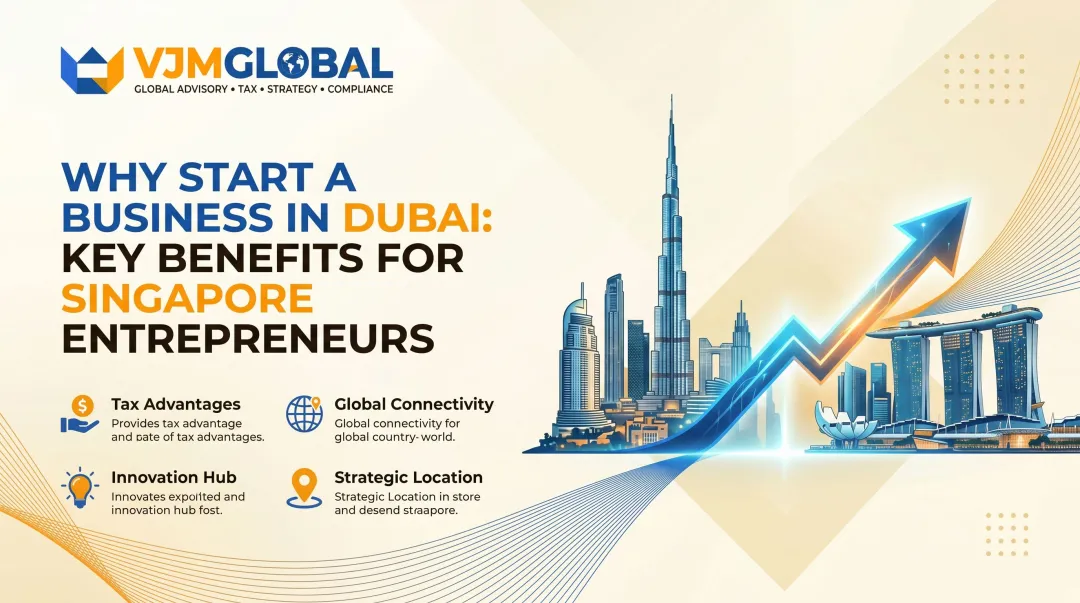
Dubai and Singapore aren't rivals—they're complementary hubs. Both offer pro-business environments, English-language operations, and world-class infrastructure. What makes Dubai compelling is its ability to unlock markets that Singapore can't easily access: the Middle East, Africa, and Eastern Europe. While Singapore dominates the Asia-Pacific corridor, Dubai provides a second headquarters that manages different time zones and geographic regions, effectively doubling your global coverage within a single workday.
This guide walks Singapore entrepreneurs through Dubai's concrete advantages, from tax structure to company formation, helping you choose the right setup and avoid common pitfalls during the expansion process.
Key Takeaways
- Dubai's 9% corporate tax (0% for qualifying free zone income) compares favorably to Singapore's 17% rate
- Full foreign ownership across most sectors—no local sponsor required in free zones or most mainland activities
- Free zone companies become operational in 1-5 business days through streamlined digital portals
- Dubai connects to 291 destinations across 110 countries, placing two-thirds of the world's population within an 8-hour flight
- The GCC-Singapore Free Trade Agreement provides preferential terms that ease trade and market access between the two hubs
Why Singapore Entrepreneurs Are Looking Beyond Home
Singapore's population of 6.11 million creates a natural ceiling for businesses that have saturated local demand. Layer in commercial real estate costs at record highs — Core CBD Grade A office vacancy fell to just 3.3% in Q1 2026 — and the economics of scaling domestically become difficult to ignore.
That's where Dubai enters the picture. A Dubai entity can handle Middle East, Africa, and European time zones while Singapore manages Asia-Pacific operations. This dual-hub structure means covering global markets around the clock — without night shifts or stretched response times.
The Lifestyle and Operational Parallel
Singapore entrepreneurs already understand how to operate in a modern, multicultural, rule-of-law environment. Dubai offers a comparable quality of life with several additional benefits:
- Zero personal income tax versus Singapore's progressive tax structure
- Lower commercial real estate costs in many segments compared to Singapore's premium rates
- Similar expat-friendly infrastructure and English-language business environment
- Over 600 Singaporean companies already operating in the UAE, with active business communities in Dubai's free zones
The operational environment is familiar. The tax position is not — and that difference compounds quickly once you're trading across the Gulf, Africa, and Europe from a single base.
Why Dubai Is the Best Place to Start a Business
Tax Advantage in Plain Numbers
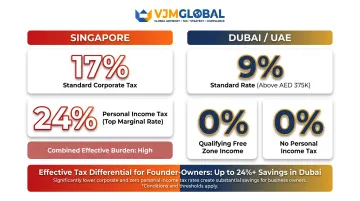
Corporate tax comparison:
- Singapore: 17% flat corporate tax rate
- Dubai: 9% on taxable income above AED 375,000 (approximately USD 102,000), with 0% below that threshold
- Dubai free zones: 0% corporate tax on qualifying income for Qualifying Free Zone Persons
Personal income tax:
- Singapore: Progressive rates up to 24%
- Dubai: 0% personal income tax
For founder-owners, the gap is significant. A Singapore entrepreneur paying out SGD 500,000 in qualifying profits could face a combined effective rate exceeding 35% when corporate and personal taxes stack. The equivalent payout from a Dubai free zone entity: zero.
Qualifying income includes:
- Transactions with other free zone persons
- Manufacturing operations
- Commodity trading
- Holding shares and fund management
- Headquarter services and logistics
100% Foreign Ownership Explained
Federal Decree-Law No. 32 of 2021, effective January 2, 2022, removed the requirement for a 51% Emirati partner in most mainland sectors. This eliminated a historic barrier that previously forced foreign investors to give up majority control or restrict themselves to free zones.
What this means for Singapore investors:
- No mandatory local sponsor for over 1,000 approved business activities
- Free zones have always offered 100% foreign ownership
- Full control over decision-making, profit distribution, and company direction
- Exceptions remain for security, defense, certain banking activities, and strategic sectors
In practice, Singapore entrepreneurs can now structure Dubai mainland companies the same way they would at home — full ownership, full control, no compromise on governance.
Strategic Location at Three-Continent Crossroads
Dubai International Airport connects to 291 destinations across 110 countries, recording 95.2 million passengers in 2025. Emirates states Dubai sits "within an eight-hour flight of two-thirds of the world's population."
Geographic markets accessible from Dubai but difficult from Singapore:
- Gulf Cooperation Council (GCC) countries
- Sub-Saharan Africa
- Eastern Europe
- Central Asia
Jebel Ali Port, described as the world's largest man-made harbour, provides over 80 weekly services connecting more than 150 ports globally. The UAE's re-export operations reached AED 830.2 billion (USD 226 billion) in 2025, up 15.7% year-on-year, positioning the country among the top five globally for re-export operations.
That trade infrastructure is backed by a regulatory environment built to move quickly — and that's where Dubai's setup process stands apart.
Business-Friendly Regulatory Environment
Speed of setup: Free zones like IFZA issue licenses within 1-5 business days once documentation is submitted. Mainland setups through the Dubai Department of Economy and Tourism (DET) typically take 1-2 weeks.
Digital infrastructure: The DET maintains a searchable portal of over 3,000 approved business activities. Most registration, licensing, and compliance processes run through online portals with minimal physical paperwork.
English common law framework: The Dubai International Financial Centre (DIFC) operates under English common law, with its own independent court system. For Singapore entrepreneurs accustomed to a British-derived legal system, this feels immediately familiar—contracts, dispute resolution, and regulatory frameworks follow recognizable patterns.
Intellectual property protection: Clear IP registration and enforcement mechanisms protect trademarks, patents, and copyrights under frameworks that align with international standards.
Singapore-UAE Trade Framework
The Singapore-UAE relationship rests on two formal agreements: the GCC-Singapore Free Trade Agreement (in force since 2013) and a broader Comprehensive Partnership signed in February 2019, which expanded cooperation into new economy sectors and entrepreneurship.
Trade corridor strength:
- Bilateral merchandise trade totaled S$27.94 billion in 2025
- Over 600 Singaporean companies operate in the UAE
- Formal government-to-government engagement on reducing trade barriers
With 600+ Singapore companies already operating in the UAE and bilateral trade pushing S$28 billion, this isn't an emerging corridor — it's an established one with institutional support on both ends.
Free Zone vs. Mainland: Choosing the Right Setup for Singapore Entrepreneurs
| Factor | Free Zone | Mainland |
|---|---|---|
| Foreign ownership | 100% (always permitted) | 100% in most sectors since 2021 |
| UAE market access | Restricted—requires local distributor or dual license | Full direct access |
| Corporate tax | 0% on qualifying income; 9% on non-qualifying | Standard 0%/9% regime |
| Government contracts | Generally not eligible | Eligible to bid |
| Setup cost (example) | From AED 12,900 (~USD 3,500) | Higher; varies by activity |
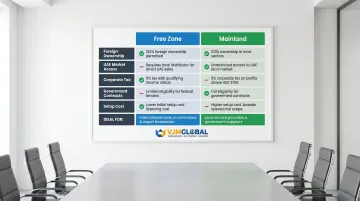
Free Zone Advantages
Free zone companies enjoy sector-specific infrastructure, full foreign ownership, 0% corporate tax on qualifying income, and easy profit repatriation. The trade-off: direct sales to UAE domestic customers require a local distributor, mainland branch, or dual license.
Best for:
- Consultancies serving international clients
- Technology firms with SaaS or digital products
- Trading companies focused on GCC and Africa markets
- Regional headquarters managing Middle East operations
Mainland Advantages
If your target is the UAE's 10-million-strong domestic market, mainland is the right structure. Mainland companies trade freely across the entire UAE, bid for government contracts, and open physical retail or service outlets anywhere in the country.
Best for:
- Retail operations serving UAE consumers
- Professional services firms targeting local businesses
- Companies bidding for government tenders
- Businesses requiring physical storefronts
Practical Considerations Singapore Entrepreneurs Miss
A few details that catch Singapore founders off-guard:
- Office space: Free zones require physical presence—even a flexi-desk counts, and costs run well below Singapore's equivalent.
- Minimum capital: Some free zones impose minimum capital thresholds. Check your specific activity code before finalizing your budget.
- Total first-year costs: In affordable free zones like IFZA, all-in first-year costs often land below Singapore's comparable setup and operational expenses, particularly once tax savings are factored in.
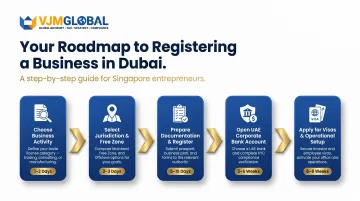
How to Start a Business in Dubai as a Singapore Entrepreneur
Step 1: Choose Your Business Activity and Structure
Dubai's Department of Economy and Tourism (DED) for mainland, or the relevant free zone authority, lists thousands of licensed activities. Singapore entrepreneurs should:
- Identify your current Singapore Standard Industrial Classification (SSIC) code
- Map it to the nearest UAE activity using the DET activity search portal
- Verify that your activity is eligible for 100% foreign ownership (most are)
- Confirm whether your activity requires free zone or mainland licensing
Step 2: Select a Jurisdiction and Free Zone
| Free Zone | Best For | Scale | Setup Cost Range |
|---|---|---|---|
| DMCC | Commodities, trading, general enterprise | 26,000+ companies from 180 countries | Medium to high |
| DIFC | Financial services, fintech, asset management | ~8,840 active firms | Premium |
| Dubai Internet City | Technology, ICT, digital media | 4,000+ companies | Medium |
| IFZA | Cost-conscious SMEs and startups | Growing | From AED 12,900 |
DMCC: Voted the world's #1 free zone for nine consecutive years, accounting for 15% of all foreign direct investment in Dubai. Ideal for trading, commodities, and businesses seeking premium infrastructure.
DIFC: Operates under English common law with independent courts and the Dubai Financial Services Authority (DFSA) as regulator. Houses the region's FinTech Hive accelerator, making it the natural home for financial services and fintech companies. DIFC registered 1,924 new companies in 2025 alone.
Dubai Internet City: Home to Microsoft, Google, Meta, Oracle, LinkedIn, and Cisco, this zone offers sector-specific networking and infrastructure for technology companies.
IFZA: Budget-friendly option for startups and SMEs not requiring sector-specific infrastructure or premium networking.
Step 3: Prepare Documentation and Register
Typical documents required:
- Passport copies of all shareholders and directors
- Proof of address (utility bill or bank statement)
- Proposed company name (check availability first)
- Business plan (required for certain activities)
- Shareholder resolution if the Singapore company will be the parent entity
- Bank reference letters
You handle most submissions through online portals. The free zone authority becomes your main regulatory contact and processes your application, issues your trade license, and coordinates visa arrangements.
Step 4: Open a UAE Corporate Bank Account
Bank account opening typically takes 6-8 weeks — and approximately 30% of first applications face rejection due to heightened KYC/AML compliance. Plan for this step early; it's the most common cause of delays for Singapore entrepreneurs.
Required documents:
- Valid trade license
- Memorandum of Association
- Passports and Emirates IDs of shareholders
- Proof of address for beneficial owners
- Personal bank statements (3-6 months)
- Business plan explaining revenue model and customer base
- Audited financial statements from Singapore operations
Tips to accelerate approval:
- Have clear source-of-funds documentation ready
- Prepare detailed business plan explaining target markets
- Consider digital-first banks like Wio Bank or Mashreq NeoBiz (1-2 week processing)
- Traditional banks include Emirates NBD, ADCB, Mashreq, FAB, and RAKBANK
Step 5: Apply for Visas and Operational Setup
Three visa categories matter most for Singapore entrepreneurs setting up in Dubai:
- Investor/partner visas: Available through your free zone or DED, these grant 2-3 year residence visas renewable based on company status
- UAE Golden Visa: A minimum AED 2 million real estate investment qualifies for a 5-year visa; AED 500,000 in a verified venture may qualify for 10 years
- Employee sponsorship: Your UAE entity can sponsor staff, with quotas and costs varying by jurisdiction
For Singapore entrepreneurs who also have India-facing operations or cross-border tax structures, advisory support becomes especially valuable at this stage. VJM Global brings 30+ years of experience in international taxation, FDI advisory, and cross-border structuring for businesses expanding across multiple jurisdictions — helping clients align entity structures with their broader Asia and Middle East strategies.
Best Industries for Singapore Entrepreneurs in Dubai
Technology and Fintech
Singapore has produced world-class fintech and SaaS companies, and Dubai has emerged as the MENA region's leading fintech hub — a natural expansion path for both.
MENA fintech attracted USD 644 million across 124 deals in 2024, with the UAE leading at 46 deals. Despite a 49% year-on-year funding decline (reflecting a global venture correction), deal count actually rose 11%. Q1 2025 alone recorded USD 372 million from 42 deals — already exceeding half of full-year 2024 capital.
Singapore tech founders find traction in Dubai for several practical reasons:
- DIFC FinTech Hive provides accelerator programs and regulatory sandboxes
- UAE's open banking push and digital transformation agenda drive consistent demand
- Payment solutions startups attracted USD 196 million in 2024 alone
- Established digital infrastructure supports rapid SaaS deployment
Logistics, Trade, and Supply Chain
Singapore entrepreneurs in trading, e-commerce logistics, or supply chain management can leverage Dubai's infrastructure to serve adjacent markets. Jebel Ali Port provides over 80 weekly services to 150+ ports globally.
The market scale is significant:
- UAE non-oil foreign trade surpassed USD 1 trillion in 2025
- Re-exports reached USD 226 billion, up 15.7% year-on-year
- Direct access to Africa and South Asia — markets adjacent to Singapore's existing trade corridors
- Free zone warehousing and re-export infrastructure reduces operational complexity
Singapore trading companies already understand cross-border compliance, documentation, and multi-leg logistics. Dubai extends that capability westward into markets that are time-zone and freight-challenged from Singapore — effectively doubling their geographic reach.
Professional Services and Consulting
Dubai's rapidly growing SME base creates strong demand for accounting, legal, HR, and management consulting services. Dubai SME facilitated the launch of 3,461 new Emirati businesses in 2024, bringing the total to 19,904 supported enterprises. The target is 27,000 by 2033.
Singapore professional services firms are well-positioned to serve this demand:
- International credibility and English-language operations translate directly
- Accounting, compliance, and advisory skills transfer with minimal adaptation
- Proven service delivery frameworks apply across GCC client engagements
- DIFC's growth (1,924 new firms registered in 2025) generates concentrated demand for legal, accounting, and compliance services
Singapore accountants and consultants already work with international standards. Dubai clients value this expertise, particularly when navigating cross-border operations between GCC markets and Asia-Pacific.
Frequently Asked Questions
Why is Dubai so good for business?
Dubai combines a 9% corporate tax rate (with 0% on qualifying free zone income), no personal income tax, and 100% foreign ownership in most sectors — backed by modern ports, airports, and digital infrastructure. Its geographic position connects businesses to over 2 billion consumers across the Middle East, Africa, and Europe.
How does Dubai compare to Singapore as a business hub?
Both cities offer rule of law, English-language business environments, and strong global connectivity. Dubai adds lower tax rates and access to Middle East and African markets, while typically offering lower commercial real estate costs — making the two hubs complementary rather than competing options.
Can Singapore citizens own 100% of a company in Dubai?
Yes, Singapore citizens can own 100% of a business in Dubai's free zones (always permitted) and in most mainland sectors following the 2021 UAE Companies Law amendments. There is no longer a mandatory requirement for a local Emirati partner in the vast majority of activities.
What is the corporate tax rate in Dubai compared to Singapore?
Dubai charges 9% corporate tax on taxable income above AED 375,000, with 0% below that threshold and extended exemptions for qualifying free zone income. Singapore's headline rate is 17%, representing a meaningful tax saving for profitable businesses operating through Dubai structures.
How long does it take to register a company in Dubai from Singapore?
Free zone registration takes 1-5 business days; mainland setups run 1-2 weeks. Bank account opening adds 6-8 weeks on top of that, so preparing KYC documentation early is critical.
Which Dubai free zones are best suited for Singapore entrepreneurs?
The right free zone depends on your sector:
- DMCC — trading and commodities businesses
- DIFC — financial services and fintech
- Dubai Internet City — technology and digital companies
- IFZA — cost-conscious SMEs and startups
Match your choice to your industry's infrastructure and networking needs.