The process looks straightforward in brochures: pick a name, submit documents, get a license. In practice, your costs, timeline, and ownership rights shift dramatically depending on whether you choose a mainland or free zone setup, plus which activities you select.
This guide walks through the exact steps, realistic costs, the mainland versus free zone decision, and the mistakes that trip up first-time applicants — including the cross-border tax questions that matter for NRIs and OCIs running these businesses.
Key Takeaways
- General trading licences cover multiple unrelated product categories, unlike standard licences capped at two
- Free zone setups start near AED 12,500; DMCC's General Trading Licence costs closer to AED 50,265
- Mainland licences grant unrestricted UAE market access; free zones add 100% foreign ownership and fast setup
- Alcohol, pharmaceuticals, weapons, and vehicles require separate government approvals regardless of jurisdiction
What Is a General Trading License in Dubai?
A general trading license is a commercial license that lets you buy, sell, import, export, and store multiple, often unrelated, categories of goods under a single registration. Think electronics one month, furniture and foodstuff the next, all legally covered by the same license.
This differs from a standard trading license, which restricts you to a narrower scope. JAFZA's own guidance notes that a regular trading license covers up to two product groups; anything beyond that is treated as general trading, according to JAFZA's guide on trading licenses. DMCC similarly positions its General Trading Licence as access to nearly all activities except oil, gas, and other regulated categories.
Who This License Actually Suits
This structure works best for:
- Wholesalers buying in bulk across multiple sectors
- Import-export businesses moving goods between countries
- E-commerce sellers listing diverse product catalogs
- Multi-category retailers avoiding separate licenses for each product line
Goods That Still Need Separate Approval
Even with a general trading license, some categories remain restricted:
- Alcohol (approval required from Dubai Police)
- Pharmaceuticals and medical products (Ministry of Health and Prevention)
- Certain chemicals (depends on classification)
- Vehicles (Ministry of Economy approval before licensing)
- Weapons and ammunition (Ministry of Interior/Dubai Police)
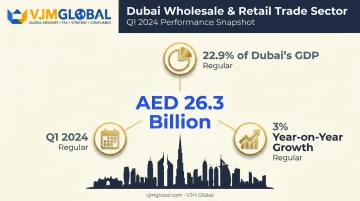
Even with these carve-outs, the addressable market for general trading remains vast. Dubai's wholesale and retail trade sector generated AED 26.3 billion in Q1 2024 alone, contributing 22.9% of the emirate's GDP and growing 3% year on year, according to Dubai's Q1 2024 economic report from the Department of Finance. That's a sizable pool of activity for anyone entering the trading space.
Step-by-Step Process to Get a General Trading License in Dubai
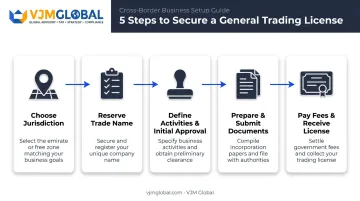
Step 1: Choose Your Jurisdiction
Your first decision shapes everything else. Mainland companies (regulated by the Department of Economy and Tourism) can trade freely across the UAE. Free zone companies get 100% foreign ownership and faster digital processing, but face restrictions on selling directly to mainland customers.
Dubai and the wider UAE host more than 20 free zones, each with its own industry focus, fee structure, and package options. Popular choices for general trading include DMCC, Meydan, and IFZA, but the "best" one depends entirely on your budget and target market.
Step 2: Select and Reserve a Trade Name
Your trade name must pass a duplicate-name check and avoid:
- Offensive, religious, or political references
- Names already registered to existing brands or government entities
- Terms incompatible with your chosen legal form or activity
Once reserved through Invest in Dubai's official checker, your name stays protected for 30 days. In specific cases, particularly names tied to personal brands or international trademarks, you may also need trademark registration or embassy approval before proceeding.
Step 3: Define Business Activities and Get Initial Approval
Business activity limits vary by authority rather than following one blanket UAE rule. Meydan's standard package, for instance, permits up to three activity groups under one license. Once you've selected your activities, you'll need initial approval: a green light to continue setup, though it doesn't yet authorize trading.
Important: Certain activities trigger mandatory external approvals (vehicles, food products, telecommunications) before you can move forward, so confirm this early to avoid delays.
Step 4: Prepare and Submit Documentation
Core documents typically include:
- Passport copies of all shareholders and officers (valid at least six months)
- Memorandum of Association (MOA) outlining ownership and structure
- Business plan (required by some free zone authorities, not all)
- Certificate of incorporation and board resolution (for corporate shareholders only)
Mainland setups additionally require an attested tenancy contract registered with Ejari. Free zones often simplify this with flexi-desk packages, letting you satisfy the premises requirement without a dedicated office.
Step 5: Pay Fees, Obtain Customs Code, and Receive License
If you're moving physical goods across borders, you'll need a Dubai Customs Business Code. The process involves submitting your trade license online, uploading supporting documents, and paying a nominal registration fee before receiving your customs code by email.
Once final license fees are settled, you'll receive your trade license, MOA, and share certificate — the documents that officially let you start operating.
Mainland vs Free Zone: Which Should You Choose?
This decision comes down to three factors: where you're selling, how much ownership control you want, and your budget.
| Factor | Mainland | Free Zone |
|---|---|---|
| Local UAE sales | Direct, unrestricted access | Requires mainland distributor or branch |
| Foreign ownership | Full ownership permitted for most activities under recent reforms | 100% foreign ownership as standard |
| Setup speed | Roughly a week with complete documents | Some licenses issued within a day |
| Premises | Physical tenancy with Ejari registration mandatory | Flexi-desk options available |
Consider your business model:
- Import-export or re-export focus: Free zones typically make more sense, with faster setup, lower entry costs, and no need to sell to local retail customers
- Direct UAE sales: Mainland removes the distributor middleman and the extra margin it eats into
There's no universally "correct" answer here. A trading company re-exporting textiles from Asia to Africa has very different needs than one supplying electronics to Dubai retailers.
Cost of a General Trading License in Dubai
Costs vary more than most first-time applicants expect, and jurisdiction is the biggest swing factor.
Free zone examples:
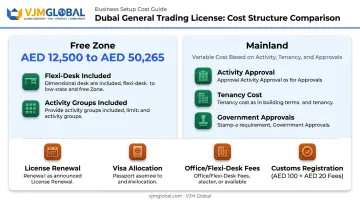
- Meydan's General Trading License starts at AED 12,500, including up to three activity groups and a flexi-desk, per Meydan's official guide
- DMCC's General Trading License carries a listed charge of AED 50,265, according to DMCC's schedule of charges (though this figure doesn't include every ancillary cost)
Mainland considerations:
There's no fixed statutory minimum capital requirement for mainland LLCs anymore. You declare capital sufficient to support your business purpose in the MOA rather than depositing a mandated cash figure. Total mainland costs depend heavily on your activity, premises, and required approvals, so confirming through the official Invest in Dubai calculator is your safest bet.
Recurring costs to budget for beyond the base license:
- License renewal fees (annual)
- Visa allocation costs, which scale with your facility type — DMCC's flexi-desk supports up to 3 visas, while serviced offices support 4–5
- Office or flexi-desk fees
- Customs registration (a modest AED 100 service fee plus AED 20 in Knowledge and Innovation fees)
First-year costs run higher than renewal years because you're paying one-time registration and approval charges alongside your standard license fee. Budget for this upfront so year-one cash flow doesn't catch you off guard.
Common Mistakes to Avoid When Applying
Even straightforward setups go sideways when applicants skip due diligence. Watch for these:
- Choosing jurisdiction on cost alone. A cheap free zone license means little if you can't reach your target customers without a mainland distributor eating your margins.
- Assuming general trading covers everything. Alcohol, pharmaceuticals, and chemicals still need separate government approvals — your license alone won't authorise these categories.
- Underestimating total spend. The base license fee is rarely the full story once you add visas, office space, and customs registration.
- Ignoring cross-border tax exposure. This one catches Indian-origin entrepreneurs off guard more than any other.
If you're an NRI or OCI running a UAE trading business while maintaining financial ties to India, dual compliance obligations don't disappear because you're licensed abroad. You may still face reporting requirements under India's Foreign Exchange Management Act (FEMA), and dual taxation risk on income earned in the UAE if your DTAA position isn't handled correctly.
Firms like VJM Global typically step in for the India-side compliance work: FEMA reporting, DTAA relief claims to avoid being taxed twice on the same trading income, and RBI approvals tied to outbound investment.
Getting this wrong doesn't just cost money in penalties. It can complicate future capital movement between the two countries.
Frequently Asked Questions
How to start a general trading company in Dubai?
Choose your jurisdiction (mainland or free zone), reserve a trade name, secure initial approval for your business activities, submit required documents, then pay fees to receive your license. The full sequence typically takes anywhere from a day to about a week.
How much does it cost to open a trading company in Dubai?
Costs vary widely by jurisdiction. Free zone options like Meydan start around AED 12,500, while DMCC's General Trading License charge alone runs AED 50,265. Mainland costs depend on activity, premises, and approvals rather than a fixed figure.
What is the difference between a general trading license and a trading license in Dubai?
A standard trading license typically limits you to one or two related product groups. A general trading license covers multiple, often unrelated, categories under a single registration.
Can a general trading license be used to trade all products?
No. Alcohol, pharmaceuticals, certain chemicals, weapons, and vehicles are excluded and require separate government approvals, regardless of your license type or jurisdiction.
Is it better to get a general trading license in mainland or free zone Dubai?
It depends on your priority. Mainland suits direct UAE market access without needing a distributor, while free zone setups offer 100% ownership and a faster launch, ideal for import-export focused businesses.
How long does it take to get a general trading license in Dubai?
Free zones can issue licenses within a day, some in under an hour through digital platforms. Mainland processing typically takes about a week once all documents are in order.