This opportunity draws a wide range of founders: Indian and South Asian entrepreneurs, Western expats already living in the UAE, and global solopreneurs who want a low-tax, internationally connected base. It is not a niche play for one type of business owner.
What this guide covers: what starting an online business in Dubai actually involves legally, the decisions you need to make before you begin, a step-by-step setup process, and the compliance realities that follow launch.
Key Takeaways
- Secure a trade license before operating — e-commerce, professional, or portal type, depending on your business model
- Mainland vs. Free Zone is the most consequential early decision — it affects costs, ownership, and market access
- Free zone licenses start from around AED 12,500/year, with total startup costs typically ranging from AED 15,000–40,000+
- Licensing takes 3–10 business days; budget an additional 2–6 weeks for business banking
- Dubai offers 0% personal income tax, 100% foreign ownership in free zones, and full profit repatriation
What "Starting an Online Business in Dubai" Actually Means
Many founders picture this as building a website and setting up payment processing — but that's only the surface. Starting an online business in Dubai means registering a business entity in the UAE, obtaining the correct trade license, and operating within the UAE's commercial and regulatory framework. Your website is one component of that structure, not the starting point.
Business Models That Require a License
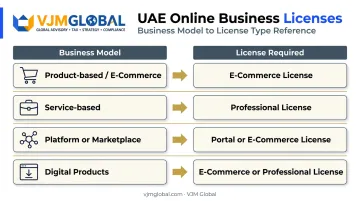
Different online business types map to different license categories:
- Product-based (e-commerce, dropshipping, physical goods) → E-Commerce License
- Service-based (consulting, digital marketing, coaching, training) → Professional License
- Platform/marketplace (connecting buyers and sellers online) → Portal or E-Commerce License
- Digital products (courses, SaaS, content subscriptions) → E-Commerce or Professional License depending on activity
Under UAE commercial law, operating without a valid license exposes you to fines, forced closure, and banking restrictions. You need a registered trade name, an active license, and a business bank account in place before you transact commercially.
What to Know Before You Start
The legal and operational groundwork in Dubai takes more time and attention than most founders budget for. Three areas tend to catch people off guard.
Time Investment in the Early Stages
Even a streamlined free zone setup involves multiple sequential steps: license application, document preparation, visa processing, and bank account opening. Expect 2–6 weeks before you can fully operate and transact — each step runs on its own approval clock and can't be rushed in parallel.
Ongoing Compliance After Launch
Setup is a one-time event. Compliance is ongoing:
- Trade license renewal — annually (most free zones issue 12-month licenses)
- VAT registration — mandatory once taxable supplies exceed AED 375,000
- Corporate tax — 9% on taxable profits above AED 375,000; qualifying free zone income may be eligible for 0% under specific conditions
- Record-keeping — audited financial statements required for free zone qualifying status
The Jurisdiction Decision Cannot Be Undone Cheaply
Choosing between Mainland and Free Zone affects your customer access, ownership structure, cost base, and tax position. Changing jurisdiction after setup involves cost and paperwork. Founders who switch jurisdictions post-setup typically spend AED 10,000–30,000+ in cancellation fees, re-registration costs, and lost setup time — making the initial decision one of the highest-stakes calls in the process.
Why Dubai Makes Sense for an Online Business
Dubai offers something rare: a globally credible legal base, one of the most tax-efficient corporate structures in the world, and direct access to the fastest-growing digital market in MENA — all in one jurisdiction.
The Market Opportunity
The UAE's e-commerce sector is growing fast. The UAE Digital Economy Strategy aims to double the digital economy's contribution to GDP — from 9.7% to 19.4% — within 10 years. Consumers here spend more per order than anywhere else in MENA.
Tax Structure
- 0% personal income tax — no tax on individual income in the UAE
- 0% corporate tax on qualifying free zone income — conditional on meeting UAE substance, audit, and activity requirements
- 9% corporate tax on taxable profits above AED 375,000 for non-qualifying income
- 100% repatriation of capital and profits for free zone businesses
The 0% free zone corporate tax rate applies only when specific substance and activity conditions are met — incorporating in a free zone alone is not sufficient for the exemption.
Infrastructure and Government Support
Dubai sits at the intersection of Europe, Asia, and Africa. Its logistics and courier networks are purpose-built for cross-border commerce.
Two government-backed free zones stand out for online businesses:
- Dubai CommerCity — the first free zone in MEASA dedicated exclusively to digital commerce
- Dubai Internet City — focused on tech and innovation, with infrastructure tailored to digital-first companies
Both reflect deliberate public investment in the digital economy, not just favorable geography.
Key Early Decisions: Jurisdiction, Structure, and License Type
Three decisions determine the shape of your entire setup. Most early problems trace back to making these choices without understanding the trade-offs.
Mainland vs. Free Zone vs. Offshore
| Setup Type | Key Characteristics | Best For |
|---|---|---|
| Mainland (DET) | Sell directly across UAE; most activities allow 100% foreign ownership; physical office required; 9% corporate tax above AED 375,000 | Businesses targeting UAE domestic consumers |
| Free Zone | 100% foreign ownership; simplified registration; potential 0% corporate tax on qualifying income; cannot sell directly into UAE mainland without a distributor | International/online-first businesses |
| Offshore | International asset holding; no UAE-based customer trading permitted | Holding structures only |
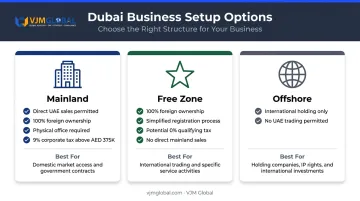
For most purely digital or service-based founders targeting international clients, a free zone setup is simpler and more cost-efficient. Over 20 specialized free zones operate in Dubai. Two worth comparing:
- Meydan Free Zone — lower-cost entry point for e-commerce and general digital activities
- Dubai CommerCity — built specifically for digital commerce, with tailored pricing structures
License Types for Online Businesses
Three main license types apply:
- E-Commerce License — selling goods or services via an online store, marketplace, or app
- Professional License — service-based businesses (consulting, marketing, training, coaching)
- E-Trader License — currently referenced by DET primarily for Emirati and GCC nationals; international founders should not assume eligibility
Common mistake: Choosing the cheapest license without confirming it covers your specific activity. Operating outside your licensed scope creates compliance risk.
How to Start an Online Business in Dubai: Step by Step
Step 1 – Define Your Business and Validate Demand
Before touching any applications, be clear on:
- What you are selling (product, service, or platform)
- Who your customer is — UAE domestic, MENA regional, or global
- Whether real demand exists at UAE price points
For product businesses, check Amazon UAE and Noon for volume and pricing signals. For service businesses, LinkedIn and direct outreach give better demand signals than assumptions. What sells well in another market does not automatically translate to UAE buying behaviour.
Step 2 – Choose Your Jurisdiction and Free Zone
Once you know your business model and target customer, choose your jurisdiction:
- Targeting UAE consumers → Mainland setup required
- International or purely online → Free zone is typically faster and cheaper
Within free zones, evaluate more than just the license price. Check visa allowances, office requirements, and what sector infrastructure the zone actually provides. Meydan suits lean solopreneurs and early-stage businesses. Dubai CommerCity suits established or scaling digital commerce operations.
Step 3 – Reserve Your Trade Name and Apply for Your License
UAE naming rules prohibit:
- Offensive or religious references
- Names similar to registered companies or government bodies
- Names referencing a person who is not a verified owner or partner
Reserve your name through DET (mainland) or your chosen free zone authority. Submit your license application with:
- Passport copy
- Passport-sized photos
- Trade name reservation certificate
- Business activity description
- Lease or office agreement
Free zone applications can be processed digitally within a few days. Mainland applications route through DET and may require additional approvals.
Step 4 – Secure Your Office Address and Visa
All UAE-registered businesses need a physical business address. Free zone options range from virtual offices and flexi-desks to full physical offices — your choice affects how many employee visas you can sponsor.
Once your trade license is issued, apply for your UAE residency visa. The license must be active before the visa application can proceed. Some free zones offer non-resident license packages for founders managing operations remotely — confirm this before applying if you plan to run the business from outside the UAE initially.
For NRI and OCI founders, this stage intersects with India-side obligations. Operating a UAE entity while managing India-linked income, remittances, or subsidiaries triggers FEMA compliance and DTAA considerations from early in the process. These run in parallel with your UAE setup and cover RBI filings, remittance structuring, and tax treaty treatment. VJM Global specializes in this cross-border advisory for Indian-origin founders and can handle the India-side compliance requirements alongside your Dubai registration.
Step 5 – Open a Corporate Bank Account and Set Up Payment Processing
Banking is the step founders most consistently underestimate. Account opening can take 2–6 weeks, and banks may decline applications without clear business activity documentation.
Major UAE banking options:
- Emirates NBD — online business account applications for UAE legal entities
- Mashreq NEO BIZ — requires trade license, MOA, address proof, and partner IDs
- HSBC UAE — corporate account portal available
- Abu Dhabi Commercial Bank — note that their e-Business account is primarily for Emirati and GCC E-Trader license holders
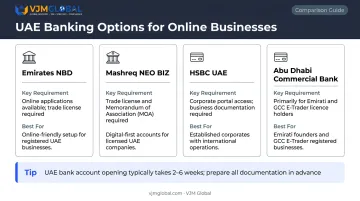
Prepare a detailed business plan and evidence of intended trading activity before approaching any bank.
For payment gateway integration, options operating in the UAE include:
- Telr — CBUAE-licensed gateway
- Network International — listed by CBUAE for retail payment services
- Stripe — launched UAE operations in 2021
- PayTabs — markets UAE payment services
Confirm your chosen gateway is compatible with your e-commerce platform and meets UAE Central Bank regulations.
Step 6 – Build, Launch, and Monitor
Build a mobile-optimised digital storefront with UAE-compliant privacy policies and integrated payment processing. If selling via Amazon UAE or Noon, set up your seller accounts — both platforms require a valid commercial trade license for professional sellers.
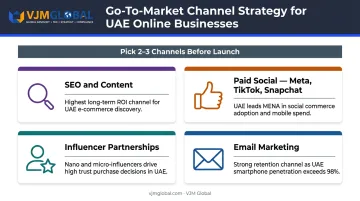
For go-to-market, pick two or three acquisition channels and build basic tracking before launch:
- SEO and content
- Paid social (Meta, TikTok, Snapchat are strong in UAE)
- Influencer partnerships
- Email marketing
After launch, keep these obligations on your calendar:
- Monitor revenue, customer feedback, return rates, and operating costs monthly
- Renew your trade license annually
- Register for VAT with the Federal Tax Authority once turnover crosses AED 375,000
Frequently Asked Questions
Can I start an online business in Dubai as a foreigner?
Yes. Foreigners can legally start and own an online business in Dubai. A valid trade license — e-commerce, professional, or portal depending on your business model — is required before you can operate commercially. UAE law prohibits commercial operation without one.
Which online business is best in Dubai?
The most viable options include:
- E-commerce and dropshipping
- Digital marketing services
- Online consulting
- Digital products (courses, SaaS)
- Subscription-based services
The best fit depends on your skills, target market, and available setup budget.
How much does it cost to start an online business in Dubai?
Free zone licenses start from around AED 12,500 per year (Meydan's published starting price). Total startup costs — including visa, office, and banking setup — commonly fall between AED 15,000 and AED 40,000 depending on jurisdiction and structure. Treat all figures as starting points and request dated quotations directly from your chosen free zone.
Do I need a UAE residency visa to run an online business in Dubai?
A residency visa is required if you plan to operate from Dubai. The visa is issued after your trade license is active. Some free zones offer non-resident license packages for founders managing operations remotely from outside the UAE.
What is the difference between a mainland and free zone setup?
Mainland businesses can sell directly to UAE consumers nationwide but require a physical office and are subject to standard corporate tax rates. Free zone businesses offer 100% foreign ownership and lower setup costs, but selling into the UAE mainland market requires a local distributor or fulfillment partner.
Can I sell on Amazon UAE or Noon without a Dubai license?
No. Both Amazon UAE and Noon require professional sellers to hold a valid commercial trade license. Operating as an unregistered commercial seller risks account suspension and potential penalties under UAE commercial law.