Interest is coming from every corner of the industry: VC-backed payment startups, established US payment processors, and remittance or lending platforms hunting for cross-border growth. This guide walks through jurisdiction selection, licensing, banking, and compliance, step by step.
TL;DR
- Pick a Payment Institution (PI) or Electronic Money Institution (EMI) license—EMI if you will issue e-money
- Use Lithuania, Germany, Ireland, or the Netherlands as the usual EU entry hubs for US fintechs
- Budget for regulator review as fast as ~3 months; full launch timelines still vary by country
- Treat ongoing AML, safeguarding, and reporting as equal priorities to the license itself
What to Know Before You Start
Before you commit capital, get clear on the structural and regulatory realities. Several hard requirements catch US founders off guard.
Plan for these realities from day one:
- A US entity can't simply "branch out" into the EU. You'll need a separate EU legal entity (subsidiary) to hold the license.
- Some jurisdictions require a locally resident director or compliance officer, which takes time and money to arrange.
- The clock on legally processing EU customer payments starts after licensing, not after incorporation. These are two very different milestones.
- Your business model might not need a full EMI/PI license at all. Operating as an agent or distributor of an already-licensed EMI can get you to market faster.
- A "narrow" PI license covers specific services only; a full license is built for scale.
Why Expand a Fintech Business to the EU
Think of this less as a guaranteed growth play and more as a set of conditions worth checking against your business model.
Euro-area non-cash transactions hit 77.6 billion in H2 2024 alone, up 8.6% year-over-year, with total value climbing to €116.9 trillion according to the European Central Bank's payments statistics. E-money payments specifically grew 15.8% in value. For founders chasing euro payment volume, the demand signal is clear.
Other reasons this expansion makes sense for the right founder:
- Passporting lets a single license cover all EEA countries, without separate licensing in each member state
- SEPA access gives you low-cost, fast euro-denominated transfers baked into the infrastructure
- Fintech hubs in Berlin, Amsterdam, and Vilnius offer real investor density
- MiCA and PSD2 offer regulatory clarity that beats navigating US state-by-state licensing patchwork
None of this guarantees traction. But if your model depends on euro-denominated payments or EU customer bases, the infrastructure is there to support it.
Choosing the Right EU Jurisdiction
This is the single most consequential decision in the entire process. It fixes your regulator, your licensing timeline, and your banking relationships for the life of the business.
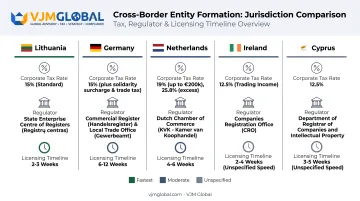
| Jurisdiction | Corporate Tax | Regulator | Licensing Timeline Evidence |
|---|---|---|---|
| Lithuania | 17% | Bank of Lithuania | 3 months after a complete file |
| Germany | ~30% (combined) | BaFin | No fixed end-to-end estimate published |
| Netherlands | 19–25.8% | DNB | 3-month statutory consideration period |
| Ireland | 12.5% trading income | Central Bank of Ireland | 90% of cases assessed within 90 business days |
| Cyprus | 12.5% | Central Bank of Cyprus | No fixed limit under new 2026 process |
Lithuania
Lithuania remains popular for payment-focused fintechs because the Bank of Lithuania publishes one of the clearest formal review clocks in the region: three months after submitting a complete application. That's a formal review period, not a guarantee of total launch time, since incomplete applications restart the clock. Operating costs tend to run lower than in Western Europe too.
Germany
BaFin runs on a "same business, same risks, same rules" philosophy. That means higher capital expectations and more compliance overhead, but also a regulatory reputation that carries real weight with banking partners and enterprise customers who care about credibility.
Netherlands & Ireland
The Netherlands offers the DNB/AFM InnovationHub, which provides regulatory guidance and direct access to supervisors. It's not a sandbox and won't waive any rules, but it's genuinely useful for founders trying to interpret ambiguous requirements. Ireland brings an English-speaking, CRO-based incorporation process that many US founders find easier to navigate than a civil-law jurisdiction.
This is exactly where cross-border structuring gets complicated fast. VJM Global works directly with the entity types and registries in Germany, the Netherlands, and Ireland: GmbH and UG formation through Germany's Handelsregister, B.V. incorporation via the Dutch KvK, and LTD/DAC formation through Ireland's CRO. US founders get a single point of contact across jurisdictions instead of juggling three separate local advisors.
So which country is "best"? It depends on what you're optimizing for: speed (Lithuania), credibility (Germany), or innovation support and English-language ease (Netherlands or Ireland). There's no universal answer.
How to Set Up a Fintech Company in the EU From the USA – Step by Step
Getting an EU fintech license from the US is a sequenced build: pick the right license, incorporate locally, file a complete application, lock in safeguarding, then passport across the EEA. Skip a step and you lose months.
Common mistakes to avoid:
- Choosing a jurisdiction on tax rate alone
- Underestimating minimum capital
- Waiting until after licensing to start banking conversations
Step 1 – Decide on Your License Type (PI vs EMI)
A Payment Institution (PI) license covers payment services. An Electronic Money Institution (EMI) license is required if you're issuing e-money or digital wallets.
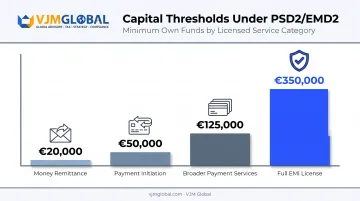
Capital thresholds vary by scope under PSD2/EMD2:
- €20,000 for money remittance only
- €50,000 for payment initiation only
- €125,000 for broader listed payment services
- €350,000 minimum for a full EMI license
Step 2 – Choose Your Jurisdiction and Incorporate a Local Entity
A US parent typically forms an EU subsidiary (a GmbH in Germany, a UAB in Lithuania, or a B.V. in the Netherlands) to hold the license. PSD2 requires the applicant to be a legal person established in a Member State, so your US entity itself can't apply.
Requirements vary:
- Ireland requires a registered office and at least one EEA-resident director (or a Section 137 bond as an alternative)
- Germany's GmbH requires €25,000 in minimum share capital and notarized articles filed through the Handelsregister
- The Netherlands requires a civil-law notary and KvK/UBO registration
Step 3 – Prepare Your Regulatory Application
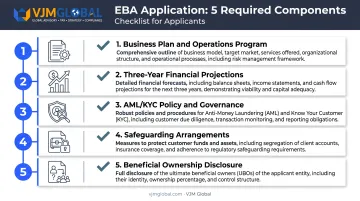
EBA guidelines require, at minimum:
- A business plan and program of operations detailing service categories and target countries
- Three years of financial projections, including budgets, balance sheets, and stress forecasts
- An AML/KYC policy and governance framework
- Safeguarding arrangements for customer funds
- Full beneficial ownership and qualifying-holding disclosure
Local legal and compliance counsel who know your target regulator's filing norms cut rejection risk and shorten review cycles.
Step 4 – Secure Banking and Safeguarding Accounts
PSD2 gives you two safeguarding options: segregating customer funds in a separate account at a credit institution, or covering them with insurance or a comparable guarantee. Traditional banks can be slow or reluctant with newly licensed fintechs; EMIs and fintech-friendly banks are often more receptive.
Step 5 – Build Your Compliance and Tech Infrastructure
Core build items include:
- AML/KYC transaction monitoring
- GDPR-compliant data handling
- PSD2-compatible open banking APIs
This is not a one-time project. It has to run continuously for as long as you hold the license.
Step 6 – Launch, Passport, and Scale Across the EEA
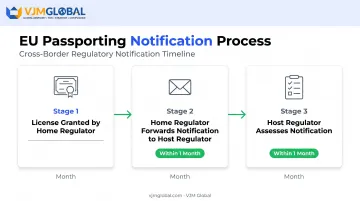
Once licensed, passporting lets you notify your home regulator and expand into other EEA states without re-licensing. The home authority forwards a complete notification to the host regulator within one month; the host then has another month to assess it. Plan for that notification window, not instant access.
After launch, annual reporting, capital adequacy checks, and safeguarding reconciliations matter as much as the initial setup. VJM Global supports the accounting and tax compliance side of those obligations for fintechs operating in Germany, the Netherlands, and Ireland, so multi-country reporting stays on schedule.
Common Compliance Pitfalls for US Founders
Most delays trace back to underestimating how deep EU compliance runs.
- Assuming US banking timelines apply. EU licensing-linked accounts often take longer than founders expect, especially with traditional banks unfamiliar with fintech risk profiles.
- Submitting incomplete beneficial ownership disclosure. AML rules require full transparency on ownership structure; gaps are a common cause of application delays.
- Underestimating ongoing reporting obligations. Annual capital adequacy checks and transaction reporting aren't optional extras. Missing them can jeopardize a license after launch.
Conclusion
Setting up a fintech company in the EU from the USA starts with matching your license type and jurisdiction to your actual business model, not the other way around. Use that lens when you weigh hubs:
- Speed: Lithuania
- Credibility: Germany
- Innovation support and English-language ease: the Netherlands or Ireland
Tax rate alone shouldn't drive the decision. Treat compliance as an ongoing operating function after launch, not a one-time setup task—and bring in multi-jurisdiction formation and compliance support early if you want local filings handled while you build the product.
Frequently Asked Questions
Which EU country is the best to register a company in?
It depends on your priorities. Lithuania suits founders who want fast, lower-cost EMI/PI licensing. Germany offers credibility and access to Europe's largest economy. The Netherlands and Ireland provide innovation support and easier English-language processes for US founders.
Do I need a physical office in the EU to get a fintech license?
Most regulators require a registered address, and some, like Ireland, require an EEA-resident director. A full physical office isn't always mandatory, but it depends on the jurisdiction.
How long does it take to get an EMI or PI license in the EU?
Lithuania's formal review runs around three months for a complete file. Germany and the Netherlands can take longer, and total preparation time before submission varies by founder readiness.
Can a US company own an EU fintech entity directly?
Yes, through a locally incorporated subsidiary. The license itself, however, must be held by the EU entity, not the US parent company.
What is EU passporting and why does it matter for fintechs?
A license obtained in one EEA country lets you operate across the entire EEA through a notification process, without applying for separate licenses in each country.
How much capital is required to start a fintech company in the EU?
PI capital requirements range from €20,000 to €125,000 depending on the specific services offered. A full EMI license requires a minimum of €350,000, depending on the jurisdiction.