A Singapore sole proprietorship is tied to an individual, not a corporate entity. That single fact changes everything about how a US business should approach this decision. The right path depends on whether you're sending a specific person to register personally, or whether your US company wants to hold the Singapore business itself.
This guide walks through eligibility rules, the exact registration steps, tax and compliance obligations, mistakes US founders commonly make, and when a Pte Ltd or branch office makes more sense than a sole proprietorship.
Key Takeaways
- Only an individual can own a Singapore sole proprietorship — a US company cannot be listed as owner
- Foreign owners need a local authorized representative and a Corporate Service Provider (no SingPass access)
- Registration is fast once documents are ready; referral-authority reviews can add weeks
- Profits face personal income tax rates, not corporate rates, and miss Pte Ltd start-up tax exemptions
Step-by-Step Guide: How US Companies Can Register a Sole Proprietorship in Singapore
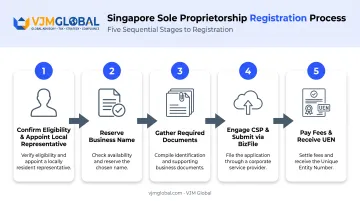
Step 1: Confirm Eligibility and Decide Who Will Be the Registered Owner
A sole proprietorship's owner must be an individual at least 18 years old, or in some cases an existing registered business entity, not a foreign corporation acting directly. If your US company wants to move forward, you need to first decide which specific person will register as the owner: a founder, a US employee relocating, or a consultant acting independently.
Because that owner lives overseas, ACRA requires a locally resident authorized representative. This person must be one of the following:
- A Singapore Citizen or Permanent Resident
- An Employment Pass, Personalised Employment Pass, or ONE Pass holder
- An EntrePass holder
Note that CPF and MediSave obligations attach to the owner if that owner is a Singapore Citizen or PR, not automatically to the authorized representative simply because of their title. Confirm which role triggers which liability before appointing anyone.
Step 2: Reserve Your Business Name
Name reservation happens through ACRA's BizFile portal and currently costs S$15, with approval valid for up to 120 days. After that window, the name is released back into the pool.
Avoid names that are:
- Identical to an existing or already-reserved business name
- Similar to government bodies or protected terms
- Undesirable under ACRA's guidelines (adding "The" or "Pte Ltd" to a conflicting name doesn't fix it)
Search existing trademarks before locking in a name — ACRA's process doesn't grant trademark protection, and a name clash discovered post-registration is expensive to fix.
Step 3: Gather the Required Documents
BizFile will ask for:
- Approved business name and eService number
- Intended start date and contact details
- A physical Singapore business address (P.O. boxes aren't accepted)
- For each position holder (owner and authorized representative): NRIC/FIN, full legal name, and date of birth
You'll also select an SSIC code (Singapore Standard Industrial Classification) describing your primary business activity, with an option to add a secondary one. Since a US-based owner won't have SingPass, your Corporate Service Provider will likely request passport and identity verification separately as part of their own onboarding — that's a firm-level requirement, not an ACRA upload.
Step 4: Engage a Corporate Service Provider and Submit via BizFile
This is the step that trips up most US founders. ACRA is explicit: foreigners without SingPass cannot self-file. You must engage a Corporate Service Provider (CSP), which files on your behalf using CorpPass credentials.
A CSP typically:
- Reviews your documents for completeness before submission
- Files the BizFile application under its own CorpPass access
- Communicates with ACRA if additional information is requested
If you don't have a local contact who can file directly, use a CSP with Singapore filing experience. VJM Global supports US founders with sole proprietorship registration and ongoing compliance in Singapore, alongside entity setup in 100+ other countries.
Step 5: Pay Fees and Receive Your UEN
Registration costs S$100 for one year or S$160 for three years (the multi-year option requires meeting CPF Board conditions), separate from the S$15 name fee. No paid-up capital is required — a genuine advantage over incorporating a company.
Once approved, ACRA issues your Unique Entity Number (UEN), which you'll use on every invoice, contract, and government filing going forward.
Most straightforward applications clear within a few working days; more complex ones can take up to 15 working days. Applications requiring referral-authority approval can take 14 to 60 days, so build that longer timeline into your planning if your activity touches a regulated sector.
When Should a US Company Choose a Sole Proprietorship Over Another Structure?
A sole proprietorship fits one scenario well: a single US individual planning to freelance, consult, or test a service personally in the Singapore market. A US corporate parent that wants to hold the Singapore business cannot use this structure.
A foreign company cannot register as the sole proprietor. If your US entity itself wants to own the Singapore operation — not just an individual acting on its behalf — you need a Pte Ltd subsidiary or a branch office instead.
Liability is personal, not corporate:
- Unlimited personal liability sits with the individual owner—there is no corporate shield
- Exposure rises with revenue, contracts, and the chance of disputes
- Cross-border disputes are harder to manage when the owner is not in Singapore
Funding schemes add another filter. Startup SG Founder and similar programmes require a Singapore private limited entity, usually under six months old with set equity rules. A sole proprietorship has no issued shares, so it does not qualify.
Use a sole proprietorship to test a low-risk, individually delivered service. Choose another structure if you need brand presence, external funding, or scalable operations under the US company's name.
Tax, CPF, and Compliance Obligations for Foreign-Owned Sole Proprietorships
How Sole Proprietorship Profits Are Taxed
A Singapore sole proprietorship does pay tax, but there is no separate corporate layer. Business profits flow directly onto the owner's personal income tax return and are taxed at individual rates.
For resident individuals (year of assessment 2024 onward), IRAS applies progressive rates starting at 0% on the first S$20,000 and climbing through bands to 24% on income above S$1,000,000.
A non-resident individual is taxed at a flat 24% on Singapore-sourced business income. That distinction matters for a US owner who will not meet Singapore's tax residency test.
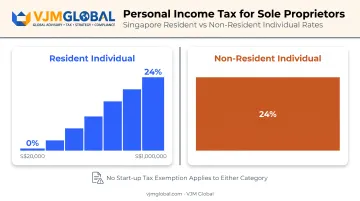
Sole proprietors also do not qualify for the Start-up Tax Exemption (SUTE) or partial tax exemption schemes—those apply only to companies. A Pte Ltd earning the same profit could shelter a meaningful portion under those exemptions.
GST Registration Thresholds
Registration for Goods and Services Tax becomes compulsory once:
- Taxable turnover exceeds S$1 million over the past calendar year, or
- You reasonably expect turnover to exceed If the appointed local authorized representative is a Singapore Citizen or PR, their CPF obligations relate to their own employment status elsewhere, not the sole proprietorship itself. The self-employed owner (if a Citizen or PR) with net trade income above S$6,000 annually must make compulsory MediSave contributions.
Retain invoices and business records for the periods IRAS requires. There is no separate corporate audit trail to fall back on.
Common Mistakes US Companies Make When Registering in Singapore
The single biggest error: assuming the US parent company can be listed as the owner. It can't. Only an individual (or, in limited cases, an existing registered entity) can hold that role. Plan around a named person from day one.
Other frequent missteps:
- Delaying the authorized representative appointment. Name reservation and the application both require this person upfront, so waiting stalls the entire process.
- Ignoring work pass requirements. Registration alone does not grant a right to work in Singapore. If the owner relocates to run the business, MOM's Employment Pass still applies separately.
- Assuming EntrePass is available. EntrePass requires a private limited company, not a sole proprietorship.
- Underestimating the CSP requirement. There is no workaround to self-file without SingPass—foreign founders need a licensed Corporate Service Provider.
Alternatives for US Companies Expanding Into Singapore
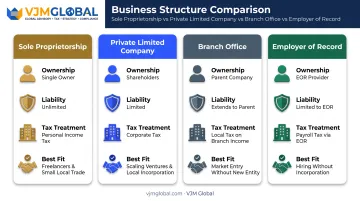
A sole proprietorship is not always the right fit for a US company. Three other structures cover most Singapore expansion scenarios.
Private Limited Company (Pte Ltd)
A Pte Ltd is a separate legal entity, so shareholders carry limited liability rather than personal exposure. Singapore taxes it at a 17% headline corporate rate. Start-Up Tax Exemption (SUTE) and partial exemption schemes can reduce that further in the early years.
For a US company that wants a real subsidiary, not just an individual operating on its behalf, this is usually the structure that fits.
VJM Global's Singapore Pte Ltd formation service covers:
- BizFile registration and UEN issuance
- Arranging an ordinarily resident director
- Appointing a company secretary within six months
- Ongoing Annual Return and XBRL filing obligations
Branch Office
A branch office extends your US company's own legal identity into Singapore rather than creating a new one. There is no separate liability shield, so obligations flow straight back to the US parent.
It suits companies that want to operate under their existing name without a distinct subsidiary. Weigh that liability trade-off carefully against a Pte Ltd.
Employer of Record (EOR)
An EOR lets a US company hire staff in Singapore without registering any local entity. That makes it useful for testing the market before committing to incorporation.
VJM Global's EOR service, available across 100+ countries including Singapore, acts as the legal employer on your behalf. It handles:
- Local employment contracts and onboarding
- Payroll and statutory contributions
- Offboarding
You can start hiring while deferring the entity decision.
Frequently Asked Questions
Can a US company register a sole proprietorship in Singapore, or does it need a local representative?
A US company cannot be the direct owner. An individual must register as the sole proprietor and, because that owner is overseas, must appoint a locally resident authorized representative.
Does a sole proprietorship need to pay tax in Singapore?
Yes. Profits are taxed as personal income at progressive rates (or a flat 24% for non-residents) through the owner's individual tax return, not through a separate corporate tax filing.
How much does it cost to register a sole proprietorship in Singapore?
Name reservation costs S$15, and registration costs S$100 for one year or S$160 for three years. No paid-up capital is required, unlike some other structures.
Can a US citizen register a sole proprietorship in Singapore without living there?
Yes, provided they appoint a locally resident authorized representative and engage a Corporate Service Provider to submit the BizFile application on their behalf.
What's the difference between a sole proprietorship and a Singapore branch office for US companies?
A sole proprietorship is owned by an individual with unlimited personal liability. A branch office extends the US company's own legal identity into Singapore, with liability flowing back to the parent.
How long does registration take for a foreign-owned sole proprietorship?
Approval is often quick once documents are complete — sometimes within days. Applications needing referral authority review or extra verification can take 14 to 60 days.