What trips people up isn't the registration itself. It's the details — which certificate you actually need, which state fits your business, and how to make that certificate usable back home. VJM Global works with founders and companies of any origin on entity formation across 100+ countries, including the US, and the process below reflects what actually needs to happen at each stage.
This guide walks through the exact steps, the paperwork you'll need on hand, and the mistakes that cost Singapore founders the most time.
Key Takeaways
- A US "Company Registration Certificate" is a state-issued Certificate of Incorporation (corp) or Certificate of Formation (LLC).
- The entire process runs remotely — no US travel required at any stage.
- You must appoint a US-based registered agent; a Singapore address will not work.
- Delaware suits investor-backed startups, while Wyoming often works better for smaller trading businesses.
- Singapore banks or authorities may need a certified copy or apostille, not only the filed certificate.
How to Get a US Company Registration Certificate from Singapore
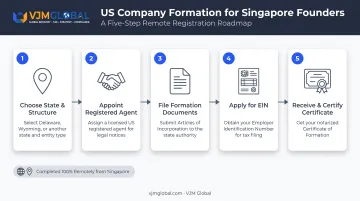
Five things need to happen in sequence: pick a state and structure, appoint a registered agent, file your formation documents, get an EIN, then request the certificate in the format you actually need. Skip a step or do it out of order, and you'll be waiting on emails instead of running your business.
Step 1: Choose Your US State and Business Structure
Your state choice determines your ongoing tax bill, your paperwork burden, and (for some businesses) how seriously investors take you.
- Delaware: the default for venture-backed startups. Investors and lawyers know its corporate law inside out, and it's the most common formation state for companies planning to raise US capital.
- Wyoming: lower ongoing costs and less bureaucracy, popular with smaller trading or consulting businesses that don't need investor familiarity.
- Nevada: sometimes considered for privacy protections, though its annual list and business license fees can add up.
On base filing fees, the gap is small. Delaware's official fee schedule lists $110 for an LLC and a $109 minimum for a stock corporation. Wyoming's Articles of Organization and Articles of Incorporation forms both list a $100 base fee.
The real difference shows up later, in annual reports and franchise tax.
Structure matters just as much as state:
- C-Corp: needed if you plan to raise venture capital or issue shares to multiple investors. Comes with corporate-level tax, then tax again on dividends.
- LLC: pass-through taxation, simpler paperwork, better fit for service businesses or smaller trading ventures not chasing institutional funding.
Step 2: Appoint a US Registered Agent
Every US state requires a registered agent — a person or company with a physical address in your formation state who receives legal notices and compliance mail on your entity's behalf. A Singapore address doesn't qualify, and you cannot serve as your own agent unless you're physically located in that state.
Since that's not an option for a Singapore-based founder, you'll need a professional registered agent service. Firms like VJM Global coordinate this as part of broader US entity setup, so it's handled alongside your filing rather than as a separate task you have to chase down.
Before committing to an agent, check:
- Forward speed for legal notices (a delayed forward can mean a missed deadline)
- Compliance reminders for annual reports and franchise tax
- Flat pricing disclosed upfront, without renewal surprises
Step 3: Reserve a Company Name and File Formation Documents
Once you've settled on a state, check name availability through that state's Secretary of State online portal. Delaware and Wyoming both run searchable databases for this.
If your preferred name is free, you file your Articles of Incorporation (corporation) or Articles of Organization (LLC). Once approved, that filing becomes your Certificate of Incorporation or Formation.
You'll typically need to have ready:
- Passport copies of all shareholders or LLC members
- Your registered agent's name and address
- A principal business address (this can often be your registered agent's address or a virtual office)
- A brief description of your business activity
Delaware accepts filings online or by mail; Wyoming's portal handles this entirely online. Neither requires you to be physically present in the US.
Step 4: Apply for an EIN from the IRS
Your Employer Identification Number is what a US bank, payment processor, or tax authority will ask for before they'll deal with your company. Getting one as a foreign founder without a US Social Security Number takes a different route than the one most US residents use.
- The IRS online EIN application is not available if your business's principal location is outside the US.
- Foreign applicants without an SSN or ITIN must file Form SS-4 by fax, mail, or phone instead, entering "foreign" on the responsible-party line.
According to the IRS's instructions for Form SS-4, fax applications with a return fax number are generally processed within about 4 business days, while mail applications take roughly 4 weeks. The IRS recommends applying at least 4–5 weeks before you actually need the EIN — which matters if a bank account or contract is waiting on it.
Step 5: Receive, Verify, and Certify Your Certificate
Once your state approves the filing, you'll receive a standard "filed" copy of your certificate. For most purposes, that's enough. But it isn't always what a Singapore bank, landlord, or government office will accept.
- A certified copy is a separately ordered, officially stamped version confirming the record is accurate — usually available for an added fee through the same state office.
- An apostille authenticates a US public document for use in another Hague Apostille Convention country. Singapore has been a member since September 16, 2021, according to Singapore's Ministry of Law, meaning a US apostille is generally recognized here without further legalization.
You can verify your entity's registration status anytime through the relevant state's free public business entity search. That check is useful for confirming a filing went through before you request certified copies.
What You Need Before You Register a US Company from Singapore
Most delays trace back to incomplete preparation, not the registration process itself. Sorting these three areas out before you start saves weeks later.
Personal and Business Documentation
Have these ready before filing:
- A valid passport for every shareholder, director, or LLC member
- Proof of your Singapore residential address (a recent utility bill or bank statement works)
- A short, clear description of your intended business activity
Registered Agent and US Address
Confirm your registered agent is engaged before you file, not after. If you need a US address for banking or licensing beyond what the agent provides, arrange that separately. Not every registered agent service includes a usable business address.
Financial and Compliance Readiness
Registration is only the beginning. Once your EIN arrives, federal, state, and possibly franchise tax filings apply. Know these obligations before you file:
- Corporate returns: Forms 1120, 1120-S, or 1065
- Payroll forms if you hire staff: W-2 or 1099-NEC
- Annual report deadlines in your formation state
- Beneficial-ownership (BOI) reporting to FinCEN
Missing a deadline after formation costs more than preparing for it now.
Key Factors That Affect Your US Company Registration Certificate
Your choice of state, structure, and certificate format shapes filing costs and how usable that certificate is once it lands back in Singapore.
Weigh these factors before you file:
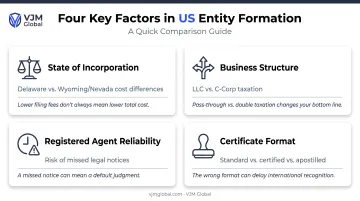
- State of incorporation. Filing fees, franchise tax, and privacy rules vary by state. Delaware carries more weight with investors; Wyoming and Nevada usually cost less to maintain year after year.
- Business structure. An LLC's pass-through taxation suits smaller trading or service businesses that won't raise institutional capital. A C-Corp brings double taxation, but most venture investors expect it if you're issuing equity.
- Registered agent reliability. A slow agent can miss a legal notice and trigger administrative dissolution—a real risk when you manage everything from another time zone. Pick a responsive agent with automated compliance alerts.
- Certificate format. A standard electronic filing may not satisfy a Singapore bank's compliance team. If you need a certified copy or apostille, request it at filing time instead of going back to the state weeks later.
Common Mistakes to Avoid When Registering a US Company from Singapore
A few recurring errors account for most of the friction Singapore founders run into:
- Picking a state on reputation alone. Delaware is popular for a reason, but its franchise tax structure can cost more than a Wyoming LLC over several years if you don't need investor pedigree.
- Delaying the EIN application. Since foreign applicants can't use the IRS online portal, waiting to start this step can stall your bank account opening by weeks.
- Skipping the certified copy or apostille. If a Singapore bank or contract will need it, request the certified or apostilled version at filing. Going back later means paying twice and waiting twice.
Conclusion
Getting a US Company Registration Certificate from Singapore is doable without setting foot in the US, provided you pick the right state, structure, and registered agent from the start. Most of the friction founders hit comes down to missing documentation or misjudging EIN timing, not the registration process itself.
Working with a cross-border entity formation partner that handles US setup end-to-end, such as VJM Global, helps catch these gaps before they cause delays and puts your certificate in a form you can use back in Singapore.
Frequently Asked Questions
Can a foreign company register in the US?
Yes. Foreign individuals and companies, including those based in Singapore, can fully own and register a US company remotely. You'll need a registered agent and must complete your chosen state's filing requirements.
How do I verify a registered company in the USA?
Check the relevant state's Secretary of State online business entity search. It shows registration status, filing date, and the registered entity name at no cost.
Do Singapore companies have certificates of incorporation?
Yes. ACRA issues a Certificate of Incorporation, purchasable through BizFile+, which serves the same proof-of-existence role as a US Certificate of Incorporation or Formation.
Do I need to travel to the US to register my company?
No. The entire process, from filing to receiving your certificate, can be completed remotely from Singapore using a registered agent.
How long does it take to get a US Certificate of Incorporation from Singapore?
State processing is often same-day for online filings. EIN issuance for foreign applicants takes about 4 business days by fax or up to 4 weeks by mail, plus extra time for a certified copy or apostille.
Which US state is best for a Singapore-based founder to incorporate in?
It depends on your goals. Delaware suits founders planning to raise venture capital; Wyoming or Nevada often make more sense if you want lower ongoing compliance costs and don't need investor recognition.