The appeal is straightforward: a massive buyer base, proven platforms like Amazon US, Shopify, and Walmart Marketplace, and revenue denominated in USD. Dropshippers, product brand owners, SaaS sellers, and Singapore agencies expanding their D2C clients into the US are all chasing the same opportunity.
But selling into the US from Singapore isn't the same as running a domestic store. This guide walks through the cross-border specifics founders actually need: entity formation, EIN applications, banking, sales tax nexus, and logistics.
Key Takeaways
- Selling into the US typically requires a registered US entity (LLC or C-Corp); no US residency or visa is needed
- Complete entity registration, EIN, US banking/payments, and sales tax nexus tracking before you scale
- Costs and timelines run higher than a Singapore-only launch due to registered agent fees and compliance filings
- Profitability hinges on managing shipping, duties, and multi-state tax obligations correctly
What Does It Mean to Start a US E-Commerce Business from Singapore?
In practical terms, it means operating an online store, structured through a US-registered business entity, that sells to American consumers while you run everything from Singapore.
That setup differs from simply shipping international orders as a Singapore-registered seller. Once you're targeting the US market seriously, you're typically forming and maintaining:
- A US-facing legal entity (LLC or C-Corp)
- A US business bank account or fintech equivalent
- A US tax presence, including federal EIN registration and state-level sales tax compliance
Common structures Singapore founders use:
- US LLC with Singapore-based operations: the most flexible setup for most product sellers
- Marketplace-only selling: listing on Amazon US or Walmart Marketplace, sometimes without a full US entity
- Dropshipping via a US-based supplier or 3PL: keeps inventory stateside and cuts shipping friction
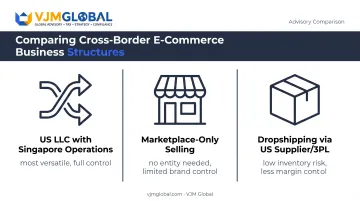
Each path carries different compliance obligations for entity formation, banking, and tax.
Why US E-Commerce Appeals to Singapore Entrepreneurs
The numbers make the case better than any pitch deck. US retail e-commerce sales hit $1,233.7 billion in 2025, up 5.4% from the year before, and now account for 16.4% of total retail sales, according to Census Bureau data released in March 2026. Early 2026 figures show growth accelerating further, with Q1 sales up 9.8% year-over-year.
Compare that to Singapore's domestic market, and the scale difference is obvious. There simply aren't enough local buyers to support the growth many founders want to build toward.
Several structural advantages make the US workable from Singapore:
- Market scale: More than $1.2 trillion in retail e-commerce demand, still growing mid-to-high single digits
- Trade framework: The US-Singapore Free Trade Agreement, in force since 2004, removes customs duties on electronically transmitted digital products
- Remote ownership: You can own and run a US-facing business without relocating, securing a visa, or setting foot in the US
Physical merchandise does not get the same duty-free treatment; those customs rules are covered later in this guide. Founders build and manage these entities from Singapore every day.
What to Know and Decide Before You Start
Before you start registration paperwork, get clear on what running a US-facing business from Singapore actually demands in time, cost, and ongoing compliance.
Setting Realistic Expectations
Unlike a same-day Singapore store launch, US legal setup takes time. Entity formation, EIN issuance, and bank account approval typically run several weeks combined, and all of it needs to happen before you can legally sell to US customers.
Founders can usually handle initial research and platform setup themselves. Where it gets harder is:
- Choosing the right entity structure and formation state
- Navigating EIN applications without a US Social Security Number
- Meeting state-specific compliance and sales tax obligations
This is typically where a cross-border accountant or entity-formation specialist earns their fee.
Physical presence in the US is generally not required at any stage. Exceptions exist for certain state-specific or product-specific licenses (alcohol, firearms, and some regulated goods, for instance), but the vast majority of e-commerce founders never need to set foot in the country.
Early Decisions That Matter
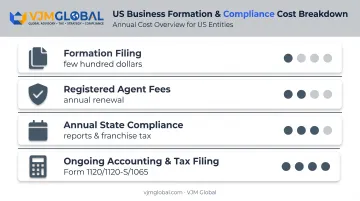
The one-time formation fee is the smallest part of the real cost. A full picture includes:
- Formation filing: a few hundred dollars depending on state
- Registered agent fees: typically renewing annually
- Annual state compliance: reports and franchise taxes vary by state
- Ongoing accounting and tax filing: Form 1120, 1120-S, or 1065 depending on entity classification
Currency conversion adds another layer. Moving profit from USD back to SGD brings exchange-rate exposure and different tax treatment in each country, so plan repatriation with an advisor before volume scales.
Foreign founders also face compliance friction that domestic founders don't:
- Beneficial ownership (BOI) reporting in some cases
- State-specific registration requirements
- Multi-state sales tax nexus tracking as revenue grows
FinCEN’s 2026 final rule removed BOI duties for US-created entities, but a foreign-law entity registered to do business in a state may still have reporting obligations.
The most common mistake? Treating entity registration as a "set and forget" task. It isn’t. Filings, renewals, and nexus thresholds need ongoing attention.
Firms like VJM Global handle recurring pieces—annual reports, franchise tax compliance, and multi-state sales tax—so founders can run the store instead of chasing deadlines.
How to Start a US E-Commerce Business from Singapore – Step by Step
These execution stages are built for Singapore-based founders entering the US market, with the cross-border details generic launch checklists usually skip.
The most common mistakes at this stage: skipping US market validation, picking the wrong formation state, and ignoring sales tax nexus until a state sends a notice.
Step 1 – Validate Product-Market Fit for US Buyers
Don't assume Singapore or Southeast Asia popularity translates to the US. Research actual demand using:
- Google Trends (US) filtered by region
- Amazon US best-seller data in your category
- Direct competitor pricing and review analysis
Then stress-test your margin. Take your USD retail price and subtract sourcing costs, cross-border shipping, and import duties. If the number that's left doesn't work, the product doesn't work, no matter how well it sells at home.
Step 2 – Choose a US Entity Structure and Register the Business
Three main paths exist for Singapore founders:
- US LLC: the most common choice for foreign owners; flexible with pass-through taxation
- C-Corporation: better suited if you're planning to raise venture funding
- Marketplace-only selling: skips entity formation entirely, though it limits payment flexibility and brand control
Singapore residents can own 100% of a US LLC with no visa, no US residency, and no physical presence required. You will, however, need a registered agent in your formation state.
Delaware and Wyoming are the two most popular choices among foreign founders:
| Factor | Delaware | Wyoming |
|---|---|---|
| Filing fee | $110 (LLC) | $100 |
| Annual tax/report | $400 flat LLC tax | Greater of $60 or asset-based fee |
| Reputation | Preferred by investors | Lower ongoing cost |
Neither state offers full anonymity — both require registered-agent and business-address details on file. VJM Global can handle entity formation, EIN application, and ongoing compliance across either state.
Step 3 – Get an EIN, US Bank Account, and Payment Processing
You don't need a Social Security Number to get an EIN. On IRS Form SS-4, foreign applicants without an SSN or ITIN simply enter "foreign" or "N/A" on line 7b. Processing generally takes about 4 business days by fax or roughly 4 weeks by mail. The fully online application isn't available if you lack a US address.
For banking, options split into two camps:
- Fintech providers (Mercury, Relay, Wise): generally more accommodating of foreign-owned entities, though each has verification quirks around addresses and entity type
- Traditional banks: often require a US branch visit for non-citizen applicants, which defeats the purpose for most remote founders
Once banking is sorted, connect a USD-capable payment gateway. Stripe and Shopify Payments both require a US business address and EIN; PayPal requests similar documentation. Test the full settlement flow before launch — some providers settle to a US account only, others allow SGD conversion.
Step 4 – Understand US Sales Tax Nexus and Compliance
Singapore has one GST rate. The US has none of that simplicity — sales tax is a state-by-state system, and there's no single national rate to plan around.
Economic nexus is the concept to understand: once you cross a revenue or transaction threshold in a given state, you're obligated to register and collect sales tax there. Thresholds vary:
- New York: more than $500,000 in gross receipts and over 100 transactions in the trailing four quarters
- California: registration required once sales exceed $500,000 in a calendar year
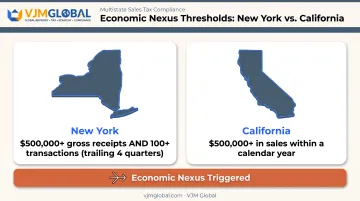
Selling through a marketplace doesn't fully remove this exposure either — marketplace-facilitator collection doesn't eliminate your own registration risk if you also sell direct.
As order volume grows across states, tracking this manually becomes unmanageable fast. Sales tax automation tools or a compliance partner become necessary rather than optional. VJM Global's e-commerce accounting work, for example, includes nexus monitoring across Shopify, Amazon, and other storefronts, flagging thresholds before they become a state tax notice sitting in your inbox.
Step 5 – Set Up Sourcing, Fulfilment, and Logistics
Three fulfilment models are common:
- Direct shipping from Singapore/Asia: lower upfront cost, slower delivery
- US-based 3PL or FBA warehouse: faster delivery and better conversion, but requires bulk inventory investment
- Dropshipping from a US supplier: no inventory risk, but less margin control
Whichever route you choose, factor in a major 2025 shift: the historical $800 de minimis exemption that let low-value parcels enter duty-free no longer applies universally. Executive Order 14324 suspended duty-free de minimis treatment for shipments from all countries, effective August 29, 2025. Every parcel now potentially carries duties, regardless of value.
This makes bulk-shipping into a US fulfilment centre more attractive for many sellers — you absorb duties once on a larger shipment rather than repeatedly on small parcels.
Step 6 – Launch, Market, and Build Trust with US Customers
Decide on your storefront mix:
- A branded website for control and margin
- Amazon US or Walmart Marketplace listings for faster access to existing buyer traffic
- Both, run in parallel
Localise everything: USD pricing, clear US shipping and returns policies, and customer support hours that overlap with American time zones. Then set up conversion tracking on your marketing channels — paid ads, SEO, and influencer outreach — so you know what's actually driving sales rather than guessing.
Costs, Timeline, and Profitability in 2026
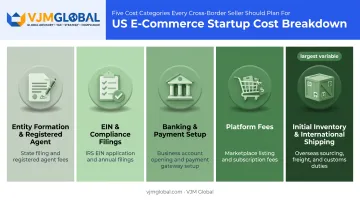
Budget for these cross-border-specific costs beyond your product and marketing spend:
- Entity formation and registered agent — a few hundred dollars combined, plus annual renewal
- EIN and compliance filings — free from the IRS directly, though professional support carries a fee
- Banking and payment setup — mostly free to open, though some fintechs charge monthly fees
- Platform fees — Shopify subscription or Amazon referral fees, depending on channel
- Initial inventory plus international shipping — the largest variable, and where duty changes hit hardest
Timelines run longer for Singapore-based founders than for US-based ones. Registered agent processing, EIN mail turnaround (up to 4 weeks), and remote banking KYC checks all add lead time that a US resident wouldn't face.
Is it still worth it? Growth data says yes: e-commerce sales grew 5.4% in 2025 and accelerated to 9.8% year-over-year in Q1 2026.
Profitability in 2026 still hinges on shipping costs, duties, and multi-state tax compliance. Founders who treat these as afterthoughts watch margins evaporate.
Frequently Asked Questions
How much money do I need to start an e-commerce business?
Entry-level costs for a basic store can start in the low thousands (USD). Singapore founders should also budget a few hundred to over a thousand dollars for cross-border setup: entity formation, registered agent fees, EIN support, and remote banking.
Which e-commerce is best in the USA?
It depends on your goals. A branded website gives you control and better margins; Amazon US or Walmart Marketplace gets you faster access to existing buyer traffic. Many sellers eventually run both.
Is e-commerce still profitable in 2026?
Yes, for prepared sellers. US e-commerce sales grew 9.8% year-over-year in Q1 2026, but profitability hinges on managing cross-border shipping costs, import duties, and multi-state tax compliance correctly.
Can a Singapore citizen or company own 100% of a US LLC?
Yes. IRS rules explicitly recognize foreign-owned US disregarded entities, meaning full ownership by a non-US person is allowed. You'll still need a registered agent in your formation state.
Do I need a US visa or to relocate to run my e-commerce business from Singapore?
No, in most cases. US e-commerce entities can be owned and operated entirely remotely. Exceptions exist for certain state or product-specific licensed activities, such as regulated goods.
How do I get a US EIN without a Social Security Number?
File IRS Form SS-4 and enter "foreign" or "N/A" on line 7b if you're ineligible for an SSN or ITIN. Faxed applications typically receive an EIN within 4 business days; mailed applications take about 4 weeks.