Introduction
US entrepreneurs eyeing Southeast Asia often struggle with market entry complexity, local compliance, and the cost of setting up overseas. Singapore has become their preferred entry point into the region's digital economy. Southeast Asian e-commerce hit $159 billion in gross merchandise value in 2024, up 15% year-over-year, according to Bain & Company's e-Conomy SEA 2024 report.
The appeal for Americans is specific: strategic access to APAC markets, a business-friendly tax structure, and the ability to incorporate without ever boarding a flight.
Who is making the move? Amazon and Shopify sellers scaling past the US market. SMEs diversifying revenue sources. Dropshippers chasing new customer bases. Consultants advising clients on cross-border expansion.
This guide walks through exactly what a US founder needs to do to launch an e-commerce business in Singapore, remotely, step by step.
Key Takeaways
- Singapore allows 100% foreign ownership, but you still need a locally resident director
- Use a Private Limited Company (Pte Ltd)—the usual structure for foreign-owned online sellers
- Incorporation can take days; banking, payments, and full launch readiness take weeks
- GST registration and US foreign-income disclosure are easy to miss—and costly if skipped
- Hands-on help on both Singapore and US rules cuts delays for first-time cross-border founders
Why Singapore Is a Strategic E-Commerce Base for US Entrepreneurs
Singapore sits at the center of one of the world's fastest-growing digital consumer markets. With 5.9 million people at home, it also serves as a launchpad into ASEAN's broader population and buying power.
Tax efficiency is a major draw. Singapore's headline corporate tax rate is a flat 17%, compared to the layered federal and state tax structures many US founders navigate at home. Qualifying startups also get a 75% exemption on the first S$100,000 of chargeable income and 50% on the next S$100,000 for their first three years, according to IRAS's corporate tax exemption guidance.
Other factors making Singapore attractive:
- Full foreign ownership — US founders retain 100% of shares and control, no local equity partner required
- Strong global standing — Singapore ranked 5th overall in the WIPO Global Innovation Index 2025, and previously scored a 2nd-place ranking in the World Bank's last published Doing Business report
- Logistics muscle — Changi Airport, deep-water ports, and established third-party logistics networks make regional fulfillment fast and reliable
One planning caveat: Singapore and the US maintain only a narrow 1988 agreement covering shipping and aircraft income, plus a FATCA reciprocal reporting arrangement. Build that limited treaty coverage into your cross-border tax plan from the start.
Singapore is not a compliance shortcut. It does put the foundations—tax structure, full ownership, and regional market access—in a founder's favor from day one.
What US Founders Need to Know Before Starting
A few realities catch first-time US founders off guard before incorporation paperwork even starts.
You don't need to be in Singapore, but you do need a resident director. Physical presence isn't required to incorporate. What is required: at least one director who is ordinarily resident in Singapore. Most US founders solve this through a nominee director service arranged by a corporate service provider rather than relocating or recruiting a local partner.
The time zone gap is real. Singapore runs 12–13 hours ahead of US Eastern Time and 15–16 hours ahead of Pacific Time, depending on daylight saving. That gap affects customer service coverage, supplier calls, and how you structure team hours.
GST has two separate tests, and they're easy to mix up:
| Regime | Who it applies to | Threshold |
|---|---|---|
| Local GST registration | Singapore-registered businesses | Taxable turnover over S$1 million |
| Overseas Vendor Registration (OVR) | Overseas sellers of digital services/low-value goods | Global turnover over S$1 million AND Singapore B2C supplies over S$100,000 |
Both thresholds under OVR must be met, not just one, per IRAS's overseas vendor guidance.
Banking is often the slowest step. Opening a Singapore corporate account remotely as a foreign national typically takes longer than incorporation itself. Banks want clear documentation on ownership, business activity, and source of funds prepared upfront, not scrambled together after registration.
How to Start an E-Commerce Business in Singapore from the USA – Step by Step
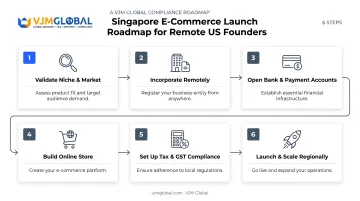
Use this roadmap if you’re a US-based founder setting up Singapore e-commerce remotely—no relocation required.
The most common mistake? Assuming Singapore incorporation mirrors forming a US LLC. It doesn't. Founders who skip researching the resident director and registered address requirements often lose weeks re-doing paperwork.
Step 1: Validate Your Niche and Target Market
Pick a product category with real demand in Singapore or wider APAC—ideally one that’s still underserved locally.
Before you commit capital:
- Gauge demand with bestseller data from Shopee, Lazada, or Amazon.sg
- Confirm your supply chain can ship from the US or a regional supplier without unworkable lead times
Step 2: Choose Your Business Structure and Incorporate Remotely
A Private Limited Company (Pte Ltd) is the stronger choice for most foreign-owned e-commerce ventures versus a branch office. It limits liability and qualifies for startup tax exemptions a branch cannot access.
Core incorporation requirements include:
- Company name approval through ACRA's Bizfile+ portal
- A registered Singapore office address
- At least one ordinarily resident director
- A company secretary appointed within six months
- KYC documentation for shareholders and directors
VJM Global handles end-to-end entity formation for US founders, including nominee director arrangements and the full documentation package, so you can incorporate without relocating or filing through ACRA alone.
Step 3: Open a Corporate Bank Account and Set Up Payment Infrastructure
Traditional banks like DBS and OCBC offer dedicated onboarding paths for foreign-owned companies, but expect a Relationship Manager process rather than instant approval. Digital banks and payment institutions, such as Airwallex or Wise Business, tend to move faster for remote applicants since their applications are built for online submission from day one.
On the payments side, integrate what Singapore shoppers actually use:
- PayNow for instant local bank transfers
- Stripe and PayPal for card and international processing
- US-facing payment options if you're also selling back into the American market
Step 4: Build Your Online Store and Choose the Right E-Commerce Platform
Compare platforms on cost, ease of use, and fit for a cross-border operation:
- Shopify — starts around S$29/month on annual billing, with online card rates from 3.2% + S$0.50
- WooCommerce — open-source, lower software cost, more setup effort
- Amazon.sg — subscription fee currently waived through 2026, with a S$1.09 per-item fee for individual sellers
- Shopee and Lazada — strong local marketplace reach, commission-based fee models
Localize once you've picked a platform: price in SGD, offer PayNow at checkout, and set delivery expectations that match what Singapore shoppers are used to (often next-day or two-day).
Step 5: Set Up Tax, GST, and Cross-Border Accounting Compliance
On the Singapore side, you'll file Estimated Chargeable Income (ECI) within three months of your financial year-end, followed by Form C-S or Form C by November 30 each year. GST registration is required once taxable turnover exceeds S$1 million.
On the US side, don't skip Form 5471, which can apply when a US person owns 10% or more of a foreign corporation, per IRS Form 5471 instructions. This is one of the most overlooked filings among American founders running foreign entities.
VJM Global’s cross-border accounting team helps US owners align Singapore tax filings with US reporting obligations across both systems.
Step 6: Launch, Market, and Scale Across the Region
Decide on fulfillment early: in-house shipping works for low volume, but a 3PL or courier partnership scales better once order volume climbs.
For marketing, focus on channels that match Singapore's digitally active consumer base:
- SEO targeting local search intent
- Social commerce on platforms like Instagram and TikTok
- Marketplace advertising on Shopee and Lazada
Stabilize operations and compliance in Singapore before expanding into neighboring ASEAN markets. Trying to scale into Malaysia or Indonesia before your Singapore base is solid usually creates more compliance headaches than revenue.
Cost & Timeline: What US Entrepreneurs Should Budget For
One-time incorporation costs are relatively modest. ACRA charges S$15 for business name reservation and S$300 for local company registration. Professional setup and nominee director fees usually exceed those government charges and vary by provider and scope of work—budget for them as the larger line items.
Recurring costs unique to non-resident founders typically include:
- Corporate secretary retainer (required for every Singapore company)
- Registered address fee for a local business address
- Nominee director annual retainer if you have no Singapore-resident director
- Ongoing accounting and tax filing support
Exact figures depend on your provider and how much of the compliance workload you outsource, so get a tailored quote rather than assuming a flat industry rate.
On timing, expect two very different clocks:
- Incorporation itself can be approved within days once documents are submitted correctly
- Full operational readiness—live bank account, working payment gateway, and functioning storefront—usually takes several weeks
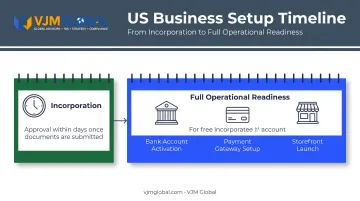
Founders who prepare banking documentation before incorporation, rather than after, consistently move through this second phase faster.
Conclusion
Launching an e-commerce business in Singapore from the US is achievable without packing a suitcase. What it requires is planning for the nominee director requirement, the banking process, and dual-country compliance obligations before you start, not after you hit a wall.
Getting the incorporation and tax structure right on day one prevents costly delays that often catch first-time founders six months in.
Support from a team that knows both Singapore's ACRA requirements and IRS reporting expectations shortens that learning curve. VJM Global helps American founders with entity formation, tax compliance, and ongoing governance so you can focus on building the business.
Frequently Asked Questions
How do I start e-commerce in Singapore?
Validate your niche, incorporate a Pte Ltd with a resident director, set up banking and payment infrastructure, then launch on a suitable e-commerce platform. Each step can be done remotely from the US.
How much does it cost to start a small business in Singapore?
Incorporation fees run around S$315 in ACRA charges alone. Add registered address, company secretary, and nominee director fees on top, which vary by service provider.
Which e-commerce platform is best in Singapore?
Shopify suits founders wanting a self-hosted, branded store. Amazon.sg and Shopee/Lazada offer built-in marketplace reach. The right choice depends on your product type and growth strategy.
Do I need to visit Singapore to incorporate my e-commerce company?
No. Incorporation can be completed remotely using a nominee director and registered address. Opening a bank account may occasionally require additional verification.
Can a US citizen fully own a Singapore company?
Yes, 100% foreign ownership is permitted. You'll still need to appoint a locally resident director, even while holding all the shares yourself.
How long does it take to set up an e-commerce business in Singapore from the US?
Incorporation itself can be done within days. Full operational readiness, including banking, payment gateways, and store setup, typically takes a few weeks.