Introduction
Singapore's position as a leading technology and financial services hub in the Asia-Pacific region continues to strengthen. The digital economy contributed 18.6% of Singapore's GDP in 2024, with over 4,500 tech startups operating locally. The city-state hosts 80 of the world's top 100 technology firms and was ranked the world's 12th tech city. For UK businesses expanding into Singapore, this growth brings an important requirement: enterprise clients in Singapore increasingly demand SOC 2 reports from their vendors before signing contracts, particularly in regulated sectors like financial services.
Understanding what a SOC 2 audit actually costs is where many UK businesses come unstuck. Costs vary widely based on audit type, organisation size, scope of Trust Services Criteria, and readiness — first-year all-in spend typically ranges from SGD 25,000 to SGD 150,000+ (approximately £14,500 to £87,000+).
That range surprises many businesses because the auditor's invoice often represents just 30–40% of total spend. The rest sits in preparation, tooling, and internal time — costs that rarely appear in a quote.
This guide covers:
- Singapore-specific pricing ranges by audit type and company size
- All cost components beyond the auditor's fee
- Key factors that push costs up or down
- Practical strategies to budget effectively and avoid surprises
Key Takeaways
- SOC 2 Type 1 audits in Singapore typically cost SGD 15,000–60,000 in auditor fees; Type 2 audits range from SGD 25,000–100,000+, depending on firm tier and scope
- Auditor fees typically represent just 30–40% of total first-year spend; readiness assessments, compliance tools, internal time, and legal review make up the remainder
- Smaller UK businesses with narrow scope pay closer to the lower end; larger organisations with complex systems or multiple Trust Services Criteria pay considerably more
- Year-two and ongoing costs typically drop 20–40% once policies, tools, and evidence systems are established
How Much Does a SOC 2 Audit Cost in Singapore?
There is no single fixed price for a SOC 2 audit in Singapore. Costs depend on audit type, the firm you choose, the number of Trust Services Criteria (TSC) in scope, and how prepared your organisation is. Two common budgeting mistakes UK businesses make are treating the auditor's quote as the total cost, and underestimating internal staff time required for evidence collection and policy work.
Typical Cost Ranges (SGD and approximate GBP equivalents)
| Tier | Typical Profile | Auditor Fees (SGD) | Approx. GBP |
|---|---|---|---|
| Type 1 — Security TSC only | Small UK businesses, under 50 employees | SGD 15,000–40,000 | £8,700–£23,100 |
| Type 2 — Security TSC, boutique/mid-market firm | 50–250 employees | SGD 30,000–80,000 | £17,300–£46,200 |
| Type 2 — Multiple TSCs or Big 4 engagement | Larger businesses, regulated sectors (finance, health tech) | SGD 60,000–150,000+ | £34,700–£87,000+ |
GBP equivalents calculated at 1.73 SGD/GBP. Type 1 covers point-in-time control design; Type 2 includes evidence testing over a 3–12 month period, auditor interviews, and report issuance.
These figures cover auditor fees only. The following costs are not included in most quotes:
- Readiness assessments (pre-audit gap analysis)
- Compliance automation tools
- Penetration testing
- Internal staff time for evidence collection and policy work
- Legal review of the final report
Each of these line items can add thousands to your total budget — and several are difficult to avoid.
Key Factors That Affect SOC 2 Audit Costs in Singapore
Five factors consistently move the cost needle for UK businesses pursuing a SOC 2 audit in Singapore — and understanding each one upfront prevents budget surprises later.
Audit Type: Type 1 vs Type 2
Type 1 is a point-in-time snapshot of control design (cheaper and faster). It assesses whether controls are properly designed on a specific date. Type 2 tests whether controls operated effectively over a 3–12 month period, making it more expensive due to auditor hours and evidence volume required.
Scope of Trust Services Criteria
Every SOC 2 audit must include the Security (Common Criteria) TSC as the mandatory foundation. Adding Availability, Confidentiality, Processing Integrity, or Privacy can increase auditor fees by 15–25% per additional criterion. Including all five TSCs can push fees 50–75% higher than a Security-only audit. UK businesses should only add TSCs where customers contractually require it.
Organisation Size and Complexity
Larger, more complex organisations generate more auditor hours — and higher fees. Key complexity drivers include:
- Headcount and the number of personnel with system access
- Systems in scope, including cloud infrastructure and SaaS tools
- Subservice providers that process or store data on your behalf
- Singapore operations requiring local documentation or evidence
A 15-person UK SaaS team will pay significantly less than a 200-person financial services firm with Singapore operations.
Auditor Firm Tier
Singapore offers three tiers of SOC 2 auditors, each with a different cost profile:
| Firm Tier | Type 2 Audit Range (USD) | Typical Client |
|---|---|---|
| Boutique specialist | $15,000 – $75,000 | SaaS startups, SMEs |
| Mid-market firm | $30,000 – $120,000 | Growth-stage companies |
| Big 4 (Deloitte, PwC, EY, KPMG) | $60,000 – $450,000 | Enterprise, regulated sectors |
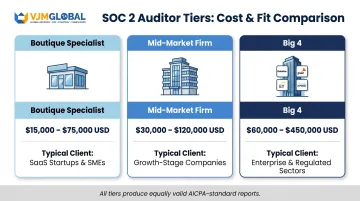
Both boutique and Big 4 firms produce equally valid reports under AICPA standards. The price difference reflects brand premium, not report quality — most UK SaaS companies find boutique specialists entirely sufficient.
Internal Readiness and Cross-Border Considerations
UK businesses without prior SOC 2 experience typically face the steepest preparation costs. Common readiness gaps that drive up fees include:
- Policies not yet aligned to AICPA Trust Services Criteria
- Limited local documentation for Singapore-based operations
- No existing evidence collection processes
- Time zone coordination between UK teams and Singapore auditors, which can extend timelines and add logistical overhead
Full Cost Breakdown: Beyond the Auditor's Fee
Full Cost Breakdown: Beyond the Auditor's Fee
The auditor's invoice typically represents only 30–40% of total first-year SOC 2 spend for most businesses. Preparation, tooling, and internal effort account for the rest — costs that rarely appear in early budget estimates but add up quickly.
Readiness and Gap Assessment
This is a one-time cost, paid before the formal audit begins. Most organisations conduct a readiness or gap assessment to identify control deficiencies against the Trust Services Criteria. Singapore-based assessments typically range from SGD 15,000–30,000 for small to mid-size businesses (approximately £8,700–£17,300).
Skipping this step often leads to failed or qualified audits, which cost significantly more to remediate.
Compliance Automation and Security Tools
This is an ongoing annual cost. Platforms such as Vanta, Drata, or Secureframe automate evidence collection, continuous monitoring, and documentation — cutting internal staff hours considerably. Indicative pricing:
- Vanta: from approximately £5,800/year
- Secureframe: £4,300–£58,000+/year, with median contracts around £11,600/year
Penetration Testing
Penetration testing is not a mandatory SOC 2 requirement, but enterprise clients in Singapore's financial services and technology sectors increasingly expect it alongside the report. Costs vary by scope — typical per-engagement ranges in Singapore are:
- Overall engagement: SGD 5,000–30,000 (approximately £2,900–£17,300)
- Web application testing: SGD 4,000–16,000
- Cloud infrastructure testing: SGD 8,000–40,000
Internal Staff Time
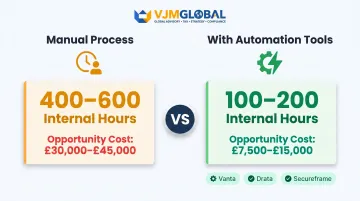
This is a recurring cost, and the one that most surprises UK businesses unfamiliar with the audit process. SOC 2 preparation typically consumes 40–150+ hours of internal engineering, security, and leadership time in year one — covering evidence collection, policy writing, control implementation, and auditor coordination.
A fully manual process can reach 400–600 hours, with an estimated opportunity cost of £30,000–£45,000 at typical UK technology salary rates. Basic automation brings this down to 100–200 hours (£7,500–£15,000).
Ongoing Annual Maintenance
SOC 2 reports are accepted for approximately 12 months, making this an annual operating cost. Ongoing expenses include re-audit fees, compliance platform subscriptions, continuous monitoring, and policy refresh hours. Year-two costs typically fall 20–40% below year-one once the control foundation is established.
SOC 2 Type 1 vs Type 2: What UK Businesses in Singapore Should Know
Type 1 serves as the faster, lower-cost starting point, while Type 2 is the standard enterprise buyers in Singapore expect.
SOC 2 Type 1
Type 1 assesses whether controls are properly designed at a single point in time. It is faster — typically 2–4 months from kickoff to report — and cheaper. It is appropriate for UK businesses that need to demonstrate a baseline security posture to close early Singapore client deals or meet initial procurement requirements.
SOC 2 Type 2
Type 2 tests whether controls operated effectively over a defined period (usually 6–12 months) and is what Singapore enterprise clients — particularly in finance, SaaS, and regulated sectors — typically require. It costs more due to the extended audit window and higher evidence burden, but carries more credibility with enterprise buyers.
Which to Choose First
UK businesses new to Singapore should consider this two-stage path:
- Start with Type 1 to establish compliance faster and close early deals
- Progress to Type 2 within 12–18 months as enterprise client requirements grow
- Ask auditors about bundled Type 1 + Type 2 pricing, which can reduce total fees by 10–20%
How to Budget and Reduce Your SOC 2 Costs in Singapore
Cost-efficient SOC 2 compliance is about strategic planning, not cutting corners. The businesses that overspend are typically those that skip readiness work, over-scope their audit, or attempt it without guidance.
Scope Ruthlessly in Year One
Start with the Security TSC only, limit the audit to the systems and products that directly touch Singapore customer data, and exclude internal tools or infrastructure that fall outside the audit boundary. Each additional system or TSC adds measurable cost.
Invest in Readiness Before Engaging an Auditor
A structured gap assessment before fieldwork begins is the single most effective cost-reduction strategy. Issues found during readiness can be fixed at a fraction of the cost compared to remediating them under time pressure once the formal audit has started.
Work With an Experienced Advisory Partner
UK businesses navigating a Singapore SOC 2 audit for the first time benefit from working with an advisory partner who understands both the AICPA attestation framework and the practical expectations of Singapore-based enterprise buyers. The right partner handles the preparation work that most teams underestimate, keeping first-year costs from spiralling.
VJM Global has supported 250+ UK businesses through complex international compliance engagements. Their advisory support typically covers:
- Internal controls review and gap identification
- Policy documentation aligned to AICPA requirements
- Audit scope decisions to avoid over-engineering year one
- Auditor coordination and liaison throughout fieldwork
This kind of structured support reduces internal hours, limits rework, and prevents the cost overruns that come from discovering gaps mid-audit.
Frequently Asked Questions
What is the average cost of a SOC 2 audit in Singapore?
Auditor fees range from SGD 15,000–40,000 for Type 1 and SGD 25,000–100,000+ for Type 2. Total first-year all-in spend including preparation and tooling typically ranges from SGD 25,000 to SGD 150,000+ (£14,500–£87,000+) depending on organisation size and scope.
How do I get SOC 2 certification in Singapore?
SOC 2 is technically an attestation, not a certification, issued by a licensed CPA firm. Key steps include readiness assessment, control implementation, observation period (for Type 2), formal audit, and report issuance. UK businesses may engage Singapore-based or internationally recognised CPA firms with AICPA-recognised licensure.
Is SOC 2 Type 1 or Type 2 more suitable for UK businesses entering Singapore?
Type 1 is appropriate for businesses that need to demonstrate security posture quickly to unlock early deals. Type 2 is expected by most Singapore enterprise and financial sector clients and should be the medium-term goal.
How long does a SOC 2 audit take in Singapore?
A Type 1 audit typically takes 2–4 months from kickoff to report. A Type 2 audit requires a 3–12 month observation period followed by 4–6 weeks of formal fieldwork, making the full process 6–14 months for most organisations.
Do UK businesses need to use a Singapore-based auditor for SOC 2?
SOC 2 audits must be conducted by a licensed CPA firm, typically AICPA-recognised. While many Singapore-based CPA firms offer this service, UK businesses can also engage internationally recognised firms with Singapore practices. Auditor licensure is the deciding factor — geography is secondary.
What are the recurring annual costs of maintaining SOC 2 compliance in Singapore?
Ongoing costs include annual re-audit fees (similar to or slightly below year-one auditor costs), compliance platform subscriptions (approximately SGD 5,000–25,000 / £2,900–£14,500 per year), and internal staff time for continuous monitoring and policy maintenance — typically SGD 15,000–80,000 (£8,700–£46,500) in total annual ongoing spend.