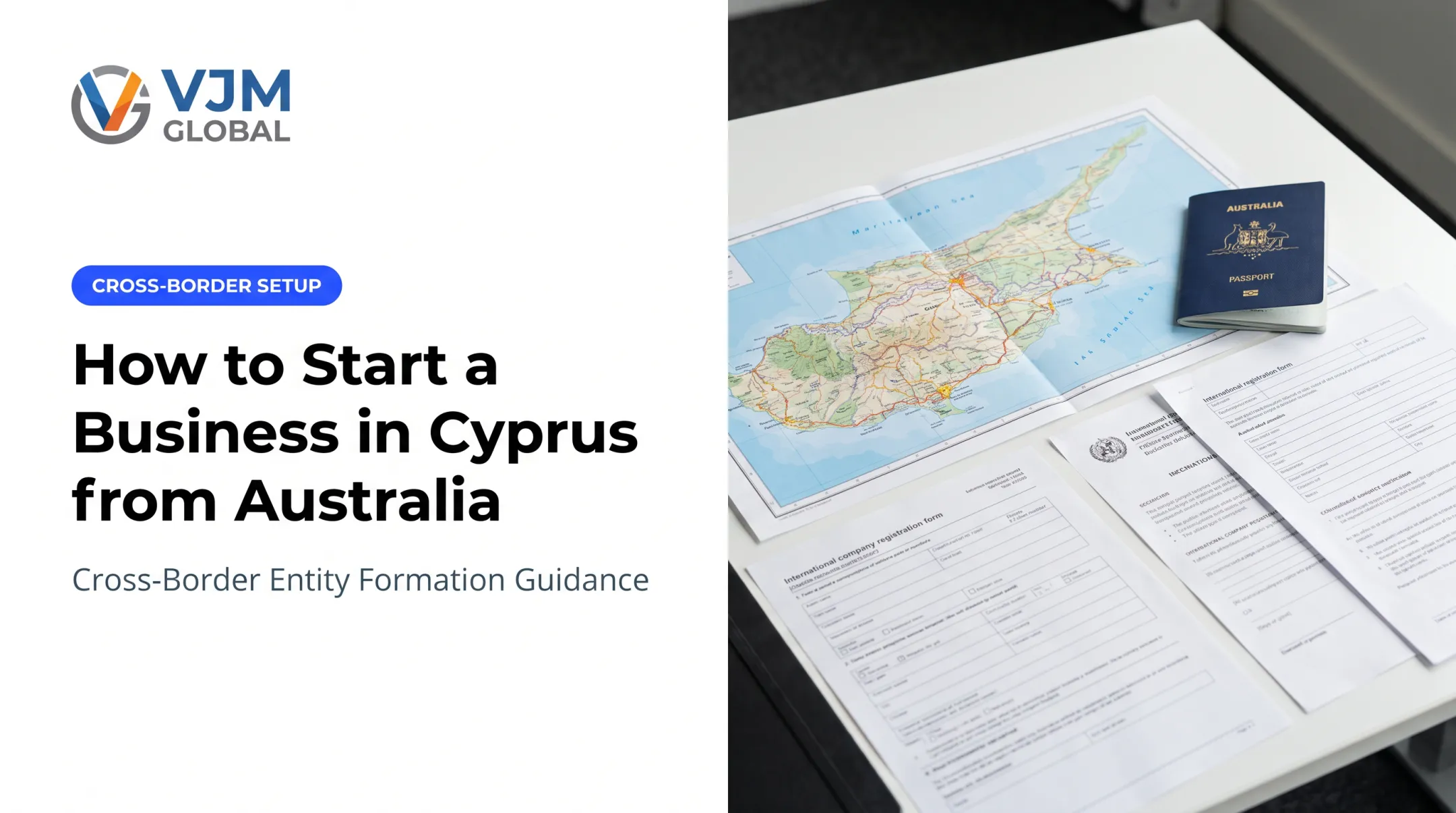
Canadian founders are drawn to Cyprus for a specific mix of reasons: EU market access, a corporate tax rate that's still among the lower ones in Europe, a wide double tax treaty network, and the ability to incorporate remotely through a licensed local lawyer. The interest isn't limited to one type of business owner, either.
Tech founders use it to invoice EU clients without opening five separate entities. Investors use it for holding structures. Canadian SMEs use it as a bridge into European markets. This guide walks through what actually happens, step by step, from choosing a structure to filing your first tax return.
TL;DR
- Cyprus offers EU market access, a 15% corporate tax rate (from 12.5% as of 1 Jan 2026), and exemptions on most share disposal gains
- Private Limited Company (LTD) is the standard structure for Canadians—registerable remotely via a Cyprus-licensed lawyer
- Registration with the Registrar typically takes 1-3 weeks once documents are certified
- Budget legal, registered address, accounting, and bank setup costs on top of government fees
- Cross-border tax and compliance make professional support essential from day one
What Is a Cyprus Business (For Canadian Entrepreneurs)?
A Cyprus business is a legal entity registered with the Cyprus Registrar of Companies, letting you trade, invoice, or hold assets within the EU. For most Canadian founders, that means a legal EU presence while you keep running operations from Toronto, Vancouver, or elsewhere in Canada—not a relocation.
Most Canadians use one of three structures:
- Private Limited Company (LTD): the standard operating vehicle for trading with EU clients
- Branch of a Canadian company: an extension of your existing entity, less common but useful in specific cases
- Holding company: built to own shares, IP, or other assets rather than run day-to-day operations
What to Know Before You Start a Business in Cyprus from Canada
Many Canadian founders underestimate two things: how dependent the process is on a local lawyer, and how much documentation is actually required. This section sets realistic expectations on timelines, process dependencies, and Canadian tax duties—not whether your business idea will work in Cyprus.
Timelines You Can Actually Plan Around
Most of the process runs remotely, but Cyprus law requires a Cyprus-licensed lawyer to draft and certify your incorporation documents. There's no workaround for this step.
- Company registration: 1-3 weeks once documents are certified and submitted
- Corporate bank account: 1-8 weeks, depending heavily on which bank or EMI (electronic money institution) you choose
Your Canadian Tax Obligations Don't Disappear
Incorporating in Cyprus doesn't remove your Canadian reporting duties. If you're a Canadian resident with a foreign corporation, the CRA generally requires Form T1134, a summary plus a separate supplement for each foreign affiliate, due 10 months after your fiscal year-end. Relief may apply if your interest cost is under CAD 100,000 and the affiliate was dormant. Both conditions must be met, so don't assume you're exempt without checking. The structure you choose also matters here. An EU operating base (invoicing clients, running payroll, holding staff) triggers different reporting considerations than a passive holding or investment vehicle sitting quietly with shares or IP.
Why Start a Business in Cyprus? (When It Makes Sense for Canadians)
Cyprus isn't a universal answer for every Canadian business. It makes sense under specific conditions:
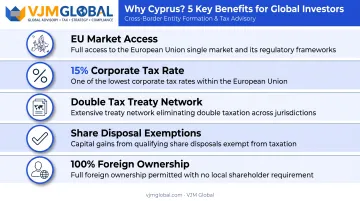
- EU market access without multiplying entities. You can invoice and trade across the EU from one Cyprus company, rather than incorporating separately in each country.
- A comparatively low corporate tax rate. Cyprus's standard rate is 15% from 1 January 2026 (up from 12.5%). It still undercuts many EU peers, though Hungary (9%) and Bulgaria (10%) go lower, per PwC's corporate income tax comparison.
- A broad double tax treaty network. The Canada-Cyprus tax convention caps source-country dividend tax at 15% for beneficial owners and adds further relief when profits return to Canadian shareholders, per the official Canada-Cyprus tax treaty text.
- Exemptions on most share disposal gains. Profits from selling shares and comparable corporate titles are generally exempt from Cyprus corporate tax, except gains tied to Cyprus real estate or non-quoted property-holding shares.
- 100% foreign ownership. No local Cypriot partner requirement for most ordinary business activities.
None of this replaces proper structuring advice. It just explains why Cyprus keeps showing up on Canadian founders' shortlists.
Early Decisions That Matter When Setting Up in Cyprus
Most problems Canadian founders run into aren't from lack of effort. They come from underestimating banking timelines and compliance overhead.
The Real Cost Picture
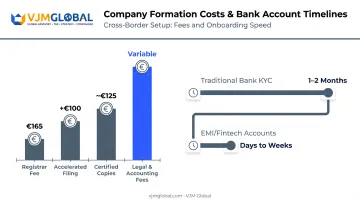
Government fees are the smallest part of your budget. The Registrar charges €165 for incorporating a company with share capital (or €235 without), plus €100 if you want accelerated processing.
Legal fees, a registered office address, a company secretary, and annual accounting or audit support sit on top of that—and none have a standard published price. Get itemized quotes rather than trusting a flat "package" figure.
| Cost Component | Amount |
|---|---|
| Registrar incorporation (with share capital) | €165 |
| Accelerated filing | +€100 |
| Certified incorporation copies | ~€120–130 |
| Legal, secretarial, registered office, accounting | Quote-based, no fixed benchmark |
Banking Takes Longer Than You'd Expect
Traditional Cyprus banks can take 1-2 months for KYC review. Electronic money institutions (EMIs) and business-focused fintech accounts often move faster. Exact timelines still depend on your ownership structure and source-of-funds documentation.
Choosing Your Structure Sets the Tone for Everything Else
Are you building an operating company for EU clients? An IP holding vehicle? A passive investment structure? Each answer changes your tax exposure, your compliance load, and even how fast your bank account clears KYC.
And regardless of which you pick, you'll need a Cyprus-licensed lawyer for document certification. This step can't be skipped or done remotely without one.
How to Start a Business in Cyprus from Canada – Step by Step
You can form a Cyprus company from Canada without relocating, but the sequence matters. Structure, registration, tax, banking, and ongoing filings each create delays if you skip ahead.
Watch for these pitfalls early:
- Skipping structuring advice before you lock an entity type
- Underestimating bank onboarding timelines
- Leaving Canadian tax reporting (such as T1134) until it is too late to plan
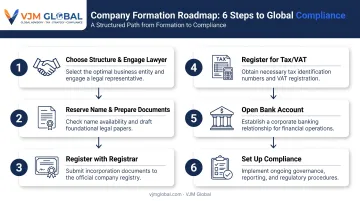
Step 1 – Choose Your Business Structure and Engage a Cyprus Lawyer
Decide between an LTD, a branch, or a holding structure based on your actual goals, not just what sounds simplest. Then engage a Cyprus-licensed lawyer, since only they can draft and certify your Memorandum and Articles of Association.
Common miss: picking a structure without considering how it interacts with Canadian tax residency rules.
Step 2 – Reserve Your Company Name and Prepare Documents
Check name availability through the Cyprus online Business Register, then submit for approval. Prepare your Memorandum and Articles of Association, plus director and shareholder ID and proof of address.
Common miss: submitting incomplete KYC paperwork, which causes registration delays that stack up fast.
Step 3 – Register the Company with the Registrar of Companies
Your lawyer submits HE1, HE2, and HE3 forms with certified documents, either online or by hand. Once fees are paid, you'll receive your Certificate of Incorporation, along with confirmation of directors, shareholders, and registered office.
Common miss: budgeting only for the €165 government fee and forgetting legal certification costs sit on top of it.
Step 4 – Register for Tax and VAT
Obtain a Tax Identification Number, then register for VAT if your turnover crosses €15,600 in the prior 12 months (or is expected to in the next 30 days). Cyprus's standard VAT rate is 19%.
Common miss: treating Cyprus tax registration as the finish line and overlooking Canadian obligations like T1134 filings that run in parallel.
Step 5 – Open a Corporate Bank Account
Prepare a full KYC package: incorporation documents, passports, CVs for directors, and proof of source of funds. If a traditional bank's 1–2 month timeline is too slow for your launch plans, an Electronic Money Institution (EMI) may move faster.
Common miss: assuming banking will move at the same speed as company registration — it rarely does.
Step 6 – Set Up Compliance, Accounting, and Ongoing Operations
Arrange a registered office, a company secretary, and annual accounting or audit support — all required under Cyprus law. File annual returns with the Registrar to stay in good standing.
Common miss: underestimating ongoing compliance costs and missing filing deadlines when you manage everything from a Canadian time zone.
How VJM Global Supports Canadians Expanding into Cyprus
Running a Cyprus incorporation project from Canada means juggling two regulatory systems at once: Cyprus registration and tax requirements, and Canada's parallel reporting obligations. Doing that without a firm that has handled cross-border entity formation before invites delays.
VJM Global brings 30+ years of experience in entity formation, accounting, tax, and compliance across 100+ countries. That cross-border scope is built for work like Cyprus incorporation: local registration handled in-market, with Canadian tax and reporting obligations kept in view so the two sides stay aligned.
For a Canadian founder, support typically covers:
- Cyprus company registration and statutory filings
- Coordination with Canadian reporting so dual-jurisdiction duties stay clear
- Accounting, tax, and compliance once the entity is live
- One coordinating team so nothing drops between the two systems
Conclusion
Starting a business in Cyprus from Canada is achievable without setting foot on the island. What matters is getting the fundamentals right:
- Pick the right legal structure for your goals
- Prepare complete documentation before you file
- Set realistic banking and KYC timelines
Speed matters less than clarity. A founder who understands the process and budgets properly will move faster than one who rushes registration and stalls at bank KYC for months.
Long-term, dual compliance—Cyprus filings and Canadian reporting—keeps the structure useful rather than a liability. VJM Global supports Canadian founders with Cyprus entity formation, tax, and ongoing filings when you want hands-on help across both sides.
Frequently Asked Questions
How much does it cost to start a company in Cyprus?
Government registration fees start around €165-235, but total first-year costs, including legal fees, a registered address, and accounting, run higher. Get itemized quotes since these vary significantly by provider.
Which business is most profitable in Cyprus?
IT and tech, financial services, shipping, and real estate consistently perform well in Cyprus. IP-holding structures also benefit from the country's IP Box regime, which offers an 80% notional deduction on qualifying profits.
Can a Canadian register a company in Cyprus without visiting in person?
Yes. Incorporation can be filed electronically through a Cyprus-licensed lawyer, who handles the required document certification on your behalf. Exact execution requirements depend on your lawyer's process.
How long does it take to open a corporate bank account in Cyprus from Canada?
Traditional banks typically take 1-2 months for KYC review. EMI (electronic money institution) alternatives can often move faster, sometimes within about a week, though this depends on your specific ownership and documentation.
Do Canadians need to report a Cyprus company to the CRA?
Generally yes. Canadian residents owning foreign corporations typically face reporting obligations, including Form T1134, due 10 months after year-end. Consult a cross-border tax advisor to confirm your specific requirements.
What is the corporate tax rate in Cyprus?
Cyprus's standard corporate tax rate is 15%, effective January 1, 2026 (up from the previous 12.5%). Confirm current rates at the time of filing, as thresholds and rules can shift.