Introduction
Cyprus keeps showing up on shortlists for US entrepreneurs building EU-facing companies, holding structures, or IP-licensing entities.
The appeal is real: full EU market access, a corporate tax rate that's been one of the lowest in the bloc, and a legal system shaped by English common law rather than an unfamiliar civil code.
That said, the corporate tax rate is shifting. Cyprus's headline rate has sat at 12.5%, but it's rising to 15% from January 2026, so plan around the new figure, not the old one.
Incorporation itself moves quickly. What most guides skip is everything around it: the mandatory local lawyer, cross-border KYC banking delays, and parallel US tax reporting like Form 5471 that runs alongside your Cyprus paperwork.
This guide walks through the actual remote registration process, what's required from a US applicant, realistic cost and timeline factors, common pitfalls, and a few alternative structures worth weighing first.
Key Takeaways
- Cyprus permits 100% foreign ownership with no US founder visit required
- Government filing fees stay low; professional and legal fees drive most of the cost
- Only a Cyprus Bar-licensed lawyer can prepare and sign incorporation documents
- US owners must plan for Form 5471, GILTI, Subpart F, and FBAR before filing
- Wrong entity type or skipped US tax coordination are the costliest mistakes to fix later
Step-by-Step: How to Set Up a Business in Cyprus from the USA
Step 1: Choose Your Structure and Decide on Tax Residency
Most US founders form a private limited company (LTD), Cyprus's standard vehicle and the closest equivalent to a US corporation. If your existing US business is simply extending operations into Cyprus rather than starting fresh, a branch or representative office may fit better.
The bigger decision is tax residency:
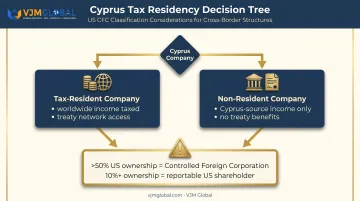
- Tax-resident companies (managed and controlled in Cyprus) are taxed on worldwide income and can access Cyprus's double-tax treaty network.
- Non-resident companies are taxed only on Cyprus-source income but generally can't claim treaty benefits.
From 2026, Cyprus-incorporated companies are treated as tax resident by default unless a treaty says otherwise. That residency decision doesn't erase US rules, though.
A foreign corporation counts as a Controlled Foreign Corporation (CFC) when US shareholders own more than 50% of vote or value, and any US person owning 10% or more is treated as a reportable "US shareholder." A sole US founder trips both wires immediately, so this isn't a detail to sort out later.
Step 2: Reserve Your Company Name Remotely
Name applications go through the Registrar of Companies (RCOR), and in practice a lawyer or licensed agent files on behalf of a US applicant. The fee structure is straightforward:
| Filing type | Name approval fee |
|---|---|
| Standard | €10 |
| Accelerated | €30 (€10 + €20 surcharge) |
Because official turnaround times aren't published and can vary, most remote applicants pay the small accelerated premium anyway. It removes one variable from a process that's already crossing five to seven time zones. Run your preferred name through the Registrar's online search first; a name too similar to an existing entity gets rejected outright, costing you another filing cycle.
Step 3: Appoint a Licensed Cyprus Lawyer and Grant Power of Attorney
This is the step that surprises most US founders. Cyprus law requires a Bar-licensed lawyer to draft and sign the Memorandum, Articles of Association, and the HE1 statutory declaration. You cannot self-file, no matter how straightforward your structure is.
Your lawyer will need, at minimum:
- Certified copies of your passport
- Proof of US residential address
- Full UBO (ultimate beneficial owner) ownership chain
- A reference letter, often from a bank, accountant, or existing lawyer
These can be notarized and sent remotely. Once your lawyer has everything, a Power of Attorney lets them sign and file on your behalf. That is the mechanism that removes the need to travel to Cyprus entirely.
Step 4: File With the Registrar and Obtain Incorporation Certificates
Your lawyer submits the HE1 (statutory declaration), HE2 (registered office notification), and HE3 (first directors/secretary notification), along with the signed Memorandum and Articles. The Registrar issues certificates covering incorporation, directors and secretary, shareholders, and registered office.
Base incorporation runs €165, with a €100 surcharge for accelerated processing. Add the accelerated name fee and the total premium comes to €120. Note: even though you reside in the USA, a registered office address in Cyprus is mandatory for every company on the register.
Step 5: Register for Tax, VAT, and Social Insurance
Once incorporated, your company needs a Cyprus Tax Identification Code, applied for through the Tax For All (TFA) portal. From mid-2026, TFA becomes the sole channel for these registrations.
- VAT registration is mandatory once taxable turnover exceeds €15,600 (with a separate €10,251.61 threshold for intra-EU acquisitions)
- Social insurance registration is required with the Social Insurance Services the moment you plan to hire employees locally
Skip these and you risk penalties that stack quietly while you're focused on the bigger incorporation milestones.
Step 6: Open a Cyprus Corporate Bank Account Remotely
This step trips up more US founders than any other. Banks apply strict AML/KYC checks to non-resident applicants and expect you to submit:
- Incorporation and Memorandum/Articles certificates
- Full UBO ownership chain and director/signatory identification
- A business plan describing activities and expected transaction flows
- Documented proof of source of funds
Non-resident reviews commonly take longer than local applications. Completeness of your file matters more than anything else for speed.
Many founders use an EMI or fintech multi-currency account (such as Wise Business or Revolut Business, both regulated under EBA-registered licenses) as an interim solution while a traditional bank account works through review. Confirm any provider's authorization status before relying on it.
What You Need Before You Start
Incomplete preparation is the single biggest cause of delay for US applicants filing remotely. Gathering everything before you engage a lawyer saves weeks.
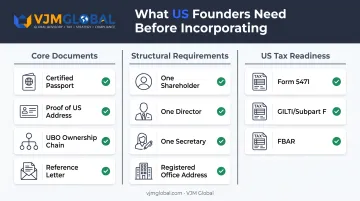
Core Documents and Information
- Certified passport copies for all shareholders and directors
- Proof of US residential address (utility bill or bank statement)
- Complete ultimate beneficial owner (UBO) ownership chain
- Reference or good-standing letters from a bank, accountant, or lawyer
Minimum Structural Requirements
Cyprus law keeps structural requirements simple:
- One shareholder (individual or corporate)
- One director
- One company secretary
- A mandatory registered office address in Cyprus
US-Side Tax and Compliance Readiness
Talk to a US tax advisor before you incorporate, not after. Owning a foreign company triggers separate US filing obligations, each with its own penalty structure for late or missed filing:
- Form 5471 for controlled foreign corporations
- Potential GILTI and Subpart F income inclusions
- FBAR reporting for foreign financial accounts
These sit entirely apart from your Cyprus filings.
Key Factors That Affect Your Cyprus Company's Cost, Timeline, and Tax Outcome
Two US founders can set up nearly identical Cyprus companies and end up with very different costs and tax exposure, depending on a handful of choices made early.
- Tax residency status: Whether your company is Cyprus tax-resident or non-resident determines if it's taxed on worldwide or Cyprus-source income only. That choice directly affects treaty eligibility and your exposure under US CFC rules.
- Standard vs. expedited Registrar processing: The fee gap is modest (roughly €120 total across name approval and incorporation). For founders juggling time zones, that is often worth paying to remove uncertainty from the timeline.
- Share capital amount: Higher declared share capital increases stamp duty on the HE1 filing. Most founders keep nominal capital modest to minimize this upfront cost—ask your lawyer for the current recommended figure rather than outdated benchmarks.
- Nominee directors or local substance: A local board presence helps demonstrate "management and control" in Cyprus, supporting treaty benefits and reducing US CFC scrutiny. It also adds real annual cost, so weigh it against the tax benefit you actually need.
Common Mistakes and Troubleshooting Tips for US Founders
Most problems US founders run into are avoidable with better sequencing, not more paperwork.
- Skipping US-side tax coordination before incorporating. This causes the most expensive surprises: unplanned Form 5471 and GILTI exposure after the fact. Engage a firm experienced in both US reporting and cross-border formation, like VJM Global’s tax and entity-setup team, before filing anything in Cyprus.
- Assuming you can register without a licensed Cyprus lawyer. Filings signed by anyone other than a Bar-licensed lawyer get rejected outright, forcing a restart.
- Sending incomplete KYC documentation to the bank. Missing certified documents or a vague source-of-funds narrative can add weeks to an already lengthy AML review. Prepare everything upfront with a clear written explanation of where the money comes from.
- Overlooking Cyprus's audit and accounting requirements. Unlike small-business exemptions common in the USA, Cyprus companies generally need annually audited financial statements. Budget for ongoing accounting and audit costs from day one and confirm current thresholds with your accountant.
When Cyprus Isn't the Right Fit: Alternatives to Consider
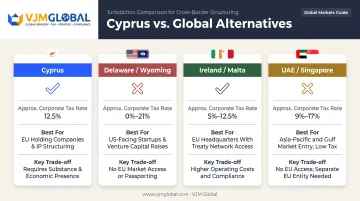
Cyprus works well for EU-facing operations, holding structures, and IP-focused businesses. Skip it if you don't need EU access, want a simpler US-only entity, or prefer a different tax and compliance mix.
| Alternative | Best for | Trade-offs |
|---|---|---|
| Delaware or Wyoming LLC | Simple US entity; no EU exposure needed | No EU presence; no Cyprus treaty network |
| Ireland or Malta | English-speaking EU base; fewer Greek-language filings | Different tax and compliance loads (Ireland 12.5% trading rate; Malta headline 35%) |
| UAE or Singapore | Very low corporate/personal tax without EU market access | Different treaty networks; substance rules are not EU-style |
VJM Global supports entity setup and compliance across the US, Ireland, UAE, Singapore, and Cyprus. We can compare real cost and filing burden for each path before you commit—not after you've already filed.
Frequently Asked Questions
How much does it cost to set up a company in Cyprus?
Government filing fees start around €175-€300 depending on processing speed, but total professional and legal fees typically push the all-in cost to €1,200-€3,000. Add €1,000+ annually for accounting and audit once the company is running.
Can a non-resident open a company in Cyprus?
Yes. Cyprus allows 100% foreign ownership with no nationality restrictions, and the entire process can be completed remotely through a licensed lawyer acting under Power of Attorney.
Is Cyprus 0% income tax?
No. Cyprus's standard corporate rate is rising to 15% from 2026 (up from 12.5%). Specific exemptions exist, such as gains on qualifying securities, but there's no blanket 0% rate.
Do I need to travel to Cyprus to register my company?
No. A Power of Attorney lets your Cyprus lawyer sign and file all incorporation documents, and in many cases handle bank account setup, without you visiting.
How does the IRS treat a Cyprus company owned by a US citizen?
US owners generally must file Form 5471 annually and may face GILTI or Subpart F income inclusions even without receiving a dividend. Coordinate with a US tax advisor before incorporating, not after.
How long does it take to set up a Cyprus company from the USA?
Name approval and incorporation can move in days to a couple of weeks with accelerated processing. Bank account KYC review for non-resident applicants is usually the longest stretch, often adding several weeks beyond incorporation itself.