
These aren't isolated events. UAE-based entrepreneurs are eyeing Ghana because it's English-speaking, sits inside the ECOWAS trade bloc, and has a growing appetite for tech and outsourcing work. Many are also looking to diversify beyond Gulf-only trade routes.
This interest isn't limited to one type of investor. Emirati founders, Indian and other diaspora traders based in the UAE, UAE-registered trading firms, and remote-first tech companies are all exploring Ghana. This guide walks through entity types, registration steps, real costs, and the practical details that matter before you commit capital.
TL;DR
- Foreign investors get several legal entity options; external companies cost more and follow different registration steps than local structures
- Company registration can move fast—banking, permits, and full operational readiness usually take longer
- Plan for GIPA capital rules, mandatory TIN registration, and sector-specific permits before you start
- Advisors who know both UAE and Ghanaian systems remove most cross-border setup friction
What Does Starting a Business in Ghana Involve for a UAE-Based Entrepreneur?
It means setting up a legally recognised entity in Ghana that you, or your UAE-registered company, own or operate — either remotely or with boots on the ground.
UAE founders generally choose one of three paths:
- An external company: a registered branch of your UAE entity
- A fully foreign-owned Ghanaian limited liability company
- A joint venture: partnership with a Ghanaian partner
The Ghana Investment Promotion Centre (GIPC) governs foreign participation and capital rules. This is a different system entirely from the UAE's free zone or mainland framework, so don't expect a like-for-like comparison.
What to Know Before You Start a Business in Ghana from the UAE
UAE entrepreneurs are used to fast, digital-first incorporation. Ghana's process is more documentation-heavy, and that catches people off guard.
Here's what actually matters before you file anything:
- Capital requirements have changed. Ghana's Investment Promotion Authority Act (Act 1173), effective 15 July 2026, repealed the old GIPC Act and removed the previous $200,000 (joint venture) and $500,000 (wholly foreign-owned) floors for most sectors.
- Trading is the exception. Trading enterprises still face a reported $500,000 cash-equity requirement and a rule that at least 75% of staff be skilled Ghanaians. Confirm both in writing with GIPA before you commit funds.
- Time zones work in your favour. Ghana and the UAE sit only 2-3 hours apart, so remote coordination for formation and banking is manageable.
- Currency and repatriation need planning. Profits move from Ghanaian cedis back to UAE dirhams through the banking system, and you'll want a bank comfortable handling that flow.
- Some sectors are off-limits. Informal retail and certain small-scale trading activities remain reserved for Ghanaian citizens.
- Timelines vary by task. Core incorporation can move quickly, but banking, tax registration, and sector permits stretch the full setup timeline into weeks, not days.

Why UAE Entrepreneurs Are Choosing Ghana (When It Makes Sense)
Ghana isn't a fit for every business model, but under the right conditions, it makes a strong case.
The bilateral momentum is real
The reported $1 billion UAE-Ghana AI and innovation hub agreement signals serious confidence between the two governments, even though construction wasn't scheduled to begin until 2026.
Separately, Dubai Chambers officially confirmed AfroVision Technologies' expansion into Ghana, pairing the UAE firm with Ghanaian BPO company On-Point Virtual Assistants to train local talent for remote work.
Other structural advantages
- Regional market access — gateway to ECOWAS and the African Continental Free Trade Area (customs and rules of origin still apply)
- Political stability relative to some neighboring West African markets
- Growing BPO demand, illustrated directly by the AfroVision partnership
- English as the official language, which cuts communication friction for UAE teams managing operations remotely
- A young, increasingly digital workforce — World Bank diagnostics still flag ICT skills gaps, which is why training partnerships like AfroVision's matter
Legal Structures and Registration Requirements in Ghana
Your structure choice shapes cost, timeline, and how you're taxed. Here are the main routes for foreign entrants.
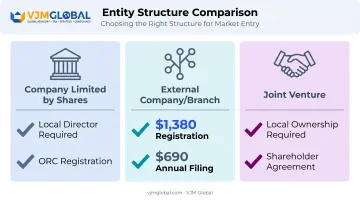
Company limited by shares
This is the most common vehicle for foreign-owned ventures. It's registered through Ghana's Office of the Registrar of Companies (ORC) under the Companies Act 2019 (Act 992), alongside GIPC registration if foreign-owned. You'll need at least one Ghana-resident director and a company secretary.
External company (branch)
This lets your UAE entity operate directly in Ghana under the same name and objects, with a resident local manager. Registration currently costs $1,380, and there's a mandatory annual Group Accounts filing that runs $690. This is notably higher than older figures floating around online, so budget accordingly.
Joint venture
Structured as a Ghanaian company with local ownership, this route is often necessary to access sectors reserved for citizens. Settle equity split, board seats, and profit share in the shareholders' agreement before you file.
Other essentials that apply across structures:
TIN registration is mandatory for the company itself, plus every director and shareholder, via the Ghana Revenue Authority (GRA)
Online filing through ORC's portal helps remote UAE applicants avoid unnecessary travel
Sector licences may still apply after incorporation, depending on your activity
One common misstep: assuming free-zone-style tax exemptions carry over from the UAE. They don't. Ghana's standard corporate tax rate is 25%, and you'll only avoid it with specific, secured incentives.
How to Start a Business in Ghana from the UAE – Step by Step
This breaks the cross-border process into stages you can actually execute. Three mistakes trip up most first-timers:
- Assuming a UAE license transfers automatically
- Underestimating capital or workforce thresholds
- Delaying the local bank account until it becomes a bottleneck
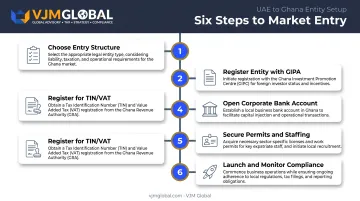
Step 1 – Choose Your Entry Structure and Validate the Opportunity
Decide between a wholly foreign-owned company, an external branch, or a joint venture based on your sector and how much capital you're willing to deploy. Validate demand through market research or a Dubai Chamber connection with Ghana-based contacts.
Common miss: entering a reserved sector without a compliant joint venture in place first.
Step 2 – Confirm Capital Requirements and Register the Entity
Get written confirmation from GIPA on your activity's classification and capital requirement, particularly if you're in trading. Then prepare your name search, incorporation documents, and file with both GIPA and the Registrar General.
Common miss: underfunding the entity relative to GIPA's expectations, which stalls approval.
Step 3 – Register for Tax (TIN) and Complete Statutory Registrations
Obtain a TIN for the company, directors, and shareholders through the GRA. Assess VAT exposure carefully:
- Ghana's VAT regime (updated under Act 1151, effective January 2026) charges 15% VAT plus 2.5% NHIL and 2.5% GETFund
- The GHS750,000 registration threshold applies only to goods — services have no threshold at all
If you're running a BPO, consulting, or software business, you likely need VAT registration from day one, not once you hit a revenue mark.
Common miss: delaying TIN registration, which blocks both bank account opening and invoicing.
Step 4 – Open a Corporate Bank Account and Set Up Financial Operations
Find a Ghanaian bank experienced with foreign-owned accounts and cross-border transfers to the UAE. Set up local bookkeeping and understand your audit obligations from the outset.
This is also where VJM Global typically steps in, helping UAE-based businesses with entity formation, tax registration, and ongoing accounting in Ghana without an in-country team.
Common miss: assuming a UAE banking relationship simplifies Ghanaian account opening. It doesn't; local KYC requirements apply in full regardless of your existing banking history.
Step 5 – Secure Permits, Staffing, and Local Presence
Obtain any sector-specific permits your activity requires. For importers, this includes customs clearance documentation such as the bill of lading, attested invoice, packing list, and Import Declaration Form.
Then decide how you'll staff the business:
- Hire locally through direct employment
- Use an Employer of Record model to hire without a local entity
- Relocate UAE staff, which requires a work and residence permit through Ghana Immigration Service
Common miss: underestimating how long a foreign manager's work permit takes. Ghana Immigration Service doesn't publish a fixed processing time, so build in a buffer.
Step 6 – Launch, Monitor Compliance, and Stabilize Operations
Set up recurring GRA tax filing, GIPA reporting, and Registrar General renewal cycles (note: GIPA renewal moved from every two years to annual under the new Act). Track financial performance and plan your repatriation process back to the UAE.
Common miss: treating Ghana compliance as a one-time setup task instead of an ongoing annual commitment.
Conclusion
Starting a business in Ghana from the UAE is achievable within weeks for straightforward structures. It still demands real attention to GIPA capital rules, tax registration, and sector restrictions that often differ from Gulf norms.
UAE entrepreneurs who lock in capital, structure, and compliance early are best placed to tap Ghana's digital economy and the investment corridor both governments are promoting. VJM Global helps with entity formation, tax registration, and ongoing compliance so that plan holds after incorporation.
Frequently Asked Questions
How much will it cost me to register my business in Ghana?
Costs vary by structure. External company branches run around $1,380 to register, plus a $690 annual Group Accounts filing. Local company fees are lower—confirm the current Registrar General schedule before you file.
How do I start up my own small business in Ghana?
The core steps are: name search, choosing a legal structure, registering with the Registrar General, obtaining a TIN from the GRA, and securing any required sector permits.
What business can I do with 10,000 cedis in Ghana?
That budget suits small-scale local trading or service businesses. Foreign investors from the UAE, however, typically face higher GIPA capital expectations, especially for trading activities.
What products sell fast in Ghana?
Consumer electronics, imported goods, agribusiness products, and digital or tech services currently see strong demand.
Can a UAE company open a branch in Ghana without a local partner?
Yes, through the external company registration route. A Ghanaian joint venture partner only becomes necessary if your activity falls into a sector reserved for citizens.
How long does it take to register a foreign-owned company in Ghana?
Core registration can move quickly, sometimes within days for expedited service, but full operational readiness, including banking, TIN registration, and permits, often takes several weeks in total.