Introduction
UAE businesses are looking west toward Africa, and Ghana keeps coming up. Its economy grew 6.0% in 2025 and accelerated to 6.4% in Q1 2026, according to the Ghana Statistical Service. That's a rare growth story right now.
But the paperwork doesn't care about growth stats. Many UAE founders struggle with the Registrar-General's Department (now the Office of the Registrar of Companies, or ORC), the newly overhauled foreign-investment law, and Ghana's tax registration chain. Rules also changed significantly in 2026, and older guides you'll find online are already outdated.
This guide walks through company types, the incorporation sequence, the new investment-registration regime, and what compliance actually looks like once you're operational.
Key Takeaways
- A Private Limited Company is Ghana's equivalent of an LLC, and most sectors allow full foreign ownership
- Foreign-owned entities must register with GIPA (not the former GIPC) under the July 2026 law
- Trading enterprises need US$500,000 cash equity and a workforce at least 75% skilled Ghanaians
- Corporate tax is 25%; VAT plus levies total 20%
- At least two directors are required, and one must live in Ghana
Why UAE Businesses Are Choosing Ghana
Ghana sits inside the Economic Community of West African States (ECOWAS), a bloc of over a dozen countries. The ECOWAS Trade Liberalization Scheme aims to eliminate customs duties between member states, though ECOWAS itself notes that access depends on satisfying rules-of-origin and approval procedures.
Incorporating in Ghana doesn't automatically hand you tariff-free access across the region. Goods still need to qualify. Gulf investors are drawn by more concrete commercial factors:
- Gold exports hit US$5.24 billion in the period covered by the Bank of Ghana's May 2025 Monetary Policy Report, up 76.4% year-on-year
- Cocoa added another US$1.8 billion, with oil reinforcing a resource economy that has real export momentum
- Active UAE–Ghana diplomacy, including an April 2026 meeting between Ghana's trade ministry and a Dubai Chamber delegation, per the UAE Ministry of Foreign Affairs
No finalized trade agreement exists yet — treat the diplomatic track as relationship-building, not a done deal.
Private Limited Company vs Other Structures in Ghana
Ghana's Companies Act, 2019 (Act 992) governs company structures. Here's how the options stack up.
Private Limited Company (Ltd)
- Shares are privately held with restricted transfer rights
- Membership is capped at 50 shareholders, with limited exceptions
- Requires at least two directors, one ordinarily resident in Ghana
- Shareholder liability is limited to unpaid share amounts
- Cannot make public share offers
Public Limited Company (PLC)
- Falls outside the private-company definition and may raise capital from the public
- Same two-director baseline generally, though a constitution allowing cumulative voting requires three directors
- Faces heavier disclosure and reporting obligations
- Common among banks and large manufacturers
Does Ghana have an "LLC"?
Not by name. The Private Limited Company is the functional equivalent: same limited liability shield, different label. If a UAE lawyer tells you to "form an LLC in Ghana," they mean this structure.
Sole proprietorship and partnership
Sole proprietors carry unlimited personal liability, as the Office of the Registrar of Companies (ORC) explicitly states. Partners in an incorporated partnership are jointly and severally liable for firm obligations. Neither structure shields a UAE founder's personal or corporate assets, which is why most UAE investors choose the Private Limited Company.
A UAE company or individual can typically hold 100% of the shares in a Ghanaian Private Limited Company. A short list of restricted sectors is the exception, covered below.
Step-by-Step Registration Process for UAE Investors
Here's the practical sequence, updated for the current framework.
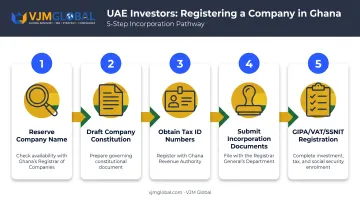
- Reserve your company name through the ORC's online portal. Check availability before drafting anything else.
- Draft the Company Constitution under Act 992, naming shareholders, directors, share structure, and the registered office. Remember: you need at least two directors, and one must be a Ghana resident.
- Obtain Tax Identification Numbers (TIN) for all UAE shareholders and directors through the Ghana Revenue Authority (GRA). Company TINs are issued to the company separately.
- Submit incorporation documents and pay fees, including stamp duty. PwC's Ghana tax summary puts stamp duty around 1% of stated capital as a budgeting benchmark, so get a current ORC assessment before wiring funds. You then receive a Certificate of Incorporation.
- Complete GIPA filing, register for VAT and SSNIT, and open a bank account. Foreign applicants typically finish GIPA registration after incorporation. VAT registration is compulsory once turnover crosses GHS750,000 for goods businesses (up from the old GHS200,000 threshold). SSNIT registration is mandatory from your first employee.
Coordinating name reservation, constitution drafting, TIN applications, and GIPA filing across two time zones is where most UAE founders lose weeks. VJM Global's entity formation team handles this filing chain directly with Ghana's regulators, which cuts down on the back-and-forth that typically slows foreign applicants down.
GIPA Registration: What UAE-Owned Companies Must Know
Here's the part that catches most people off guard: the old GIPC Act, 2013 (Act 865) no longer applies. The Ghana Investment Promotion Authority Act, 2026 (Act 1173) repealed it on 15 July 2026. If you're reading a guide that cites US$200,000 or US$1,000,000 thresholds tied to Act 865, that guide is out of date.
Under the current regime, any enterprise with foreign participation, including UAE shareholders, still must register with the Ghana Investment Promotion Authority (GIPA) after Office of the Registrar of Companies (ORC) incorporation and before starting operations. What's changed is the capital math.
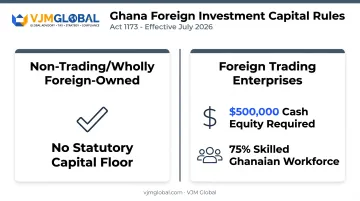
Current capital rules (Act 1173):
- Non-trading joint ventures and wholly foreign-owned companies: No general statutory capital floor
- Foreign trading enterprises: US$500,000 cash equity, plus a workforce that's at least 75% skilled Ghanaians
That's a real shift. The old tiered capital system is gone, replaced by a simpler test: are you classified as "trading," or not? That classification decides whether the big capital hurdle applies at all.
Documents you'll typically need:
- Certificate of Incorporation
- Company Constitution and current ORC particulars
- Beneficial ownership declaration
- Completed GIPA registration form
- Evidence of the US$500,000 cash equity (trading enterprises only)
GIPA must process a complete application within five days, and registration must now be renewed annually — a change from the old system. Existing Act 865 registrations carry over, but the annual-renewal requirement applies going forward.
Restricted sectors remain off-limits to foreign investors, including UAE nationals, under Act 1173 section 32:
- Petty trading and market hawking
- Beauty salons and barbershops
- Taxi services with fewer than 25 vehicles
- Exercise books and basic stationery production
- Retail of finished pharmaceuticals
- Sachet water production
Small-scale mining is separately restricted to Ghanaian citizens under the Minerals and Mining Act, 2006. Confirm your activity against both lists before you commit capital.
Tax and Ongoing Compliance Obligations
Once incorporated and GIPA-registered, the compliance clock starts running.
Corporate income tax is 25% at the general rate, though sector, location, and industry-specific rules can shift that. Accurate bookkeeping from day one matters here, not later.
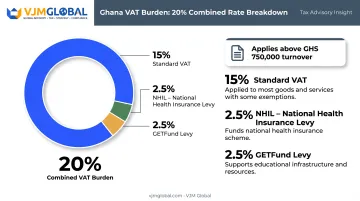
VAT now works differently than most older guides describe. The current structure combines:
- 15% standard VAT
- 2.5% NHIL (National Health Insurance Levy)
- 2.5% GETFund Levy
That's a 20% combined burden on VAT-registered goods and services once you cross the GHS 750,000 threshold.
PAYE withholding applies to any locally hired staff, with employer returns due by the 15th of the following month.
Annual obligations to track separately:
- ORC annual return, filed within 36 days of circulating financial statements to shareholders
- GIPA renewal, now annual under Act 1173
- SSNIT contributions for every registered employee, Tier 1 and Tier 2
Running four separate compliance calendars (GRA, ORC, GIPA, SSNIT) while managing UAE-side tax obligations is a lot for a founder without a finance team on the ground.
VJM Global's accounting, payroll, and multi-jurisdiction tax compliance services handle Ghana-side filings and keep your UAE reporting in sync, so you are not building duplicate finance functions in two countries.
Frequently Asked Questions
Does Ghana have an LLC?
Not by that name. Ghana's Companies Act, 2019 uses "Private Limited Company (Ltd)" as its equivalent structure, offering the same limited liability protection investors expect from an LLC.
What documents are required for GIPA registration?
Core documents include the Certificate of Incorporation, Company Constitution, beneficial ownership declaration, and (for trading enterprises) evidence of the US$500,000 cash equity requirement.
What qualifies as a public company?
A Public Limited Company offers shares to the public and faces stricter disclosure rules than a Private Limited Company, generally requiring at least two directors, with three needed if the constitution allows cumulative voting.
Can a UAE company own 100% of a Ghanaian business?
Yes, in most sectors. Exceptions include a short list of reserved activities like petty trading, beauty salons, small taxi fleets, and small-scale mining.
How long does company registration take in Ghana?
Timelines vary based on name approval speed, document completeness, and GIPA processing (which has a five-day statutory target for complete applications). Complete filings with professional support usually clear faster and avoid resubmission delays.
What is the minimum capital required for a UAE-owned company in Ghana?
Non-trading foreign-owned companies currently face no general statutory capital floor under Act 1173. Trading enterprises need US$500,000 cash equity plus a workforce that's at least 75% skilled Ghanaians. Confirm current rules before committing funds, since this framework changed in July 2026.