Introduction
Singapore-based entrepreneurs are increasingly registering businesses in the UK — attracted by the country's non-resident ownership rules, its access to established financial infrastructure, and a deepening bilateral trade relationship. The UK-Singapore Free Trade Agreement, which came into force in February 2021, has reinforced those ties.
Total bilateral trade between the two nations reached S$25.06 billion in 2025, reflecting how actively businesses on both sides are crossing borders.
If you're considering UK expansion, the questions tend to cluster around the same concerns: whether you need to relocate, which structure suits a non-resident founder, and how cross-border taxes actually work. This guide addresses each of those directly — a practical, step-by-step walkthrough built for Singapore-based founders.
Key Takeaways
- Singapore residents can register and own a UK limited company without relocating—the entire process is completed remotely online
- A private limited company (Ltd) offers limited liability and is the most suitable structure for non-resident founders
- Online registration costs £100 (as of February 2026) and typically completes within 24 hours; Corporation Tax, VAT, and PAYE registrations are separate steps where applicable
- You'll need a UK registered office address, which third-party services provide for approximately £50–275 annually
- The UK-Singapore Double Taxation Agreement prevents income being taxed twice, so understanding it early is key to structuring your company and repatriating profits efficiently
Why Singapore Entrepreneurs Are Choosing the UK to Expand
The UK remains highly accessible for non-resident founders — no minimum capital requirement, no residency requirement for directors, and a transparent regulatory environment. During the financial year ending March 2025, 801,864 companies were incorporated, including 14,574 overseas companies registering UK establishments.
Singapore offers specific structural advantages for UK entry:
- The UK-Singapore FTA reduces tariffs and simplifies cross-border trade for goods and services
- Both jurisdictions operate under English common law, which cuts legal complexity when drafting contracts or structuring entities
- Singapore's position as Southeast Asia's financial centre makes it a direct entry point for UK expansion
- Enterprise Singapore identifies five high-potential sectors for Singapore businesses entering the UK: fintech, digital technology, e-commerce, green energy, and lifestyle retail

For founders already operating across Asian time zones, the UK's business hours also overlap with key European and Middle Eastern markets — a practical edge when managing multi-region operations from Singapore.
What to Know Before You Register a UK Business from Singapore
Cross-Border Operational Realities
Registration is quick and remote, but running the business successfully requires planning for three key operational areas.
UK Banking
Traditional banks like Barclays and HSBC often require in-person verification — a hurdle for non-residents. Digital banks are far more practical:
- Wise Business: Accepts non-UK resident directors; requires UK Companies House registration and proof of ID/address from your country of residence
- Tide: Accepts non-UK residents with conditions; additional verification may apply
- Starling: Requires all directors to be UK residents (not suitable for non-residents)
Account opening typically takes 1–4 weeks depending on the provider. Multi-currency accounts like Wise Business simplify GBP-to-SGD transfers and international invoicing.
Registered Office and Time Zones
You'll need a UK physical address — not a PO box — to satisfy Companies House requirements. Third-party registered office services run approximately £50–275 per year, depending on location and services included.
Time zone coordination is the other ongoing reality. Singapore is 7–8 hours ahead of the UK, so scheduling client calls and meeting regulatory deadlines takes deliberate planning from day one.
The Visa Question
Registering a UK company does not require a visa. Many Singapore-based founders manage UK entities entirely remotely. However, physically working or managing the business from within the UK does require a visa.
The most relevant route for experienced entrepreneurs is the Innovator Founder Visa:
- Open to all non-UK and non-Irish nationals, including Singaporeans
- Requires a new, innovative, viable, and scalable business idea
- Requires endorsement from an approved UK endorsing body (endorsement application costs £1,000)
- Must show at least £1,270 in your bank account for 28 consecutive days before applying
- English language requirement: CEFR Level B2
- Granted for up to 3 years, with eligibility for settlement after 3 years
- No minimum investment amount required
One route worth ruling out early: the Scale-Up Worker visa applies to employees of approved scale-up businesses, not to self-employed founders or directors managing their own entity.
Timeline and Early Costs
Companies House online registration completes within 24 hours in most cases. Budget additional time for:
- UK bank account setup: 1–4 weeks
- Registered office address arrangement: same day to 1 week
- Tax registrations: immediate online
Typical upfront costs:
- Companies House online registration: £100
- Registered office service: £50–275 per year
- Professional formation fees (if using an agent): varies by provider
- UK bank account: typically free for basic accounts
- Corporation Tax registration: free
- Accountancy fees: budget for ongoing compliance support
Choosing the Right UK Business Structure as a Non-Resident
Private Limited Company (Ltd) vs. Sole Trader
For Singapore-based founders, the choice is straightforward:
Sole trader registration requires a National Insurance number, which can only be applied for when you are physically in the UK with the right to work. This makes the sole trader structure impractical for non-residents.
A Private Limited Company (Ltd) is the default choice for non-residents and offers:
- Personal assets stay protected through legal separation between you and the company
- Non-UK-resident directors and shareholders are fully permitted — no residency needed
- Corporation Tax applies to profits rather than personal income tax, which can reduce your overall tax burden
- Stronger credibility with UK clients, investors, and banking partners
- Ability to raise investment and issue shares as the business grows
There is no minimum share capital requirement — companies are commonly registered with £1 in share capital.
UK Branch vs. Subsidiary
If you already operate a registered company in Singapore, expanding into the UK means choosing between two structures — a branch of your existing entity or a standalone UK subsidiary:
| Feature | UK Branch | UK Subsidiary (Ltd) |
|---|---|---|
| Legal status | Extension of Singapore parent; not a separate legal entity | Separate UK-incorporated legal entity |
| Liability | Parent company bears full liability | Limited liability; parent's exposure limited to capital invested |
| Compliance | Must register under Overseas Companies Regulations | Standard UK company filing obligations |
| Tax treatment | Worldwide profits may be taxable in UK | Only UK-sourced profits taxable in UK |
| Preferred by | Founders who need a temporary or transitional UK presence | Most founders, for cleaner liability separation and more predictable tax exposure |
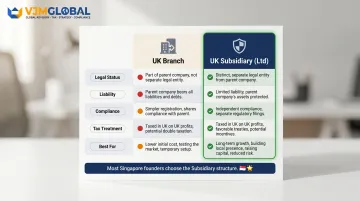
For most Singapore entrepreneurs, the subsidiary structure is the practical default — it draws a clean line between the parent company's obligations and UK operations from day one.
How to Register a UK Company from Singapore – Step by Step
Each step below can be completed online or through a UK formation agent without travelling to the UK.
Step 1 – Choose a Company Name and Secure a Registered Address
Company name rules:
- Must be unique — check availability on the Companies House register
- Cannot be misleading or identical to an existing name
- Must end in "Limited" or "Ltd"
- Consider searchability and brand consistency
UK registered office address:
Every UK limited company must have a UK registered address (not a PO box). Singapore-based founders typically use a registered office service provider, which costs approximately £50–275 per year depending on location (London addresses cost more) and whether mail forwarding is included.
Step 2 – Register with Companies House
What you need to register:
- Memorandum of Association: Legal statement signed by all initial shareholders agreeing to form the company (created automatically if registering online)
- Articles of Association: Written rules about running the company (you can use standard "model articles" or customised versions)
- Director details: Full name, date of birth, nationality, occupation, service address, residential address
- Shareholder details and Statement of Capital: Shareholder names, number/class of shares, currency and value, rights attached
- UK registered office address
- Registered email address (required since March 2024)
- SIC code(s): Standard Industrial Classification code describing your business activity
- People with Significant Control (PSC): Details of anyone holding more than 25% of shares or voting rights
Cost and processing time:
As of 1 February 2026, Companies House fees are:
- Online incorporation: £100
- Same-day software filing: £156
- Paper (by post): £124
Online registration typically completes within 24 hours. You'll receive a Certificate of Incorporation, which officially establishes the company.
Step 3 – Register for Corporation Tax with HMRC
Within 3 months of starting to trade, all UK limited companies must register for Corporation Tax with HMRC. "Starting to trade" includes carrying on business activity, providing services, earning interest, or managing investments.
You'll receive a Unique Taxpayer Reference (UTR) after Companies House registration, which you'll use to complete the HMRC registration online.
UK Corporation Tax rates (2025–2026):
| Profit Band | Rate |
|---|---|
| Under £50,000 | 19% (Small Profits Rate) |
| £50,000 – £250,000 | Marginal Relief applies |
| Over £250,000 | 25% (Main Rate) |
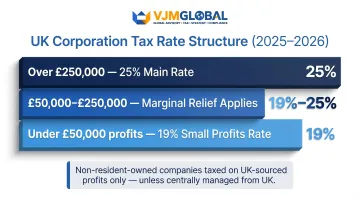
Important: UK Corporation Tax applies only to UK-sourced profits for non-resident-owned companies. However, if HMRC deems your company UK tax resident—based on where it's centrally managed and controlled—global income becomes taxable. This distinction is critical for Singapore-based directors who make key decisions from outside the UK.
Step 4 – Open a UK Business Bank Account
A UK business bank account is essential for receiving payments, managing expenses, and meeting compliance requirements.
Digital business banks are more accessible for Singapore-based founders:
- Wise Business: Accepts non-UK residents; offers multi-currency accounts with real exchange rates, ideal for GBP-to-SGD transfers
- Tide: Accepts non-UK residents with additional verification steps
- Starling: Requires UK residency (not suitable for Singapore-based founders)
Most Singapore-based founders get a Wise Business account open within 1–3 business days, making it the fastest path to operational banking.
Step 5 – Register for VAT and PAYE (If Applicable)
VAT registration:
Mandatory once taxable turnover exceeds £90,000 (the current threshold as of 2024–2026). Voluntary registration below the threshold is possible and can be beneficial if you have significant UK-based B2B clients who are VAT-registered, as it allows you to reclaim VAT on business purchases.
PAYE registration:
Required before your first payday if you're taking on UK employees or paying yourself a salary through the UK company. Note that registration cannot be completed more than 2 months in advance.
VJM Global supports Singapore-based founders through each of these registration steps—from document preparation and Companies House filing to early HMRC compliance—so you're set up correctly from day one.
UK Tax, Compliance, and Ongoing Obligations for Singapore-Based Owners
Annual Compliance Calendar
Every UK limited company must maintain the following annual compliance obligations:
| Obligation | Key Details | Deadline / Fee |
|---|---|---|
| Confirmation Statement | Filed with Companies House; updates shareholdings, directorships, registered address | At least once per year; £50 online, £110 by paper |
| Annual Accounts | Statutory accounts prepared and filed with Companies House | 9 months after financial year-end; late penalties from £150 to £1,500 (doubles if late two years running) |
| Corporation Tax Return | Submitted to HMRC each accounting period | 12 months after the accounting period ends |
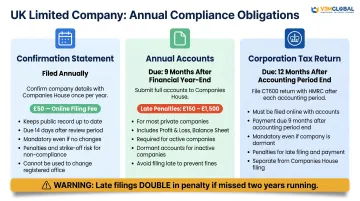
These obligations can be managed remotely with the right accounting support. VJM Global provides UK accounting and compliance services tailored to Singapore-based owners managing cross-border obligations, including bookkeeping, tax advisory, annual accounts preparation, and Corporation Tax filing.
UK-Singapore Double Taxation Agreement (DTA)
The UK-Singapore DTA prevents the same income from being taxed in both countries. Key provisions include:
| Income Type | Treaty Rate |
|---|---|
| Portfolio dividends | 0% |
| Dividends on direct investments | 0% |
| Property income dividends (e.g., UK REITs) | 15% |
| Interest | 5% (with exemptions for banks and government entities) |
| Royalties | 8% |
How it applies to Singapore-based founders:
- Profits earned by your UK company are subject to UK Corporation Tax
- Dividends paid from the UK company to you as a Singapore-based shareholder are generally not subject to UK withholding tax under the treaty (0% rate), unless they are property income dividends
If you're repatriating profits to Singapore, consult a cross-border tax advisor to structure your profit repatriation efficiently and ensure compliance in both jurisdictions.
UK Tax Residency for Companies
A company incorporated in the UK is automatically UK tax resident under statutory incorporation rules. This means your UK limited company is subject to UK Corporation Tax on its worldwide income if centrally managed and controlled from the UK.
If you're managing the UK company entirely from Singapore, the central management and control test becomes relevant. Planning this carefully helps avoid unintended personal UK tax residency and keeps profit repatriation tax-efficient.
VAT Compliance
Once VAT-registered, you must:
- File quarterly VAT returns with HMRC
- Charge VAT on UK sales of applicable goods or services
- Reclaim VAT paid on business purchases
For Singapore-origin businesses selling into the UK market, VAT has pricing and margin implications—factor it into your pricing strategy early.
UK GDPR
VAT isn't the only compliance layer affecting your UK operations. UK GDPR applies to any organisation processing data from UK customers, regardless of where the owner is based — meaning Singapore-based founders are not exempt. Compliance is mandatory and covers:
- Clear privacy policy
- Data processing agreements with third-party vendors
- Process for handling data subject requests (access, deletion, etc.)
Frequently Asked Questions
Can a foreigner set up a business in the UK?
Yes. Non-UK residents and foreign nationals can register a UK limited company. There is no residency requirement for directors or shareholders, and the entire registration process can be completed online from Singapore.
How much does it cost to set up a UK business?
Core costs include Companies House online registration (£100 as of February 2026), registered office address service (£50–£275 annually depending on location), and formation agent fees if using a professional service (typically £50–£300). Budget for additional costs such as UK bank account setup and accountancy fees for ongoing compliance.
How much money do you need to start a small business in the UK?
There is no minimum capital requirement — share capital can be as low as £1. In practice, most founders budget £500–£2,000 to cover registration, a registered address, banking setup, and first-year compliance, with additional costs depending on sector and scale.
How do I set up a business in the UK?
Choose a structure (limited company for non-residents), register with Companies House, register for Corporation Tax with HMRC, open a UK business bank account, and register for VAT or PAYE if applicable. The entire process can be completed remotely from Singapore.
Do I need to live in the UK to run a UK limited company?
No. Many Singapore-based founders manage UK companies entirely remotely, though you will need a UK registered address and should be aware of when physical presence could trigger tax implications.
Do I need a UK visa to manage my UK business from Singapore?
No visa is needed to register or own a UK company remotely from Singapore. A visa is only required if you intend to physically work or operate the business from within the UK. The Innovator Founder Visa is the most relevant route for entrepreneurs who wish to work or operate from within the UK.