Introduction
Brexit didn't close the door on UK entrepreneurs expanding into the Netherlands, but it did change the locks. Before 2021, a British founder could relocate to Amsterdam or Rotterdam with the same freedom as any EU national. That's no longer the case, and most guides on this topic still write as if nothing shifted.
This article is for UK-based founders, freelancers, and companies that want a route into the EU single market. It explains how to register a BV, open a branch, or set up a subsidiary in the Netherlands under post-Brexit rules.
You’ll get the step-by-step registration process, the structures that fit different goals, realistic costs, visa requirements, and the mistakes that trip up most first-time applicants.
Key Takeaways
- UK citizens are third-country nationals in the Netherlands; remote company ownership needs no residence permit
- KVK registration requires a genuine Dutch business address—UK addresses and PO boxes do not qualify
- A Dutch BV is the most bank- and investor-friendly structure for EU market entry
- Budget for KVK fees, notary costs, VAT/EORI registration, and corporate tax at 19%/25.8%
- VJM Global helps UK businesses register and stay compliant in the Netherlands without relocating
Why the Netherlands Is a Top Destination for UK Businesses After Brexit
Losing automatic EU market access was one of Brexit's biggest blows to UK exporters. A Dutch entity solves that problem directly, giving a single point of entry into the entire EU single market rather than 27 separate customs relationships.
The infrastructure case is just as compelling. Rotterdam is Europe's largest port, linked to the Western European hinterland by rail, inland waterway, road, and pipeline.
Schiphol adds a major air-cargo hub with links to more than 300 destinations. For UK firms shipping goods or moving time-sensitive freight, that mix is hard to match elsewhere in Europe.
The trade relationship already backs this up. UK-Netherlands trade reached £118.3 billion in the four quarters to Q1 2026, making the Netherlands the UK's third-largest trading partner and representing 6.2% of total UK trade.
Tax structure also favours cross-border founders:
- 1980 UK-Netherlands double tax treaty (as amended): dividend withholding capped at 10%, often 0% with a 10%+ voting stake
- Dutch corporate tax at 19% on profits up to €200,000, then 25.8% above that threshold
- Profits taxed where the company is resident, unless tied to a Dutch permanent establishment
Post-Brexit: What Actually Changed for UK Citizens?
Pre-2021, UK nationals had the same freedom of establishment as any EU or EFTA citizen. Move to Rotterdam, register a business, no permit needed. That door is now shut for anyone who wasn't already living in the Netherlands before 1 January 2021.
Today, UK citizens are assessed as third-country nationals for residency purposes, the same category as applicants from the US, India, or Australia. This matters more than most guides admit, but it's narrower in scope than it sounds.
- Affects: personal relocation, work rights, and long-term residency
- Does not affect: owning 100% of a Dutch company, serving as director, or holding shares from the UK
A UK company can open a branch or incorporate a Dutch subsidiary without a single person ever needing to relocate. The registration and the residency question are two separate tracks, and treating them as one is where a lot of confusion starts.
Step-by-Step Process to Start a Business in the Netherlands from the UK
The path runs from choosing your entry structure through registration, tax onboarding, and, if you're relocating, visa approval and banking. Here's how it breaks down.
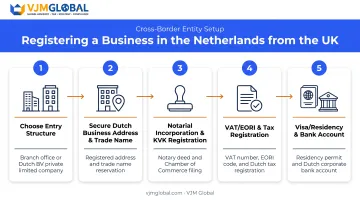
Step 1: Choose Your Entry Route and Business Structure
Decide first whether you're extending your existing UK company through a branch or incorporating a fresh Dutch legal entity (the BV). A branch keeps your UK company as the parent and is treated as a permanent establishment. A BV creates a genuinely separate Dutch legal person with its own liability shield, which most banks and EU partners find easier to work with.
Step 2: Secure a Dutch Business Address and Reserve a Trade Name
Every KVK registration needs a real visiting address where business activity actually happens, not just a mailbox. A PO box cannot serve as your visiting address, though it can work as a separate postal address.
Non-residents typically use a virtual office or serviced address provider that meets KVK's evidence requirements, such as a lease agreement or signed landlord consent. There's a narrow exception for founders in the Belgian or German border regions, but that's it. Run your proposed trade name through KVK's registry check before you commit to it.
Step 3: Complete Notarial Incorporation and KVK Registration
Forming a BV requires a Dutch civil-law notary to draft and execute the incorporation deed, something the UK's Companies House process has no real equivalent for. The notary typically handles the KVK filing and UBO registration as part of the same process.
Once registered, KVK issues the official KVK number, the identifier banks, suppliers, and Dutch authorities will ask for at every turn. If your business starts trading within eight days of registration, KVK can issue the number immediately.
Step 4: Register for VAT, EORI, and the Tax Administration
KVK automatically forwards your details to the Belastingdienst (the Dutch tax authority), which typically issues your RSIN and VAT identification number within about two weeks. But VAT and EORI aren't the same thing. VAT covers your turnover-tax status and intra-EU sales. EORI is a separate, mandatory number for customs clearance on any import, export, or transit activity through the EU. If you're trading goods, you need both.
Step 5: Arrange Visa/Residency (If Relocating) and Open a Dutch Business Bank Account
If you're staying in the UK and running the company remotely, skip this step entirely. If you're relocating, two main routes apply:
- Self-employed residence permit – requires your business to serve an essential Dutch economic interest, assessed via a points system covering experience and business plan
- Startup visa – for innovative ventures with a recognised facilitator and a structured development plan, valid for one year before transitioning to the self-employed route
Both applications carry a €423 fee and a 90-day IND decision period.
Opening a Dutch business bank account as a non-resident director is separate and triggers extra KYC scrutiny. Banks look closely at your company's activities, customer base, and expected transaction volumes before approving an account, so build this into your timeline rather than treating it as a formality.
Business Structures, Costs & Visa Requirements for UK Founders
Choosing the Right Business Structure
| Structure | Best for | Key consideration |
|---|---|---|
| BV (private limited company) | UK founders wanting a separate legal entity with liability protection | Most credible with EU banks and investors; requires a notary |
| Branch office | UK companies extending existing operations | Simpler setup, no new legal entity, still needs KVK listing |
| Eenmanszaak (sole proprietorship) | Founders who actually relocate | Only realistic with Dutch residency; not suited to remote UK operators |
For most UK founders targeting the EU market without relocating, the BV is the practical default. It signals permanence to Dutch partners and banks in a way a branch sometimes doesn't.
Costs, Taxes and Visa Fees to Plan For
Budget these items upfront so year-one costs don't catch you off guard:
- KVK registration fee: €85.15, one-off
- Notary costs for BV incorporation: typically €500-€1,500, depending on complexity
- Corporate tax: 19% up to €200,000 taxable profit, 25.8% above that
- VAT: standard rate of 21% on most goods and services
- Ongoing compliance: annual accounts filed with KVK, periodic VAT returns, and bookkeeping
- Visa fees (if relocating): €423 for either the startup or self-employed application
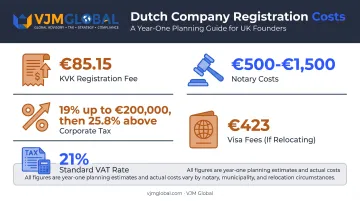
Ongoing accounting and compliance costs vary by transaction volume and industry. They are recurring, not one-off—build them into year-one and year-two budgets rather than treating incorporation as the finish line.
Common Mistakes UK Founders Make When Expanding to the Netherlands
Most delays we see aren't caused by the Netherlands being unusually bureaucratic. They come from founders applying pre-Brexit assumptions to a post-Brexit process.
- Assuming EU-level freedom of establishment still applies. UK citizens now face the same residency assessment as any third-country national, which catches founders off guard when they try to move without a permit.
- Registering with a UK-only address or PO box. The Dutch Chamber of Commerce (KVK) will reject this outright. A compliant Dutch visiting address needs to be sorted before you file, not after.
- Underestimating bank KYC timelines. Non-resident directors face more scrutiny than Dutch-resident ones. Treating account opening as a quick formality can delay your ability to trade.
- Picking the wrong structure for the goal. A branch might suit a company testing the market; a BV suits one planning to scale, hire, or raise investment locally.
Avoiding these mistakes is doable on your own, but each one adds weeks if you catch it late. VJM Global has supported 250+ UK businesses with entity formation, tax registration, and compliance in the Netherlands and 100+ other markets.
Conclusion
Starting a business in the Netherlands from the UK is entirely achievable. Brexit added a residency and visa layer that didn't use to exist, but it didn't touch your ability to own or run a Dutch company remotely.
Treat company registration and personal relocation as two separate projects, and plan for both if you intend to eventually move. Getting your structure, address, and tax registrations correct from day one prevents the costly delays that catch out founders who rush the paperwork.
VJM Global supports UK founders with Dutch entity formation, tax registrations, and ongoing compliance, so you can focus on building the business instead of navigating setup alone.
Frequently Asked Questions
Can a foreigner start a business in the Netherlands?
Yes. Foreigners, including UK nationals, can own 100% of a Dutch company and serve as director. Living there permanently is a separate matter requiring its own visa or residence permit depending on nationality.
Do UK citizens need a visa to start a business in the Netherlands after Brexit?
Only if you plan to relocate. Owning or registering a Dutch company remotely from the UK doesn't require a visa or residence permit at all.
Which business is most profitable in the Netherlands?
Tech and SaaS, e-commerce, logistics, and trading businesses tend to perform well thanks to the country's EU market access and infrastructure. Specific profitability still depends on sector-level market research.
Is the Netherlands good for startups?
Yes. Between the startup visa, the entrepreneur allowance for qualifying self-employed founders, and direct EU market access, the Netherlands ranks well among European startup destinations.
How long does it take to register a company in the Netherlands from the UK?
The Dutch Chamber of Commerce (KVK) can issue your registration number quickly once the notarial deed is complete, sometimes within days. Add visa processing and bank account approval, though, and the full timeline can stretch to several weeks or more.
Can I run a Dutch company while living in the UK?
Yes. A branch or a Dutch BV (private limited company) with a valid registered Dutch address lets you operate in full compliance without the director needing Dutch residency.