Dutch SMEs, tech founders, exporters, and consultants are all exploring what a Canadian entity could do for their North American ambitions. This guide walks through the practical steps: eligibility, structure choice, registration, taxes, banking, and the compliance work that follows.
TL;DR
- Choose federal or provincial incorporation: Ontario and BC have no Canadian resident director requirement
- Canada allows 100% foreign ownership, remote incorporation, and no minimum capital requirement
- Registration takes a few business days; full setup including banking can take several weeks
- Company registration does not grant residency or work rights; immigration is separate
- CETA and CUSMA give a Canadian entity preferential trade access across North America and the EU
What Is Involved in Starting a Business in Canada from the Netherlands?
Starting a business in Canada means legally registering an entity, either federally through Corporations Canada or provincially in a jurisdiction such as Ontario or British Columbia. Dutch founders don't need to relocate to do this.
You can operate entirely remotely, or set up local operations later when you need a local team or physical presence. Common structures include:
- Sole proprietorship or partnership: simple setup, but with personal liability
- Federal corporation: nationwide name protection under the Canada Business Corporations Act
- Provincial corporation: registered in a single province, such as Ontario or BC
- Extra-provincial registration: required when a foreign or out-of-province corporation operates in another province
What to Know Before You Start
Many Dutch founders underestimate how residency rules, banking access, and cross-border tax obligations affect their timeline. Plan for those constraints first; they usually drive the calendar more than the incorporation filing itself.
Residency and Director Requirements
Federal incorporation under the CBCA requires that at least 25% of directors be Canadian residents, with at least one resident director if the board has fewer than four members. Ontario and British Columbia have no such general residency requirement: BC explicitly removed director-residency rules, and Ontario's current statute shows no equivalent condition.
Entity choice matters as much as residency. Sole proprietorships and partnerships carry personal liability and rarely make sense for a non-resident founder operating remotely.
Time and Effort Expectations
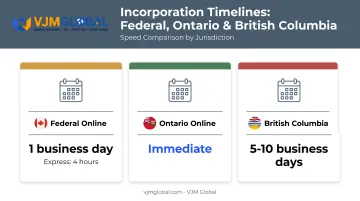
Incorporation itself moves fast:
- Federal online filing: 1 business day (express service in 4 business hours)
- Ontario online filing: immediate
- BC filing: typically 5-10 business days
Building real operations (bank account, registered office, and staff) takes considerably longer. Decide early whether Canada is only a legal and trade base, or whether you will run day-to-day local operations—that choice sets how much lead time you need beyond the filing.
Why Start a Business in Canada from the Netherlands (When It Makes Sense)
This isn't a blanket recommendation. It's a set of conditions under which a Canadian entity genuinely pays off.
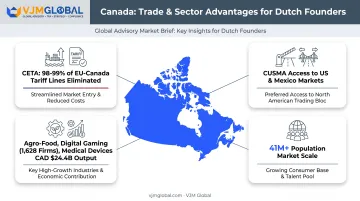
Trade access is the biggest draw. CETA has eliminated tariffs on roughly 98% of EU-Canada tariff lines at provisional entry, with full coverage reaching 99% once fully ratified.
Layer on CUSMA, and a Canadian entity becomes a base for reaching the US and Mexico too. Product-specific origin rules still need checking before you assume duty-free status.
Market scale matters. Canada's population sits above 41 million, and the country remains a stable, foreign-investment-friendly economy even without a current World Bank ease-of-doing-business ranking (the index was suspended after an audit found irregularities).
Incorporation advantages are real and practical:
- Remote incorporation with no in-person requirement
- 100% foreign ownership permitted
- No minimum capital requirement
- Government filing fees as low as CAD 200 (federal, online)
Economic incentives add further weight. The CRA's SR&ED program offers most CCPCs a refundable 35% tax credit on qualifying R&D spending up to the expenditure limit. That credit is a meaningful pull for Dutch tech founders.
Sector fit rounds it out. Canada has documented strength in agro-food, digital gaming (1,628 firms as of 2022), and medical device manufacturing (CAD $24.4B in output in 2023) — all areas where Dutch exporters and tech founders already compete internationally.
Early Decisions That Matter When Starting a Business in Canada
Most setup problems trace back to underestimating banking access, tax exposure, and director requirements, not lack of effort.
Structure Choice
| Factor | Federal Corporation | Provincial Corporation (ON/BC) |
|---|---|---|
| Name protection | Nationwide | Single province only |
| Director residency | No Canadian residency requirement (since 2022) | No requirement in ON or BC |
| Best for | Multi-province operations, national brand | Single-province focus, simpler local filing |
Real Costs and Banking Friction
Filing fees vary by jurisdiction:
- Federal (online): CAD $200, one-day processing
- Ontario (online): CAD $300, immediate
- British Columbia: CAD $380 total (incorporation plus name approval), typically 5-10 business days
Add professional service costs for name search and incorporation support on top of these government fees.
Banking is where most delays happen. RBC and TD generally require a branch visit to verify identity, even after phone-based account opening. BMO, by contrast, allows a single-owner corporation to open an account online. Bank policy varies significantly, so don't assume every major bank requires an in-person visit, but plan for the possibility.

Compliance and Immigration Are Separate
Incorporating a Canadian company does not grant work or residency rights. If you or your team need to relocate and manage operations on the ground, that's a separate immigration application entirely — typically a work permit route. Conflating the two is one of the most common and costly mistakes Dutch founders make.
How to Start a Business in Canada from the Netherlands — Step by Step
Skipping banking and tax registration planning is the single most expensive mistake in this process. Here's the practical sequence.
Step 1 – Choose Your Business Structure and Confirm Eligibility
Decide between federal and provincial incorporation based on where you plan to operate and your director residency situation. Decide between federal and provincial incorporation based on where you plan to operate and who will sit on the board. Federal corporations generally need at least 25% Canadian-resident directors (or one resident director if there are fewer than four); some provinces have different or no residency rules.
No Canadian citizenship or residency is required to own a Canadian corporation — that holds for either route.
Step 2 – Choose a Business Name and Reserve It
Conduct a NUANS name search for federal incorporation, or the provincial equivalent. Make sure your chosen name includes a required legal element:
- "Ltd." or "Limited"
- "Inc." or "Incorporated"
- "Corp." or "Corporation"
Step 3 – Prepare and File Incorporation Documents
You'll need:
- Articles of Incorporation
- Identification for all directors and shareholders
- A Canadian registered office address (a physical address in Canada for official documents—not a P.O. box)
File with Corporations Canada federally, or with the relevant provincial registry.
Step 4 – Register for a Business Number and Tax Accounts
Apply for a Business Number through the Canada Revenue Agency. Non-resident businesses can register online through the CRA's dedicated portal, or by mail using form RC1.
Register for GST/HST if annual revenue is expected to exceed the CAD $30,000 threshold over four consecutive quarters. You can also register voluntarily below that threshold.
Step 5 – Open a Business Bank Account
Prepare for possible in-person verification at major Canadian banks, and expect account activation to take longer than incorporation itself. Consider an interim payment processor while you build the full banking relationship.
This is where founders often lose weeks. Banks want incorporation papers, CRA accounts, and clear ownership records before they activate the account.
VJM Global supports Dutch clients entering Canada with entity formation and the documentation trail banks and the CRA expect: name search, Articles of Incorporation, registered office arrangements, and tax registration, coordinated as one path rather than separate errands.
Step 6 – Establish Ongoing Compliance and Cross-Border Reporting
Once incorporated, you need to:
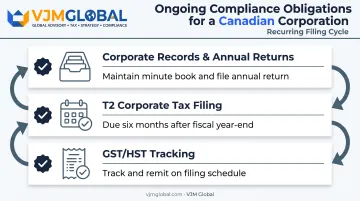
- Maintain corporate records and file annual returns
- Meet T2 corporate tax filing deadlines — generally due six months after fiscal year-end
- Track GST/HST obligations on an ongoing basis
If you need to hire staff in Canada without setting up a full entity, VJM Global's Employer of Record service can act as the compliant local employer, handling payroll, CPP/QPP contributions, Employment Insurance premiums, income-tax withholding, and T4 filings on your behalf.
Conclusion
Starting a Canadian business from the Netherlands is accessible and remote-friendly. Success depends on getting structure, banking, and tax registration right from the start — not on the incorporation filing itself, which is often the easiest part.
Immigration and incorporation run on separate tracks. Treating them as one process causes avoidable delays for founders who assume a Canadian entity gives them a path to relocate.
Longer term, ongoing compliance and cross-border coordination matter more than that initial registration. Get the foundation right, and the rest becomes routine filing rather than repeated firefighting.
VJM Global supports Dutch founders with Canadian entity formation, tax registration, and ongoing compliance so the setup stays on track from day one.
Frequently Asked Questions
What are the requirements to start a business in Canada?
You need a chosen business structure, a registered office address, incorporation documents, a Business Number from the CRA, and GST/HST registration if revenue is expected to exceed CAD $30,000 annually.
What is the CAD $40,000 small business loan in Canada?
This figure is often confused with the Canada Emergency Business Account (CEBA), a pandemic-era program. The current Canada Small Business Financing Program offers term loans up to CAD $1M and lines of credit up to CAD $150,000 — verify current eligibility directly with the lender.
How difficult is it to start a business in Canada?
Registration itself is fast and largely online. The parts non-resident founders find hardest are banking access and coordinating cross-border tax obligations between the Netherlands and Canada.
Can a Dutch citizen own a Canadian company without living in Canada?
Yes, particularly through provincial incorporation in Ontario or British Columbia. Tax substance and banking considerations still apply, so this shouldn't be treated as a fully hands-off process.
Does registering a Canadian company grant residency or a visa?
No. Business ownership and immigration status are handled through entirely separate applications. Incorporating doesn't create any pathway to work or live in Canada.
How long does it take to register a company in Canada from the Netherlands?
Incorporation itself can take as little as one business day online. Full operational setup, including a working bank account, typically takes several weeks.