But most guides skip the parts that actually slow you down: getting documents attested from India, proving your capital remittance to Philippine regulators, and finding a signatory who can show up in person for a bank account visit. This guide covers the structures, costs, and registration steps — and tells you honestly when incorporating isn't your best first move.
Key Takeaways
- Full foreign ownership is allowed in many Philippine entities, subject to Foreign Investment Negative List (FINL) sector caps
- SEC/DTI, LGU, BIR, and social-agency registration takes roughly 2-3 months when coordinated remotely
- Costs span low DTI sole-prop filing fees up to high paid-up capital thresholds for foreign-owned corporations
- Philippine Embassy authentication from India adds lead time most founders underestimate
- A representative office, branch, or Employer of Record validates the market faster than full incorporation
What Is Involved in Starting a Business in the Philippines from India?
Starting a business in the Philippines from India means registering a Philippine entity — a corporation, One Person Corporation (OPC), or branch office — while you stay based in India. Once complete, you hold three core credentials that let you legally trade, hire staff, and invoice clients:
- SEC or DTI registration
- Mayor's Permit
- BIR Certificate of Registration
One important clarification: sole proprietorships filed through DTI's BNRS system are open to non-Philippine nationals who submit the right supporting documents. That said, most Indian founders still default to a corporation, OPC, or branch, since these structures better handle liability separation and foreign capital flows.
Cross-border document authentication is the extra layer domestic founders never face. Your board resolutions, articles, and corporate documents need notarisation and legalisation through the Philippine Embassy or Consulate in India before Philippine agencies will accept them.
Why Indian Entrepreneurs Are Choosing the Philippines
For Indian founders, the commercial case is market access at a workable operating cost. ASEAN's 2023 goods trade totaled US$3,526 billion, so a Philippine base can open a large, connected consumer market without the cost profile of Singapore or Hong Kong.
What makes the Philippines specifically attractive:
- A young, English-proficient workforce feeding a 1.82 million-strong IT-BPM industry
- ASEAN membership opening regional trade and services access
- Time zone overlap that makes daily coordination with India workable
- BOI and PEZA incentives — income tax holidays of 4-7 years and duty-free equipment imports — that can offset the extra cost of remote coordination
Those advantages only hold if your activity is allowed at the ownership level you need.
The Ownership Assumption That Trips Founders Up
A common mistake: founders assume full foreign ownership is automatic because they're bringing in capital. It isn't. Restrictions under the Foreign Investment Negative List (FINL) attach to the business activity, not the founder's nationality.
A retail trading business and an export-focused software company face very different ownership ceilings, regardless of who funds either one. Check your specific activity against the current FINL before you lock a structure.
Costs, Structures and Tax Obligations You Need to Get Right
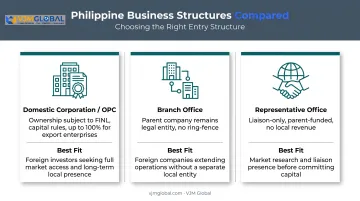
Comparing the Structures Available to Indian Founders
| Structure | Ownership | Best Fit |
|---|---|---|
| Domestic corporation/OPC | Subject to FINL and capital rules; export enterprises outside restricted lists may reach 100% foreign equity | Standalone Philippine operating business |
| Branch office | Parent company remains the legal entity; no separate ring-fence | Extending an existing Indian/foreign company's operations |
| Representative office | Liaison-only, funded by parent, no local revenue | Market research before committing capital |
What to Budget For
Filing fees themselves are modest. DTI business-name fees run from PHP200 to PHP2,000 depending on territorial scope. Paid-up capital is the real cost driver.
Under RA 11647, capital rules shape what Indian founders can own:
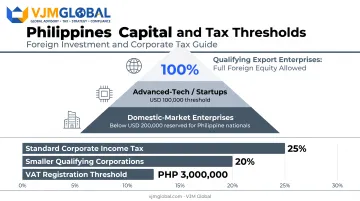
- Domestic-market enterprises below USD200,000 paid-in equity are reserved for Philippine nationals
- Advanced-technology, qualifying-startup, or workforce conditions can open foreign participation at USD100,000
- Export enterprises outside restricted product/service lists may reach 100% foreign equity with different capital treatment
Additional costs to plan for:
- Notarisation and Philippine Embassy authentication fees in India
- Document translation, where required
- Professional fees for in-country filing support
Tax and Remittance Considerations
The Philippines applies a 25% corporate income tax rate under the CREATE Act, dropping to 20% for corporations with net taxable income under PHP5 million and total assets under PHP100 million (excluding land). VAT registration kicks in at gross sales exceeding PHP3 million annually.
The India-Philippines tax treaty caps withholding at 15% on dividends where the beneficial owner holds at least 10% of shares (20% otherwise), 10-15% on interest, and 15% on royalties — subject to residence and beneficial-ownership conditions being met.
Here's what founders underestimate: clean, well-documented remittance channels matter more to SEC and BIR verification than chasing the best exchange rate. Regulators want a clear paper trail showing capital arrived through proper inward-remittance channels, not just proof that money landed in an account.
How to Register a Company in the Philippines from India: Step-by-Step
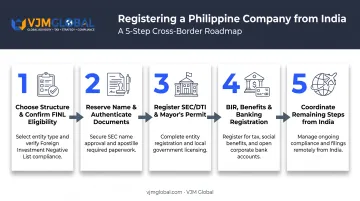
Registration runs on two tracks simultaneously: document attestation from India, and in-country filing with Philippine agencies. Running them in parallel, not one after the other, is what keeps your timeline to 2–3 months instead of 5–6.
Step 1: Choose Your Structure and Confirm Sector Eligibility
Check your target sector against the current Foreign Investment Negative List before locking in anything. This single check determines whether a domestic corporation, One Person Corporation (OPC), or branch even makes sense for your activity.
Step 2: Reserve Your Name and Prepare Documents from India
Search name availability through SEC's eSPARC portal. Meanwhile, get your board resolutions and corporate documents notarised and authenticated through the Philippine Embassy or Consulate in India.
Start this early. The authentication queue is typically the slowest step in the entire process, and founders who leave it for later routinely miss their timeline.
Step 3: Register with SEC or DTI and Secure the Mayor's Permit
File your Articles of Incorporation through eSPARC. SEC advises applicants of review status within seven working days as a benchmark, though foreign-owned applications with capital-remittance proof often take longer to clear. Once registered, apply for your LGU Mayor's Permit. Typical requirements include:
- Zoning clearance
- Fire safety certification
- Barangay clearance
Step 4: Complete BIR, Employee Benefit, and Banking Registration
- Register for your TIN and BIR Certificate of Registration
- Monitor the PHP 3 million VAT threshold
- Enroll staff in SSS, PhilHealth, and Pag-IBIG
- Open a corporate bank account (one in-person signatory visit is usually still required, even if the rest was handled remotely)
Step 5: Coordinate What's Left from India
You don't need to fly to Manila for every remaining errand. A cross-border corporate services provider can handle the remaining in-person government steps while your online approvals continue in parallel.
VJM Global coordinates entity formation and compliance work across 100+ countries and is regularly engaged by India-based founders to keep registrations moving without requiring a flight for each individual appointment.
Common Mistakes and When a Different Approach Makes Sense
Three assumptions cause the most rework:
- Assuming Philippine ownership rules mirror an Indian SEZ setup. They don't. FINL caps follow the business activity, full stop, not the founder's passport.
- Treating a representative office as revenue-capable. It isn't. A rep office is limited to liaison, research, and promotional work funded entirely by the parent company. It cannot invoice Philippine clients.
- Incorporating before confirming you need to. Full incorporation brings ongoing compliance overhead: annual filings, local tax obligations, and employer registrations. If you're only testing demand or hiring one or two people, an Employer of Record arrangement may fit better.
VJM Global provides EOR services for this path: compliant cross-border hiring without setting up a local entity first.
Conclusion
The core registration path — SEC/DTI, LGU, BIR, and social-agency enrolment — is identical for every foreign investor entering the Philippines. What the India corridor adds is document attestation and remote coordination on top.
Your timeline and cost hinge on three things:
- Identifying your FINL exposure correctly
- Capitalising at the right threshold for your activity
- Starting document authentication early, not as an afterthought
Get the structure and sector-eligibility check right before you file, and you avoid the costly rework that catches most first-time founders.
Frequently Asked Questions
How much does it cost to register a small business in the Philippines?
DTI/SEC filing fees are relatively low. For foreign-owned corporations, the real cost is paid-up capital plus notarisation and embassy authentication from India. Tech and export activities may qualify for lower capital thresholds.
How can a foreigner start a business in the Philippines?
Indian nationals can form a corporation, OPC, or branch in most open sectors. Ownership share and minimum capital still follow FINL limits for that specific activity.
What business can I start with PHP50,000 in the Philippines?
PHP50,000 can cover a small local operation under DTI’s business-name registration. It is far below typical foreign-owned corporation capital, so at this budget use an EOR setup or a local partnership model instead.
What is the best small business to start in the Philippines?
For many Indian founders, practical first bets are IT/BPO support, sourcing and trading, and food or agro-processing. Confirm FINL eligibility before you lock the activity and entity type.
What's the most profitable business in the Philippines?
Higher-margin plays often sit in BPO/IT services, export manufacturing, and scaled e-commerce. Returns still hinge on cost control, demand access, and staying compliant from day one.
Do I need to travel to the Philippines to register my company?
Most registration steps can be handled remotely from India. Corporate bank account opening usually still needs one in-person signatory visit or a locally appointed representative.