Interest comes from three groups: trading companies wanting duty-free import/export routes, Dutch SMEs scouting manufacturing bases, and Turkish-Dutch business owners with existing family or trade ties. All three face the same question: how do you actually register and operate legally in Turkey?
This guide walks through it step by step, from choosing an entity type to post-registration compliance.
TL;DR
- Turkey allows 100% foreign ownership — no local partner required for Dutch nationals or companies
- LLC (Limited Şirket) is the fastest, most common structure; JSC suits larger, growth-focused ventures
- EU-Turkey Customs Union drops duties on most EU-origin industrial goods with an A.TR certificate
- Trade Registry filing can be same-day; full timelines depend on translations and bank setup
- Local-language filings and tax rules make legal and accounting support essential from day one
What Does Starting a Business in Turkey From the Netherlands Actually Involve?
Starting a business in Turkey means establishing a legally recognised Turkish entity, branch, or liaison office as a Dutch resident or company. This is different from simply exporting to Turkish customers under the customs union.
A properly registered Turkish operation requires:
- A Turkish tax identification number
- A registered business address inside Turkey
- An entry in the Trade Registry, filed through the MERSİS system
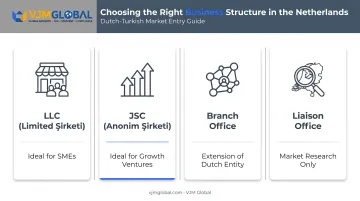
Common structures Dutch entrepreneurs choose from:
- LLC (Limited Şirketi) — best for SMEs and service businesses
- JSC (Anonim Şirketi) — suited to larger, export-driven, or growth-focused ventures
- Branch office — extends an existing Dutch entity into Turkey without creating a separate legal person
- Liaison office — limited to non-commercial activities such as market research and representation
Why Turkey Appeals to Dutch Entrepreneurs (When It Makes Sense)
The Netherlands and Turkey already trade heavily in textiles, vehicles, electrical goods, and fresh produce. Turkey's Ministry of Foreign Affairs reports bilateral goods-and-services trade of $13.588 billion in 2024, with Turkish exports to the Netherlands at $8.568 billion. That existing trade relationship makes Turkey a natural next step for many Dutch traders, not a cold-start market.
The Customs Union Advantage
Under the EU-Turkey Customs Union, industrial products and most processed agricultural goods move duty-free and quota-free between the two markets. An A.TR certificate proves free-circulation customs status for goods manufactured in the customs union or already released into free circulation.
Basic agricultural products and coal/steel products under the old ECSC (European Coal and Steel Community) regime are excluded.
Further practical draws for Dutch entrants:
- Turkey's population passed 85.6 million in 2024, according to TurkStat's ABPRS release
- Foreigners and Turkish nationals have equal rights to register and hold 100% of a company
- Free zones and technoparks offer tax exemptions for qualifying activities
The Caution: Lira Volatility
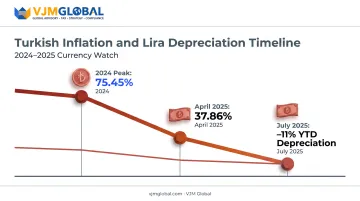
Turkish inflation isn't a footnote. Reuters reported annual CPI hitting a 75.45% peak in 2024, then settling near 37.86% by April 2025. By July 2025 the lira was down roughly 11% year-to-date. That volatility affects pricing, contract terms, and how easily profits get repatriated to the Netherlands.
Common miss: Assuming Turkey offers EU-membership-style legal certainty. Turkey is only an EU candidate country. Dutch court rulings aren't automatically enforced in Turkey, and enforcement mechanisms differ significantly from what Dutch companies are used to within the EU.
What to Know Before You Start: Early Decisions and Overlooked Details
Many Dutch entrepreneurs underestimate how much more bureaucratic Turkish registration is compared to setting up a Dutch BV. A few decisions deserve attention before you file anything.
LLC vs. JSC: Capital Requirements
Following Presidential Decision No. 7887 (effective 1 January 2024), minimum capital figures are:
| Structure | Minimum capital | Capital deposit rule |
|---|---|---|
| LLC (Limited Şirketi) | TRY 50,000 | No pre-registration deposit required |
| JSC (Anonim Şirketi) | TRY 250,000 (TRY 500,000 for registered-capital system) | At least 25% before registration, remainder within 2 years |
LLCs are simpler to manage and faster to register. JSCs carry more prestige, allow easier share transfer, and open the door to a future public offering, but they demand a larger upfront capital commitment.
True Costs to Budget For
Beyond the headline capital figure, plan for:
- Notarisation and Turkish translation of Dutch incorporation documents
- Apostille certification (or consular legalisation)
- Trade Registry and Competition Authority fees (0.04% of capital)
- The capital deposit itself
Currency and Payment Risk
Cross-border transactions with Turkish counterparts are usually settled in EUR or USD rather than TRY, given lira volatility. Agree payment currency and terms upfront. For higher-value transactions, a Letter of Credit reduces exposure on both sides.
Tax Residency Risk
If your Turkish company is actually managed and controlled from the Netherlands, this can trigger dual tax residency. The Netherlands-Turkey tax treaty determines corporate residence using domestic connecting factors, including legal head office and place of effective management. Where the two don't line up, residence has to be settled through competent-authority agreement between Dutch and Turkish tax authorities.
Note: VJM Global's tax-advisory work assesses Place of Effective Management (where board decisions are made and executive control sits) when dual-residency questions arise. Board minutes and organisational charts matter here.
Employment Rules
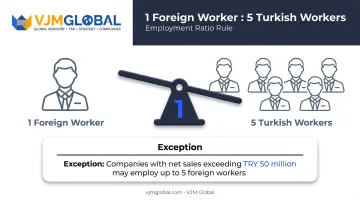
Hiring one foreign worker generally requires employing five Turkish citizens at the same workplace. Companies with prior-year net sales of at least TRY 50 million can get this ratio waived for up to five foreign workers, though narrower exceptions apply beyond that. This has real implications for staffing a Dutch-run Turkish entity. Plan headcount early.
Step-by-Step: How to Register a Company in Turkey as a Dutch Entrepreneur
The registration process is procedurally similar for all foreign investors. Dutch entrepreneurs face one extra layer: notarised Turkish translations, apostilles, and cross-border banking checks on top of the standard steps.
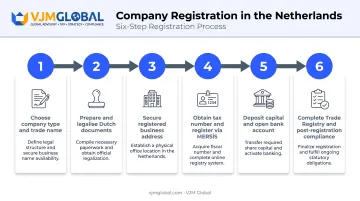
Step 1 – Choose Your Company Type and Trade Name
Decide between LLC and JSC based on available capital, growth ambitions, and whether a future public offering matters. Check trade name availability through TOBB's official name-query tool: LLC and JSC names must include "Limited Şirket" or "Anonim Şirket" respectively.
Step 2 – Prepare and Legalise Your Dutch Documents
Translate passports, incorporation documents, and board resolutions into Turkish, then have them notarised and apostilled. Common miss: Submitting incomplete or improperly translated documents. This is one of the leading causes of registration delays for foreign investors.
Step 3 – Secure a Registered Business Address in Turkey
Lease or purchase premises, or use a compliant virtual office. Whatever address you declare must match exactly what's registered with the tax office. Mismatches cause complications later.
Step 4 – Obtain a Tax Number and Register via MERSİS
Each non-Turkish shareholder and board member needs a potential tax identity number from the tax office. This is required before you can open the capital-deposit bank account. Incorporation documents are then submitted electronically through the MERSİS system, which handles all Trade Registry transactions.
Step 5 – Deposit Capital and Open a Turkish Bank Account
Open a corporate bank account. Expect additional AML/KYC scrutiny for foreign shareholders, including Dutch ones. Deposit the required minimum capital:
- LLC: No pre-registration deposit obligation
- JSC: At least 25% of subscribed capital before registration, proven with a bank certificate
Step 6 – Complete Trade Registry Registration and Post-Registration Compliance
File at the relevant Trade Registry Directorate. The Trade Registry step itself can often be completed the same day. After that, the Directorate notifies the tax office and the Social Security Institution (SGK) automatically. You still need to obtain your tax registration certificate, register for social security, and handle any sector-specific licences. Keeping books aligned across a Dutch entity and a Turkish one is a persistent headache: different charts of accounts, filing deadlines, and statutory report formats on each side. VJM Global supports Dutch clients with Netherlands VAT returns (21% standard rate), corporate income-tax filing, and KvK annual accounts, and runs multi-entity accounting on Xero, QuickBooks, or SAP to each jurisdiction's standards.
Conclusion
Starting a business in Turkey from the Netherlands is achievable. There's no legal barrier to 100% foreign ownership, and the process, while more paperwork-heavy than a Dutch BV setup, is well-documented and predictable once you know the steps.
Success comes down to getting three things right from day one:
- Document preparation and translation
- Tax residency planning under the Netherlands-Turkey treaty
- Currency risk management given lira volatility
The customs union and Turkey's market size make the opportunity real, but only if you plan for the bureaucracy rather than discovering it mid-registration.
Ongoing compliance matters just as much as the initial filing. Accounting, tax filings, and payroll obligations continue long after the Trade Registry certificate arrives. Keeping two jurisdictions' books aligned is where many cross-border setups go wrong.
Frequently Asked Questions
Do foreigners pay taxes in Turkey?
Yes. Foreign-owned companies pay Turkish corporate tax (25% for most sectors) on Turkey-sourced income, plus VAT and withholding tax on certain payments. The Netherlands-Turkey tax treaty helps prevent the same income being taxed twice.
Can a Dutch citizen own 100% of a Turkish company?
Yes. Foreign individuals and companies, including Dutch nationals, can hold 100% of shares in either an LLC or JSC. No local partner is required under Turkish foreign investment law.
How long does it take to register a company in Turkey?
The Trade Registry filing itself can be completed the same day. However, total timelines depend heavily on document translation, apostille processing, and bank account setup — plan for several weeks end-to-end.
What is the minimum capital needed to start a business in Turkey?
An LLC requires TRY 50,000 minimum, with no pre-registration deposit. A JSC requires TRY 250,000 (or TRY 500,000 under the registered-capital system), with at least 25% deposited before registration.
Is it better to set up an LLC or a branch office when expanding from the Netherlands?
An LLC creates a separate Turkish legal entity, suited to standalone operations. A branch office extends your existing Dutch company's liability into Turkey and is often used for testing market entry before committing further.
How does the EU-Turkey Customs Union affect a Dutch-owned business in Turkey?
EU-origin industrial goods can generally enter Turkey duty-free and quota-free with an A.TR certificate. This significantly eases import and export operations for Dutch-linked companies trading physical goods.