Introduction
Australia exported more than $48.5B to the United States and pulled in over $33.7B in imports in 2025. Australian investment in the US sits at $1.64T, according to DFAT's current trade data.
Those figures reflect one of Australia's deepest economic ties.
Shared language creates a dangerous illusion of simplicity. Many Australian founders assume US business setup will feel like registering with ASIC. It doesn't.
The pull is real though: a market ten times the size of Australia's, USD-denominated revenue, and access to venture capital pools that dwarf anything at home. Interest isn't limited to tech startups either. Solo consultants, e-commerce sellers, and established SMEs are all eyeing US expansion.
This guide walks through entity choice, registration, tax, banking, and visas: the practical steps to set up correctly from Australia.
Key Takeaways
- Australians can register an LLC or C-Corp without US citizenship, residency, or a visa
- There's no federal ASIC equivalent — incorporation happens state by state
- Non-residents must apply for an EIN by fax, phone, or mail, not the IRS online portal
- AUSFTA and the US-Australia tax treaty ease market access and limit double tax, but compliance still applies
- Full operational readiness typically takes several weeks to a few months
What Does Starting a US Business from Australia Actually Involve?
Starting a US business isn't the same as simply selling into the US market. It means:
- Incorporating a US legal entity (LLC or C-Corp) in a chosen state
- Obtaining federal and state tax registrations
- Building banking and operational infrastructure to run the business
Selling into the US without a US entity doesn't trigger full corporate tax obligations. That changes the moment you incorporate, hire US staff, or establish a physical presence there.
Two structural paths dominate:
- US subsidiary of an Australian parent: the Australian company owns the US entity outright
- Standalone US entity: set up independently, often preferred by solo founders or those seeking US investors
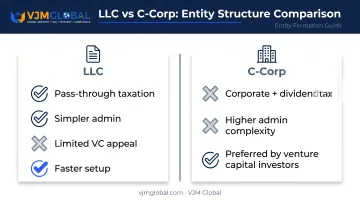
Within either path, you'll choose between an LLC (pass-through taxation, simpler admin) and a C-Corp (better suited to raising venture capital).
What to Know Before You Start
Most Australians assume the process mirrors ASIC and GST-style simplicity. It really doesn't.
Get clear on these points before you begin:
- State-by-state registration takes more paperwork than Australia's centralised system. Every state has its own rules, fees, and filing bodies
- Remote management is possible. Fintech banking partners and registered agents mean you often don't need to visit the US in person
- Realistic timelines run from a few weeks for basic registration to a few months before you're ready for banking and full compliance
- Structuring knowledge matters early. Get the entity and tax setup wrong and you'll pay for it later, long before day-to-day operations matter
- Market entry and full incorporation differ. Selling into the US doesn't require a US entity; operating there does
Why Expand to the USA? (When It Makes Sense)
Expansion only pays off under the right conditions. A bigger market alone does not guarantee a win.
What favours expansion:
- Deep trade and investment ties: Australian investment in the US stands at $1.64T, and DFAT figures show two-way trade exceeding $80B annually
- Access to USD revenue and the US federal procurement market
- AUSFTA eliminates tariffs on more than 99% of tariff lines for qualifying goods, with average tariffs sitting at just 4.3%
- Reach into US venture capital networks and a market roughly ten times Australia's size
- Long-term brand credibility that comes with an actual incorporated US presence, not just a website
These conditions matter more for e-commerce sellers and product businesses that benefit directly from tariff relief. Service businesses will care more about VC access and procurement eligibility.
Early Decisions That Matter
Most costly mistakes come from underestimating how complex US formation, tax, and employment rules are.
Cost and Structure Traps
Watch for these commonly overlooked issues:
- Setup and first-year costs — formation fees, registered agent charges, and franchise taxes add up fast. Wyoming LLC registration is a flat $100; Delaware prices formation differently and adds annual franchise tax
- Foreign qualification — a Delaware or Wyoming entity does not authorise physical operations in another state. If your team or office sits elsewhere, register there too
- Employment law differences — at-will employment and no superannuation equivalent catch Australian employers off guard
Tax Classification Surprises
Two cross-border tax points catch Australian founders often:
- ATO hybrid treatment — under ATO ID 2012/70, a US LLC can be classified as a foreign hybrid company for Australian tax purposes. It is not automatic for every LLC, but it is a real risk worth checking before you form
- S-Corp status is off the table — IRS Form 2553 instructions confirm S-Corps cannot have nonresident-alien shareholders, so non-resident Australians are not eligible
How to Start a Business in the USA from Australia – Step by Step
Common mistakes include registering only in Delaware while operating elsewhere, rushing the EIN application, and assuming Australian banking norms will transfer. Work through the stages below in order so those gaps don’t show up later.
Step 1 – Choose Your Business Structure
LLCs and C-Corps differ meaningfully:
| Factor | LLC | C-Corp |
|---|---|---|
| Tax treatment | Pass-through | Corporate tax + dividend tax |
| Admin complexity | Lower | Higher |
| Investor suitability | Limited for VC | Preferred by VCs |
Remember: the ATO may treat your LLC as a foreign hybrid company, adding Australian-side reporting complexity. And S-Corp status simply isn't available to you as a non-resident.
Step 2 – Select a State and Register
Delaware and Wyoming are the two most commonly chosen states, each with trade-offs on fees and structure. If you operate physically in a different state (for example, you hire a sales rep in Texas), you'll need to foreign qualify there too, regardless of where you incorporated.
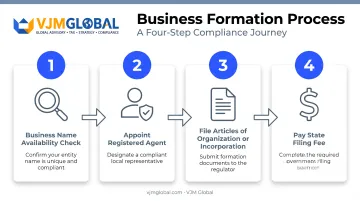
Core registration steps:
- Run a business name availability check
- Appoint a registered agent (required in every state)
- File Articles of Organization (LLC) or Incorporation (C-Corp)
- Pay the applicable state filing fee
Step 3 – Obtain an EIN and Register for Taxes
The IRS online EIN portal isn't available to non-residents. Instead, applicants without a US address use the International EIN Operation, submitting Form SS-4 by fax or mail. Processing typically runs 4-5 weeks for mail, according to IRS SS-4 instructions.
Once you have an EIN:
- Register for applicable federal tax filings
- Check state tax registration requirements
- Assess sales tax nexus (post-Wayfair, states set their own economic thresholds). Washington, for example, applies a $100,000 combined gross-receipts threshold
Nexus rules vary by state — don't assume one threshold applies everywhere.
Step 4 – Open a US Business Bank Account
Traditional banks often require in-person visits and extensive documentation, which is a real hurdle for non-residents.
Fintech platforms have filled this gap:
- Mercury: No US citizenship or residency required; entity must be US-formed with existing or planned US operations
- Relay: Needs an EIN, formation document, physical US business address, and a signed operating agreement for multi-member LLCs
Compare a few options before committing — documentation requirements shift regularly.
Step 5 – Assess Visa and Immigration Requirements
Owning a US business doesn't grant you residency rights. These are separate legal questions entirely.
Relevant pathways for Australians:
- E-2 Treaty Investor: substantial, at-risk investment plus active management of the enterprise
- E-3: Australia-specific specialty occupation visa, capped at 10,500 per fiscal year; needs a genuine job offer and approved labour condition application
- L-1A: executives/managers transferring from a related foreign entity after one year of continuous employment abroad
- O-1A: individuals with extraordinary ability and sustained acclaim in their field
AUSFTA gives Australians E-3 access that most nationalities don't get. Factor that into your visa strategy if you plan to relocate.
Step 6 – Protect IP and Manage Ongoing Compliance
Your Australian trademark doesn't automatically protect you in the US. Filing with the USPTO separately is necessary if brand protection matters to your business.
Recurring compliance obligations include:
- Annual state reports and franchise tax payments
- Federal tax filings
- Payroll filings if you hire US-based staff
- Beneficial ownership reporting to FinCEN
Coordinating US filings with Australian-side obligations is where many founders get tripped up. Separate advisers on each side often leave gaps between the two calendars.
VJM Global’s cross-border tax and compliance team covers both sides in one engagement: US state-nexus filings, transfer-pricing documentation, and forms such as W-8/W-9, alongside Australian bookkeeping, BAS reporting, and GST.
Understanding Tax Obligations Between Australia and the US
Australian company tax sits at 25% for base-rate entities or 30% otherwise, per the ATO's current rates. Compare that to the US federal corporate rate of 21%, per IRS Publication 542, plus state corporate tax that runs from 0% to about 11.5%, depending on where you operate.
The US-Australia Double Tax Agreement reduces withholding tax on income flowing back to Australia:
- Dividends (10%+ owned subsidiaries): reduced to 5%
- Portfolio dividends: 15%
- Royalties: 5%
- Certain interest payments: exempt or reduced to 10%
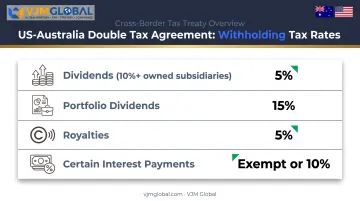
Without the treaty, these rates would be far higher. One structural risk sits on the Australian side: if the ATO classifies your US LLC as a foreign hybrid company, reporting becomes more complex. That treatment is not automatic for every LLC; it depends on how the entity is set up. Confirm the classification before you lock in an entity type.
Conclusion
Starting a US business from Australia doesn't require residency or a visa. It does require getting the entity structure, tax classification, and compliance obligations right from day one.
Speed matters less than clarity. A rushed EIN application or a poorly chosen state can mean months of restructuring later. Map both US and Australian-side obligations early — ideally with advisers who understand both systems — and you avoid considerable pain down the track.
Frequently Asked Questions
How do I start my own business in the USA?
Choose a business structure, register in a state, obtain an EIN, open a US bank account, and address your tax and visa requirements. Each step has specific documentation and processing times to plan around.
Can a non-citizen register a business in the US?
Yes. Australians can register an LLC or C-Corp without US citizenship or residency. No visa is required simply to own a US business, though operating from within the US is a separate legal matter.
Can I stay in the US if I start a business?
No — business ownership alone doesn't grant residency. Australians can pursue the E-2 Treaty Investor visa, which requires active management and a substantial, at-risk investment in the enterprise.
Is $5,000 enough to start a business?
That typically covers basic formation fees and a registered agent, but it's tight for a fully operational business once banking setup, compliance, and early operating costs are factored in.
What is the best business to start with $100,000?
This budget suits capital-intensive options like retail, import/export, or franchising. Lean service or consulting models generally need far less capital to get moving.
What are some Australian companies operating in the USA?
Canva has built a significant US presence, reporting a US team exceeding 200 staff by 2023 with an Austin campus, according to Canva's own newsroom. Atlassian also maintains a San Francisco headquarters as part of its global operations.