Introduction
German founders searching for how to open a "Public Limited Company" in the USA usually hit the same wall fast: the term doesn't exist here. US state law has no filing category called a PLC.
The closest match is a US Corporation, commonly called a C-Corp. Getting from that realization to a functioning US entity means handling several unfamiliar steps:
- Choosing a formation state
- Applying for an EIN without a Social Security Number
- Opening a US bank account remotely
- Navigating the Germany-US tax treaty
This guide covers the terminology, the step-by-step formation process, what you need before you start, and the mistakes that trip up German companies most often. VJM Global supports this kind of cross-border entity formation regularly, and we'll flag where specialist help matters most.
Key Takeaways
- No US entity is called a "PLC"; German companies typically form a C-Corporation (Inc.) to mirror an AG
- Complete the full setup remotely from Germany through a US registered agent
- Foreign-owned entities need an EIN, may face BOI filings with FinCEN, and must handle forms like W-8BEN-E
- State choice (Delaware, Nevada, Wyoming) and entity type shape liability, tax, and fundraising options
- A cross-border compliance partner cuts delays from notarization, apostilles, and foreign-owner banking checks
What Is a "Public Limited Company" in the US Context?
"PLC" is UK and Commonwealth terminology. It signals a company that can offer shares to the public and trade on an exchange, subject to specific governance and disclosure rules. No US state uses this designation in its corporate filing statutes. Delaware law, for instance, simply forms a "corporation."
The Terminology Bridge
For German founders, the mapping looks like this:
| German Entity | UK Equivalent | US Equivalent |
|---|---|---|
| AG (Aktiengesellschaft) | PLC | C-Corporation |
| GmbH | Ltd | LLC |
The AG and PLC are both built for public capital markets. The C-Corporation is the US structure that plays the same role, whether the company stays private or eventually lists shares.
Incorporating Is Not the Same as Going Public
Forming a C-Corp doesn't put you on a stock exchange. "Going public" (SEC registration, an IPO, a listing) is a separate legal step that happens later, if at all. Most German-founded US entities start as private corporations with a small group of shareholders and stay that way indefinitely.
This surprises a lot of founders coming from the AG structure, where the public-capital framing is baked into the entity type from day one.
Capital Requirements Differ Sharply
A German AG requires a statutory minimum share capital of €50,000 under Section 7 of the Aktiengesetz. Delaware's Certificate of Incorporation asks for authorized-share and par-value details but sets no minimum paid-in capital.
Founders coming from Germany often assume a similar capital threshold exists in the US. It doesn't, at least not in Delaware.
C-Corp vs. LLC vs. US Branch: Choosing the Right Structure
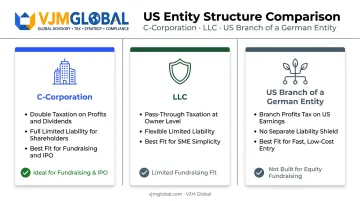
The entity you choose shapes everything downstream: taxation, liability, and whether investors will even consider writing a check. Here's how the three main options compare.
C-Corporation
- Best fit if you plan to raise institutional capital or eventually go public
- Subject to double taxation: the corporation pays tax on profits, then shareholders pay tax again on dividends
- The standard structure for venture-backed and exchange-listed companies
LLC
- Suited to SMEs that want pass-through taxation and lighter compliance
- Single-member LLCs default to disregarded-entity treatment; multi-member LLCs default to partnership treatment (IRS LLC classification)
- Not suitable for public share issuance or most VC deal structures
US Branch of the German Entity
- Fastest and cheapest to set up: no new legal entity to form
- Liability flows to the German parent; a branch is an extension of the parent, not a separate entity
- Complicates permanent establishment tax treatment under Articles 5 and 7 of the Germany-US tax treaty
- Foreign corporations with a US branch generally file Form 1120-F; a 30% branch profits tax can apply before treaty relief
Most founders planning to raise capital or list shares choose the C-Corp. Those running a smaller operation with no fundraising plans often prefer the LLC.
How to Set Up a US Corporation (PLC Equivalent) from Germany: Step-by-Step
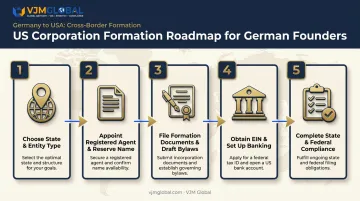
Step 1: Choose the Right State and Entity Type
Not every state is equal for foreign founders. Delaware dominates for a reason: it recorded more than 2.1 million active legal entities and 289,810 new formations in 2024. According to the Delaware Division of Corporations 2024 Annual Report, 81.4% of US-based IPOs were formed there.
Other states worth knowing:
- Nevada: no state corporate income tax (Commerce Tax filing applies once Nevada gross revenue tops $4 million)
- Wyoming: no corporate or personal state income tax
Decide between a C-Corp and an LLC based on your growth plan, not just cost. And remember: your state of incorporation doesn't need to match where you actually operate.
Step 2: Appoint a Registered Agent and Reserve the Company Name
Every corporation needs a registered agent with a physical street address in its state of incorporation. A PO box won't satisfy Delaware's requirements. Since you're based in Germany, this agent becomes your legal point of contact for state correspondence.
Before filing:
- Search name availability through the Secretary of State's database
- Reserve the name if needed (Delaware charges $75 for a 120-day hold)
- Run a basic US trademark search — a clear state name search doesn't mean the name is trademark-safe
An established US point of contact, such as VJM Global's New York office, gives founders a reliable local address for document handling while the entity gets off the ground.
Step 3: File Formation Documents and Draft Governing Bylaws
The Certificate of Incorporation (called Articles of Incorporation in some states) needs:
- Corporate name
- Registered office and agent details
- Purpose of the business
- Authorized shares and par value
Authorized share count matters if you're thinking about a future public issuance. Under-authorizing shares now means amending the certificate later.
After filing, draft corporate bylaws and appoint initial directors and officers. German nationals can serve as directors without any US residency requirement; Delaware's statute imposes no citizenship condition on directors.
Step 4: Obtain an EIN and Set Up US Tax and Banking Infrastructure
You need an Employer Identification Number (EIN) before you can open a bank account or file taxes. If the responsible party has no Social Security Number or ITIN and isn't eligible for one, IRS Form SS-4 instructions allow "foreign" or "N/A" on line 7b.
Applicants without a US address can't use the online tool. They apply by international phone, fax, or mail instead.
Banking is the harder part in practice. Expect:
- Documentation proving the entity's legal existence
- Passport identification for beneficial owners
- Extended KYC review timelines, since foreign-owned entities trigger more scrutiny
You'll also need Form W-8BEN-E on file for the German parent shareholder. It documents foreign status and any treaty-based withholding rate claims to the paying institution, not to the IRS directly.
Step 5: Complete State and Federal Compliance Registrations
Formation isn't the finish line. Ongoing obligations include:
- State franchise tax: Delaware's minimum runs $175–$400 depending on method, due March 1
- Sales tax registration in any state where you have nexus
- BOI reporting to FinCEN: most US-formed entities are exempt under the 2025 interim rule; foreign-formed entities registered in a US state may still need to report
- Annual report filings and registered agent renewal
Set up a compliance calendar now. Missed franchise tax deadlines and lapsed registered agents are two of the most common (and easily avoidable) failure points for foreign-owned entities.
What You Need Before You Start
Gather these before you file anything.
German-side documents:
- Certificate of incorporation or Handelsregisterauszug for the parent company
- Passport copies for all directors
- Notarization and apostille when a US bank or state agency needs authenticated German documents (1961 Hague Apostille Convention applies)
US-side logistics:
- A confirmed registered agent address in your chosen state
- A virtual mailbox for ongoing US correspondence
- EIN application materials ready to submit the moment your entity is formed
Financial readiness:
- Filing fees and franchise tax deposits budgeted upfront
Most US states set no statutory minimum paid-in capital, unlike Germany’s €50,000 AG threshold.
Common Mistakes German Companies Make When Setting Up in the US
German founders often hit the same avoidable snags. Watch for these:
- Filing "PLC" as the legal suffix. State registrars reject it outright. Use Inc. or Corp., not PLC.
- Underestimating banking timelines. Foreign shareholders without a US SSN or ITIN face longer KYC reviews. Budget weeks, not days, for account opening.
- Skipping treaty and reporting setup. Without a valid W-8BEN-E, payers may withhold at the full statutory rate instead of the treaty rate.
- Ignoring PE and BOI exposure. Permanent establishment risk and beneficial ownership reporting create double-tax and penalty risk if left unplanned.
Cross-border support from a firm such as VJM Global helps keep withholding, PE analysis, and BOI filing aligned so launch timelines stay on track.
Conclusion
The US equivalent of a Public Limited Company is a Corporation, most often formed in Delaware. Choose the right entity and state early, and plan for ongoing Germany-US compliance once the entity exists.
Preparation makes the difference: know your documents, timelines, and obligations before you file. A cross-border formation partner like VJM Global can take you from document legalization through EIN issuance and the filings that follow.
Frequently Asked Questions
Is it better to be a PLC or Ltd?
In the US context, this translates to choosing between a C-Corp (public and capital-raising route) and an LLC (private, pass-through route). The right choice depends on your fundraising and growth goals.
What is the equivalent of an LLC in Germany?
The GmbH (Gesellschaft mit beschränkter Haftung) is the closest German equivalent to a US LLC. Both offer limited liability with relatively flexible management structures.
What is a public limited company in Germany?
The German AG (Aktiengesellschaft) is Germany's public limited company equivalent. It requires €50,000 minimum capital and a two-tier board structure with management and supervisory boards.
Does the United States have a legal entity literally called a "PLC"?
No. No US state recognizes "PLC" as a filing designation. The closest functional equivalent is a C-Corporation, especially once it is publicly traded.
Can a German citizen or company own 100% of a US corporation?
Yes. US law places no restriction on foreign ownership of a corporation or LLC. Tax treaty filings, EIN applications, and banking KYC steps still apply regardless of ownership percentage.
How long does it take to set up a US corporation from Germany?
State filing can take days to a few weeks, depending on the state and expedited options. EIN issuance is typically about four business days by fax or around four weeks by mail; bank account opening is usually the longest step because of foreign-owner KYC checks.