For American entrepreneurs, that combination looks less like a risk and more like an opening. The UK shares a language, a legal tradition rooted in common law, and deep trade ties with the US, which lowers the learning curve compared to entering, say, continental Europe or Asia.
Interest is coming from several directions: US logistics companies expanding internationally, American entrepreneurs with UK family or business connections, and investors looking to diversify into a stable, English-speaking market. Whatever your starting point, the legal, entity, and cross-border mechanics differ from anything you've done in the US. This guide walks through exactly what changes.
Key Takeaways
- Own and direct a UK haulage business from the US without relocating—UK compliance still applies in full
- Secure an Operator’s Licence, a UK operating centre, and a UK-resident Transport Manager before you haul
- Budget thousands of pounds for a single-vehicle start, plus entity setup, banking, and dual-country tax
- Need a UK visa only if you will work in the UK day-to-day—not merely to own or direct the company
- Use a cross-border setup specialist to form the entity remotely and keep US and UK compliance aligned
What Is a Haulage Business, and Why Is the UK Market Attracting US Entrepreneurs?
A haulage business transports goods by road for payment. That's it. It's distinct from passenger transport and from freight forwarding, where a broker arranges movement without operating the trucks themselves.
Two common formats exist:
- Single-vehicle owner-operator — one HGV, one owner, often the fastest way to test the market
- Multi-vehicle fleet — scales revenue but multiplies licensing, insurance, and staffing requirements
That distinction matters later: the licensing requirements in this guide apply only to operators who physically move goods, not to freight forwarders.
Why the Timing Favours New Entrants
Three market conditions are opening the door for new operators:
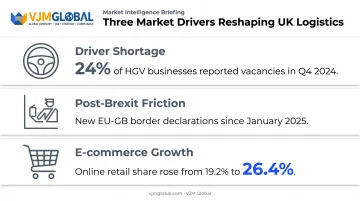
- Driver shortage: 24% of surveyed HGV businesses reported driver vacancies in Q4 2024 (DfT HGV driver vacancy statistics); one in five of those firms missed deliveries
- Post-Brexit friction: New safety and security declarations for EU-to-GB imports (in force since January 2025) have added complexity that favors operators who can navigate compliance well
- E-commerce growth: Online sales made up 26.4% of UK retail in 2023, up from 19.2% in 2019, feeding steady demand for last-mile and regional delivery capacity
None of this makes UK haulage an easy business. Margins in the sector hover around 2.5%, squeezed by wages, fuel, and financing costs. But the demand signals are real — which is why outside capital and management expertise are finding a foothold.
Can a US Citizen or Company Legally Start a Haulage Business in the UK?
Yes, and this surprises a lot of American founders. UK company law does not require directors or shareholders to be UK residents.
A US citizen can own 100% of a UK limited company and direct it from a laptop in Chicago or New York. The company needs a UK registered office, but the people running it don't need a UK address.
That said, "owning the company" and "operating the trucks" are two separate legal questions, and the second one has firm UK-only requirements.
Choosing the Right Legal Structure as a US-Based Owner
Most overseas founders choose between two structures:
- Standalone UK limited company: a new legal entity registered with Companies House, with its own liability shield and UK tax residency
- Branch of an existing US company: extends your US entity into the UK without creating a separate legal person
A standalone UK limited company is the more commonly used route for haulage specifically, largely because Operator's Licence applications and financial standing tests are built around a UK-registered entity with its own balance sheet.
Tax follows the entity. A UK limited company pays UK Corporation Tax at 19% on profits below £50,000, rising to 25% above £250,000, with marginal relief in between.
The 2003 US-UK Double Taxation Convention helps stop the same profit being taxed twice, but it does not remove UK filing duties. Map the treaty position before you incorporate. A firm like VJM Global, which handles UK entity compliance and US-side reporting, can set that out up front.
Do You Need a Visa to Run a UK Haulage Business Remotely?
No — not for ownership or remote direction. Attending board meetings, signing contracts, or making occasional site visits under a Standard Visitor visa is permitted. What changes things is physically working in the UK on a regular basis: managing day-to-day dispatch, sitting in an office running the operation full-time.
At that point you need a work-authorizing route. Options include a Skilled Worker visa (sponsor and job offer required) or an Innovator Founder visa (endorsed, innovative business idea required). A standard haulage startup rarely qualifies for Innovator Founder status. Most remote US founders stay remote and hire UK-based staff for on-the-ground operations.
Meeting the UK "Operating Centre" and Transport Manager Requirements
This is the part of the process that has nothing to do with where you live and everything to do with where your trucks live.
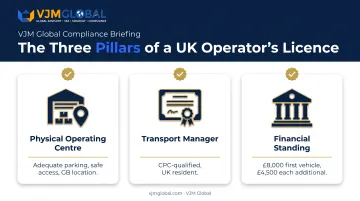
An Operator's Licence (O-licence) requires:
- A physical operating centre in Great Britain with adequate parking, safe access, and an environmentally acceptable location
- A Transport Manager who holds a Certificate of Professional Competence and resides in or near the UK
- Proof of financial standing: currently £8,000 for the first HGV and £4,500 for each additional vehicle, per the Traffic Commissioner's goods vehicle operator licensing guide
Many overseas founders keep strategic control from the US while hiring a UK-based Transport Manager to satisfy the residency requirement. This is normal practice, not a workaround — the role exists precisely so that day-to-day compliance sits with someone physically present.
How to Start a Haulage Business in the UK from the USA – Step by Step
The general UK haulage setup process is well documented. What's less obvious is how it changes when you're founding and directing the business from the United States.
The most common mistake American founders make is assuming their US LLC formation experience transfers directly. It doesn't. UK entity law, licensing, and banking all run on different rules.
Step 1 – Research the UK Market and Define Your Niche
Start by identifying where demand is concentrated. In 2024, groupage (consolidated shipments) made up 24% of goods lifted, and the five largest commodity groups accounted for 73% of total tonnage. Regional delivery, specialised cargo (such as dangerous goods, which requires extra regulatory approval), and long-haul each carry different licensing and insurance profiles.
If you already have US shipper or industry relationships, use them. A US retailer with UK distribution needs, or a logistics partner with existing UK lanes, can hand you an early customer before you've bought a single truck.
Step 2 – Register Your UK Entity and Set Up Compliance from Abroad
Registering a UK limited company involves:
- Choosing and reserving a company name with Companies House
- Appointing at least one director and identifying any Person with Significant Control
- Filing incorporation documents and obtaining a Company Registration Number
- Registering for Corporation Tax with HMRC and obtaining a Unique Taxpayer Reference
None of this legally requires you to set foot in the UK. A cross-border entity formation specialist such as VJM Global can handle company registration, provide a registered office, and manage the ongoing Companies House and HMRC filings that follow incorporation, so a US founder can get the entity live without booking a flight.
Step 3 – Secure Your Operator's Licence and Appoint a Transport Manager
This is the step that actually determines when you can start hauling.
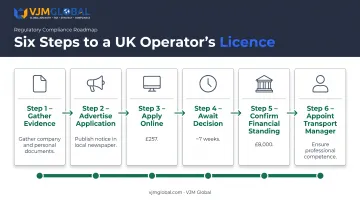
- Gather financial evidence, vehicle details, and organisational information
- Advertise the application locally (required for standard licences) between 21 days before and 21 days after applying
- Apply online through the Traffic Commissioner, budgeting £257 for the application and £401 for the issue fee
- Expect a decision in roughly 7 weeks, but apply at least 9 weeks ahead. Objections or missing evidence add delay
- Confirm your £8,000 first-vehicle financial standing is available and stays available for the licence's duration, not a one-time payment
- Appoint a Transport Manager with a valid Certificate of Professional Competence (CPC), as an employee or external contractor with continuous responsibility for the fleet
You cannot operate before the licence is issued, full stop.
Step 4 – Arrange Vehicles, Insurance, and UK Banking
Decide between buying, hire purchase (which can transfer ownership at the end of the term), or leasing. Leasing avoids ownership risk; hire purchase builds equity over 12-60 month terms.
You'll need three types of cover:
| Insurance Type | Legally Required? | Covers |
|---|---|---|
| Motor/fleet | Yes, minimum third-party | Vehicle damage, liability |
| Goods in transit | Not compulsory, but standard practice | Loss/damage to cargo |
| Public liability | Not always legally required | Third-party injury/property claims |
Opening a UK business bank account as a non-resident is often the biggest practical snag. Banks typically want proof of UK trading activity, a UK registered address, and director identification, which can be hard to produce before you've operated in-country. This is another area where working with a formation partner who has existing UK banking relationships shortens the runaround considerably.
Step 5 – Plan Funding and Manage Cross-Border Cash Flow
Common funding routes include:
- Asset finance for vehicles and equipment (lease or hire purchase)
- Invoice finance to bridge the gap between completing jobs and getting paid
- Bank or business loans for working capital, subject to UK lender underwriting
Moving startup capital from US dollars into sterling exposes you to exchange-rate movement between the day you commit funds and the day they land. Build a currency buffer into your cash-flow model, and don't assume today's exchange rate will hold three months from now.
Step 6 – Launch Operations and Build UK Customer Relationships Remotely
Once licensed and insured, find early work through:
- Freight exchanges and load boards, which list return loads and reduce empty running
- The Road Haulage Association (RHA), which provides Conditions of Carriage that reduce contractual risk
- Logistics UK membership, which offers compliance updates and a member advice centre
A US founder directing strategy from abroad still needs someone UK-based fielding calls and building trust with customers face-to-face. Even a part-time local operations contact makes a measurable difference in the early months.
Costs, Funding, and Ongoing Cross-Border Compliance to Plan For
No authoritative UK source publishes a reliable all-in startup figure for a single-vehicle haulage operation, so treat any number you see online with suspicion. Confirmed cost components still add up quickly:
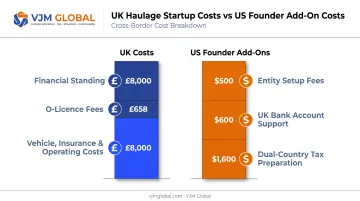
- £8,000 financial standing for your first HGV
- £658 total in O-licence fees
- Vehicle acquisition or lease payments, insurance, driver recruitment, and operating-centre rent
US-based founders should budget additional line items on top of that:
- Entity setup and registered office fees for the UK company
- UK bank account opening support, if using a formation specialist to smooth the process
- Dual-country tax preparation, since UK filings don't replace US reporting obligations
For funding, most new operators lean on asset finance or hire purchase for the vehicle, then cover working capital with a start-up loan, invoice finance, or retained cash. Build the O-licence financial-standing sum into that plan so it is not tied up in day-to-day cash flow.
Compliance Runs on Two Fronts
Once trading, UK obligations include:
- VAT registration once taxable turnover exceeds £90,000 in a 12-month period
- Corporation Tax filing via form CT600, due 12 months after your accounting period ends
- O-licence renewal and ongoing financial standing checks
American ownership of a foreign company can also trigger US reporting: FBAR filings when foreign account balances exceed $10,000 at any point in the year, and possible FATCA foreign-asset disclosure depending on ownership structure. Errors here draw penalties on both sides of the Atlantic.
VJM Global coordinates UK entity compliance and US-side reporting through one team, so filings stay aligned instead of split across two advisors who never compare notes.
Conclusion
Owning a UK haulage business from the US is legally doable. It still demands a UK operating centre, a UK-resident Transport Manager, and deliberate choices about entity structure and licensing that don't mirror US business setup.
Success comes from pairing US-based capital and strategic direction with strong on-the-ground UK execution. Get the compliance right early, and the rest of the business becomes a normal operating challenge rather than a legal minefield.
A partner who knows both jurisdictions won't haul freight for you, but will cut months off setup and catch mistakes that trip up first-time overseas founders. VJM Global helps US owners with UK entity formation, tax compliance, and accounting so the regulatory work stays handled while you run operations.
Frequently Asked Questions
How do you start a haulage company in the UK?
Write a business plan, register a UK entity, apply for an Operator's Licence with an appointed Transport Manager, arrange vehicles and insurance, then build a customer base through load boards and industry contacts.
How much money do you need to start a haulage business in the UK?
Budget at least £8,000 in financial standing per vehicle plus £658 in O-licence fees, on top of vehicle, insurance, and operating costs. US founders should add entity setup and dual-country tax compliance costs.
Can a US citizen own a UK haulage company without living in the UK?
Yes, UK company law allows non-resident ownership and direction. However, you'll still need a UK operating centre and a UK-resident Transport Manager to hold the Operator's Licence.
Do I need a UK visa to run a haulage business remotely from the US?
No visa is needed simply to own shares or direct the company from the US. A visa becomes necessary only if you plan to relocate and actively manage day-to-day UK operations.
What licence do I need to operate a haulage business in the UK?
You need a standard Operator's Licence (O-licence) from the Traffic Commissioner, plus a Transport Manager holding a Certificate of Professional Competence.
How long does it take to set up a UK haulage company from the USA?
Company registration can take days, but the O-licence typically takes around 7 weeks, with the Traffic Commissioner recommending you apply at least 9 weeks ahead. Working with a formation specialist can help avoid delays from missing paperwork.