Introduction
India's coworking market is having a moment. Flex-space stock across the country's top seven cities hit 72.3 million sq ft in 2025, and Colliers projects it will cross 100 million sq ft by 2027. Growth is driven by startups, hybrid-work adoption, and global companies opening Global Capability Centers (GCCs) in cities like Bengaluru and Pune (Colliers, 2025).
That expansion has drawn NRIs investing back home, US real estate investors seeking diversification, and remote entrepreneurs who see India's commercial real estate as underpenetrated compared to saturated US markets. The hard part is doing it from overseas: entity structure, FDI rules, and ongoing compliance are easy to get wrong without a clear India-entry path.
This guide walks through exactly how a US-based founder can legally set up and run a coworking space in India, from entity structure to daily operations, without relocating.
Key Takeaways
- India's flex-space market is growing fast, but profitability still hinges on occupancy and location, not market size alone
- A Private Limited Company (Wholly Owned Subsidiary) is the most common structure for full foreign ownership
- Indian law requires at least one resident director — a purely remote setup isn't legally possible
- Entity registration can take as little as 13 days once paperwork is ready, but full launch often takes several months
- Cross-border tax reporting applies on both sides: India (GST, ROC) and the US (foreign-ownership disclosures)
What Is a Coworking Space Business?
A coworking space business leases flexible office infrastructure (desks, private cabins, meeting rooms) to freelancers, startups, and companies, typically on a membership or subscription model.
What you sell is ready-to-use workspace with amenities and community: high-speed internet, reception support, printing, event space, and a shared professional environment that saves tenants from signing long-term leases.
In India, common formats include:
- Hot-desk or day-pass models for freelancers and remote workers
- Dedicated desks for small teams needing consistency
- Private suites for growing startups
- Managed offices for Global Capability Centers (GCCs), where a global company outsources fit-out and facilities to an operator
- Virtual office add-ons, useful for companies needing a registered business address without daily occupancy
A US-based owner doesn't typically run any of this personally. The business operates through a locally registered Indian entity, with day-to-day execution handled by an on-ground team.
Why Start a Coworking Space in India From the USA? (Market Opportunity)
The opportunity is real, but only when demand, policy, and cost structure line up in your favor.
Demand is genuinely strong. Grade A flex stock is expected to grow nearly 20% annually through 2027, and enterprise seat uptake is projected to rise from roughly 160,000 seats to around 200,000 seats by 2026-2027: a 25% jump (Colliers, 2025).
FDI Policy Works in Your Favor — Mostly
Coworking and related real-estate services generally fall under India's 100% FDI automatic route, meaning foreign-owned entities don't need prior government approval for activities not otherwise restricted (DPIIT Consolidated FDI Policy, 2020).
India prohibits FDI in "real estate business," defined as dealing in land or property for profit. Earning lease income as a service operator is generally treated as outside that definition, but the line depends on how you structure the business, not only which industry label you use. Confirm the structure with a FEMA/FDI advisor before you lock the model.
Where the Real Advantage Sits
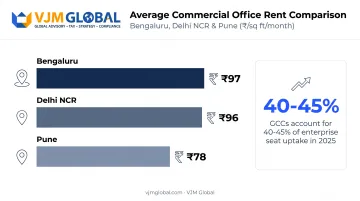
- Lower operating costs. Bengaluru's average office rent runs around ₹97 per sq ft/month, Pune around ₹78, and Delhi NCR around ₹96, a fraction of comparable US commercial rents.
- GCC-driven demand. GCCs already account for 40%-45% of enterprise seat uptake in 2025, and that share is expected to keep climbing.
- Under-supply in Tier-2 cities. Cities beyond Bengaluru and NCR still have room to grow before hitting saturation.
None of this guarantees returns. Occupancy, pricing discipline, and location selection still decide whether a coworking space turns a profit. Market growth only makes the attempt worth serious evaluation.
What to Know Before You Start (as a US-Based Founder)
Most first-time overseas founders underestimate how much of this business has to run through a local, on-ground presence, not remotely and not alone.
The resident director requirement is non-negotiable. Indian company law requires at least one director who stays in India for a specified period during the financial year. A structure with zero local presence simply isn't legal.
Here's the realistic timeline breakdown:
- Entity incorporation: can move quickly once documents are ready. VJM Global's typical registration-stage process runs about 13 days: 2 days for Digital Signature Certificates, 1 day for Director Identification Number allotment, and roughly 10 days combined for name approval and registration.
- Property lease and licensing: adds several weeks depending on the city and landlord negotiations.
- Fit-out and hiring: extends total launch time to several months in most cases.
This business leans heavily on hands-on local management (property upkeep, staff supervision, compliance deadlines) far more than on the US founder's daily involvement. A trustworthy local general manager is the backbone of the operation, not a nice-to-have.
Expect quick wins in early memberships, but budget realistically for the longer runway needed to hit break-even occupancy. Coworking spaces rarely fill up in month one.
Early Decisions That Matter: Entity Structure, FDI Route, and Local Partner
Most cross-border setup problems trace back to picking the wrong entity type or skipping a compliance step early, not from a lack of capital.
Wholly Owned Subsidiary vs. LLP
| Factor | Private Limited Company (WOS) | LLP |
|---|---|---|
| Ownership | Full foreign ownership, up to 200 shareholders | Minimum 2 partners; no upper cap |
| Resident requirement | One resident director | One designated partner resident in India |
| Fundraising | Easier to raise equity, scale, own property | More limited for outside investment |
| Compliance burden | Higher, more formal | Comparatively lighter |
| Legal identity | Separate legal entity, limited liability | Separate legal entity, liability capped at contribution |
For most coworking founders aiming to scale beyond one location, the WOS structure wins: it supports fundraising, contract-signing, and property ownership in the company's own name.
The Compliance Checklist Nobody Skips
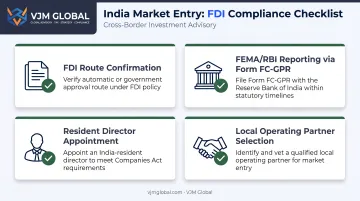
- FDI route: Coworking typically falls under the automatic route when structured as a services business; confirm sector conditions before remitting capital.
- FEMA/RBI reporting: File Form FC-GPR through your Authorized Dealer bank on the RBI FIRMS portal after each equity issue.
- Resident director: Use a trusted local co-founder, a nominee director service (VJM Global includes this in incorporation support), or a compliance partner.
- Local operating partner: A building owner or operator under a managed model cuts capital exposure while you validate demand; a direct lease gives more control with higher upfront risk.
The most common misstep: choosing a structure based on US tax convenience alone, without checking Indian repatriation and compliance rules first. That usually ends in an expensive restructuring exercise a year or two in.
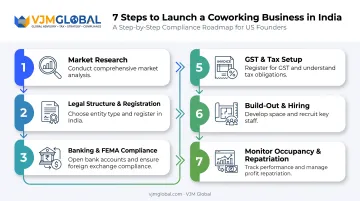
How to Start a Coworking Space in India From the USA – Step by Step
These steps walk you through registering and launching the business from outside India. Skip local market validation or start operating before licensing clears, and you're setting yourself up for avoidable delays.
Step 1 – Research the Market and Shortlist a City Remotely
Use secondary research, virtual site visits, and local brokers to assess demand, competition, and rental rates in candidate cities: Bengaluru, Pune, Noida, and Hyderabad are common starting points given their flex-space maturity.
Validate your target audience (startups, GCC satellite teams, freelancers) and test realistic pricing before committing capital.
Step 2 – Choose the Legal Structure and Register the Company
Decide between a Wholly Owned Subsidiary and other structures based on ownership goals and scaling plans. Incorporation formalities (DIN/DSC for directors, MOA/AOA drafting, ROC filing, PAN/TAN registration) can be completed remotely with a firm experienced in foreign-entity registration. VJM Global, for example, handles entity formation for US companies entering India.
Step 3 – Set Up Cross-Border Banking and FEMA/RBI Compliance
Open a current account for the Indian entity and route your investment as equity, following FEMA reporting requirements for inbound foreign investment. Keep documentation like the Foreign Inward Remittance Certificate ready. Incomplete filings are a common cause of delayed fund remittance.
Step 4 – Secure the Property and Complete Licensing
Negotiate a commercial lease (or managed-model partnership) suited to coworking layouts, relying on local broker input since you can't always inspect in person. Before fit-out begins, secure:
- Trade license
- Fire NOC
- Shops & Establishment registration
Step 5 – Register for GST and Set Up Ongoing Tax Compliance
Register for GST once turnover crosses the applicable threshold, then set up recurring GST and corporate tax filing for the Indian entity.
On the US side, separate disclosure rules apply. A US person acquiring 10% or more of a foreign corporation's voting power or value may need to file Form 5471. Penalties start at $10,000 per foreign corporation per accounting period for non-compliance (IRS Instructions for Form 5471). Coordinate both sides through advisors who understand each jurisdiction.
Step 6 – Build the Space, Hire a Local Team, and Launch
Fit out the space with furniture, connectivity, and amenities, and hire an on-ground general manager to run daily operations. Set up remote-monitoring systems (booking software, financial dashboards, video check-ins) so you can track performance without being physically present.
Step 7 – Monitor Occupancy, Compliance, and Repatriation of Profits
Track occupancy, revenue per desk, and compliance deadlines (ROC annual filings, tax returns) on a fixed schedule. When you move profits back to the US, the India-US tax treaty caps source-country dividend withholding at 15% for qualifying corporate shareholders owning at least 10% voting stock, or 25% otherwise. Those figures are treaty ceilings, not automatic rates, so confirm eligibility before assuming the lower rate applies.
Conclusion
Starting a coworking space in India from the USA is achievable, but it isn't a passive investment. Getting the legal structure, local presence, and compliance sequence right from day one determines whether the business actually works.
Market demand alone won't carry a coworking business to profitability. Disciplined location selection, pricing, and remote-management systems matter more than market growth alone.
Working with a firm that understands both Indian entity setup and cross-border compliance can shorten the learning curve for a first-time overseas operator. VJM Global handles this combination regularly for US founders entering India.
Frequently Asked Questions
Is owning a coworking space in India profitable?
Profitability is possible, but it depends on occupancy levels, location, pricing, and cost control. The market growth is real — over 20% annual expansion in Grade A flex stock — but growth doesn't guarantee individual-property returns.
Can a US citizen or company own 100% of a coworking space business in India?
Generally yes, since coworking and related services typically qualify for the FDI automatic route allowing full foreign ownership through a Wholly Owned Subsidiary. Always verify current sector-specific FDI rules before finalizing your structure.
What is the best legal structure for a US company entering India's coworking market?
A Private Limited Company (Wholly Owned Subsidiary) is typically preferred over an LLP for full ownership, easier fundraising, and long-term scalability across multiple locations.
Do I need to be physically present in India to start a coworking space?
Much of the incorporation and setup can happen remotely, but Indian law requires at least one resident director. A trusted local presence is essential even if you never relocate.
How long does it take to register a company in India from the USA?
Registration itself can move in around 13 days once documentation is ready, but the full process — including property, licensing, and fit-out — typically takes several months.
What are the tax obligations for a US owner of an Indian coworking business?
The Indian entity handles GST, corporate tax, and ROC filings. Separately, the US owner faces foreign-ownership disclosure obligations, including potential Form 5471 filing, making coordinated cross-border tax advice essential.