The interest makes sense. Buying through US middlemen adds markup at every layer, and Surat's lab-grown diamond boom has lowered the capital needed to enter manufacturing.
This guide isn't a general "how to start a diamond business" primer. It's built specifically for founders who are staying in the USA while building in India, meaning entity structuring, cross-border compliance, and remote management take center stage.
Key Takeaways
- Choose between remote sourcing (no Indian entity) and a formal legal entity before you register anything
- Your FDI route and entity structure lock in taxation, control, and how you repatriate profits
- Run compliance on two tracks at once: India-side (FEMA, GST, IEC) and US-side (Form 5471, FBAR)
- Budget separately for entity setup costs and diamond inventory or working capital
- A cross-border compliance partner reduces entity-structuring mistakes and dual-filing miss steps
What Does Starting a Diamond Business in India from the USA Actually Involve?
It means sourcing, trading, or manufacturing diamonds and diamond jewelry in India while a US-based individual or company owns or controls the operation. That control requirement triggers two separate compliance frameworks: India's foreign investment rules and US cross-border tax reporting on foreign holdings.
The real value is direct access to India's cutting, polishing, and manufacturing ecosystem at costs domestic wholesalers can't match.
Structures Available to a US Founder
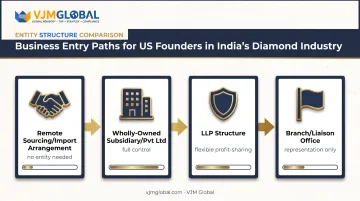
You generally have four paths:
- Remote sourcing/import arrangement - no Indian entity, working through an established Indian export partner
- Wholly-owned Indian subsidiary (Private Limited Company) - full operational and legal control
- LLP structure - more flexible, subject to sector-specific FDI checks
- Branch or Liaison Office - representation only; a Liaison Office cannot trade or invoice independently
A US citizen doesn't need Indian citizenship or residency to own an Indian entity outright. Most entity types still require a resident director or authorized signatory based in India. Verify that requirement against current Companies Act provisions before you commit to a structure.
One more distinction matters early: a B2B model (sourcing and wholesale for your US retail operation) carries a lighter compliance load than a B2C model (an India-based export or online retail brand), since the latter often triggers additional retail-specific FDI conditions.
Why the USA-to-India Route Makes Sense for Diamond Entrepreneurs
This route works best when a founder wants:
- Direct sourcing control over cutting and polishing
- Better margins than buying through US intermediaries
- Long-term supply chain security
Those advantages are real. They still require careful execution.
The scale of India's diamond industry is what draws people in. According to a GJEPC-hosted January 2026 report, India meets over 90% of global demand for cut and polished diamonds. That is a demand-volume figure, not export value share, but it still shows how concentrated cutting and polishing is in one country.
Lab-grown diamonds (LGDs) get pitched as the lower-capital entry point, and there's truth to that. Surat's LGD manufacturing base is enormous. Recent data still needs a clear-eyed read: India's polished LGD exports totaled $1.13 billion in FY2025-26, a 10.55% year-over-year decline in US-dollar terms, according to GJEPC's FY2025-26 export data.
That contraction does not make LGD manufacturing a bad opportunity. It means pricing pressure has increased. Anyone entering now should build margin assumptions around current conditions, not last year's growth narrative.
Key Decisions Before You Start: Entity Structure, FDI Route & Compliance Partner
Most US founders underestimate how much this one decision cascades. Entity structure and FDI route determine your taxation, your degree of control, how easily profits flow back to the US, and how fast you can actually start trading.
Comparing Your Entity Options
| Structure | Control | Liability | Ongoing Compliance |
|---|---|---|---|
| Wholly-owned subsidiary (Pvt Ltd) | Full | Limited to entity | Highest (ROC filings, audit, GST) |
| LLP | High, flexible profit-sharing | Limited to entity | Moderate |
| Branch/Liaison Office | Representation only | Parent company liable | RBI approval-driven |
| Joint venture with Indian partner | Shared | Limited, but shared decision-making | Moderate to high |
Diamond trading and manufacturing generally sit under a favorable FDI category. Manufacturing activities and B2B wholesale/cash-and-carry trading both currently allow 100% foreign ownership under the automatic route, meaning no prior RBI or government approval is needed, according to DPIIT's July 2025 FDI policy documentation.
That's a meaningful advantage over sectors that need case-by-case government sign-off. Sectoral rules get revised periodically, so reconfirm against current DPIIT/RBI policy before filing.
Repatriation and the DTAA
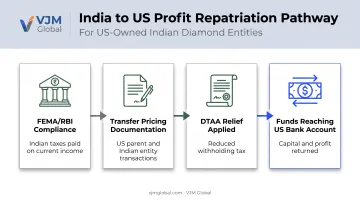
Sending profits home isn't automatic just because you own the entity. A few things determine how much reaches your US bank account:
- FEMA/RBI rules govern how and when current income (dividends) can be repatriated, generally after applicable Indian taxes are paid
- Transfer pricing between your US parent and Indian entity needs documentation to withstand scrutiny on both sides
- The US-India DTAA caps Indian withholding tax on dividends and reduces the risk of paying tax twice on the same income
Getting this wrong doesn't just cost money. It can delay repatriation for months while you sort out documentation gaps.
This is where most solo founders get stuck. VJM Global works at exactly this intersection: assessing FDI permissibility for your activity, helping you choose between a wholly-owned subsidiary, LLP, or liaison structure, and managing the FEMA/FDI filings. That way a founder in New York or Los Angeles isn't reverse-engineering RBI circulars between sourcing calls.
How to Start a Diamond Business in India from the USA – Step by Step
Two assumptions trip up nearly every US founder here: that US LLC-style registration processes translate directly to India, and that managing an Indian operation remotely is as simple as email and video calls. Neither holds up. Here's the sequence that actually works.
Step 1 – Decide Your Business & Entry Model
Before touching paperwork, decide whether you're pursuing remote sourcing with no Indian entity, building full legal presence, or partnering with an existing Indian exporter.
Match the model to your capital, your desired level of hands-on involvement, and your customer: B2B wholesale to US jewelers looks very different from an export-focused D2C brand. The most common misstep: setting up a full entity before validating demand, when a lighter sourcing agreement would have tested the model at a fraction of the cost.
Step 2 – Choose the Right Legal Entity Structure & FDI Route
Compare a Private Limited Company, LLP, and Liaison/Branch Office against how much control and independent trading capability you actually need. Confirm your FDI route (automatic or government approval) before filing anything.
Most entity types require a resident director or designated partner physically present in India for a minimum statutory period each financial year. Companies need at least one director meeting India's residency test; LLPs have a separate, shorter threshold for a resident designated partner. Verify current thresholds before structuring, since this determines whether you need a nominee arrangement.
Step 3 – Complete India-Side Registrations & Compliance
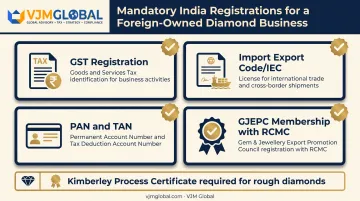
Once your entity exists, several registrations follow:
- GST registration for tax compliance and export refund eligibility
- Import Export Code (IEC) from DGFT, a 10-digit code mandatory for any cross-border trade
- PAN and TAN for the Indian entity
- GJEPC membership and RCMC registration, which unlock export benefits and add industry credibility
Rough diamonds carry an additional layer: every shipment needs a valid Kimberley Process certificate, and trade is only legal between scheme participants. Finished jewelry with precious metal content may also fall under BIS hallmarking rules, though hallmarking certifies metal purity, not the diamond itself.
VJM Global's registration support directly covers GST, IEC, and PAN/TAN filings for foreign-owned entities entering India, which removes a meaningful chunk of this administrative load from a founder's plate.
Step 4 – Set Up Cross-Border Banking, Tax & Repatriation Structure
Open the appropriate Indian bank accounts and put transfer pricing documentation in place between your US parent and Indian entity before intercompany transactions start flowing.
Owning a foreign entity also triggers US-side reporting:
- Form 5471: Required when a US owner holds more than 50% control. Missing it starts at a $10,000 penalty, with more possible after IRS notice.
- FBAR (FinCEN Form 114): Applies if aggregate foreign account value crosses $10,000 at any point in the year.
The DTAA helps offset double taxation on repatriated profits, but claiming that relief requires proper documentation, including a Tax Residency Certificate.
VJM Global supports FBAR advisory and broader cross-border tax compliance alongside its India-side GST, ROC, and FEMA reporting work, which matters because these two reporting tracks run on separate deadlines and separate authorities.
Step 5 – Build Your Sourcing, Quality Control & Local Operations Base
Surat is the center for cutting, polishing, and lab-grown manufacturing. Mumbai is stronger for trading and finished jewelry. Build supplier relationships through a site visit or a trusted local representative. Don't skip this.
Establish quality control using certified grading (GIA or IGI) since you can't physically inspect every stone from New York or Chicago. The most expensive mistake at this stage: trusting a single overseas supplier without in-person or third-party verification. Stones get substituted. Grading claims get inflated. Verification isn't optional.
Step 6 – Manage Remotely, Monitor Compliance & Scale
Set up ongoing compliance tracking for ROC annual filings, GST returns, and FEMA reporting through a retained back-office or virtual CFO service. Track inventory and financial performance through B2B diamond platforms, and schedule real check-ins with your India-based team, not just quarterly emails.
The most common failure mode here is treating initial setup as "done." Annual ROC filings (like AOC-4 and MGT-7), monthly GST returns, and FEMA reporting events don't stop after year one.
Miss enough of them and your entity risks penalties or strike-off. Retained compliance support that handles GSTR-1, GSTR-3B, and FC-GPR/FC-TRS filings on a recurring basis keeps this from becoming a surprise.
Conclusion
Starting a diamond business in India from the USA is as much a cross-border structuring challenge as it is a sourcing opportunity. The diamonds themselves are the easy part once you're on the ground in Surat or Mumbai.
Getting entity structure, FDI route, and repatriation planning right upfront is what determines whether you build a durable operation or spend your first year untangling avoidable compliance gaps. A cross-border advisor such as VJM Global, working both US and Indian rules daily, helps you lock those choices in before capital moves.
Frequently Asked Questions
How do I start a diamond business in India?
Decide your entry model first (remote sourcing vs. full entity), choose the right entity and FDI route, then complete GST, IEC, and GJEPC registrations. From there, build sourcing relationships in hubs like Surat or Mumbai.
How much does it cost to start a diamond business in India?
Costs vary widely by entity type, inventory scale, and sourcing model. Budget separately for entity setup and compliance costs versus diamond inventory and working capital, and get current figures before committing capital.
Is a diamond business profitable in India?
Profitability depends heavily on business model and volume. Cut-and-polished manufacturing often runs on thin single-digit operating margins, while trading and branded retail can differ widely by volume and positioning.
Can a US citizen or company own 100% of a diamond business in India?
Yes, generally. Manufacturing and B2B wholesale trading both currently permit 100% foreign ownership under the automatic FDI route, subject to a resident director requirement and current RBI/FEMA compliance.
Do I need to travel to India to set up the business?
Entity registration and compliance filings can largely be handled remotely with a local partner. That said, an initial visit is strongly recommended for supplier vetting and quality control before you commit real inventory capital.
What's the best legal structure for a US founder starting a diamond business in India?
A wholly-owned Private Limited subsidiary generally offers the most control and credibility. A remote sourcing arrangement suits founders who want to validate demand before committing capital to a full entity.