That's a lot of buyers for a market that shares your language and, unlike most international expansions, doesn't require you to relearn how to write a product description. Add in mature logistics infrastructure, a formation process that doesn't care where you live, and the UK's position as a gateway into Europe and Commonwealth trade, and it's no surprise the interest is broad-based.
Solo dropshippers testing the waters, established Shopify and Amazon sellers scaling internationally, and founders incorporating purely for credibility all end up asking the same question. This guide walks through the legal, financial, and logistical steps involved.
Key Takeaways
- US citizens and residents can own and direct a UK company with no UK residency requirement
- Core setup spans Companies House registration, VAT, non-resident banking, and store launch
- Registration takes days; full operational readiness usually takes several weeks
- A cross-border formation partner reduces filing errors, bank delays, and VAT missteps
Why US Entrepreneurs Are Eyeing the UK E-Commerce Market
The UK isn't a niche test market. It's one of the largest, most mature developed e-commerce economies in the world, with an estimated 52 million UK residents shopping online in 2025, according to Statista's UK e-commerce overview. That's a customer base larger than the entire population of most European countries, concentrated in one country with one currency and one regulator.
A few things make it particularly attractive to American founders specifically:
- Language and cultural proximity — no translation, minimal localization, familiar marketing tone
- Established logistics — dense courier networks and fulfilment infrastructure already built for D2C volume
- Gateway positioning — a UK base, paired with the right shipping setup, makes onward expansion into the EU and Commonwealth markets far simpler
- Credibility — a UK-registered entity carries weight with UK buyers, marketplaces, and payment processors that a US company selling cross-border sometimes doesn't get
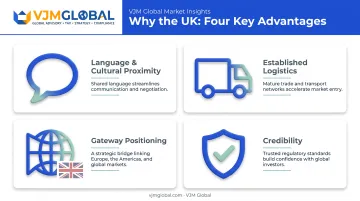
That last point matters more than founders expect. Local incorporation often means faster marketplace account approval and quicker payout settlement than selling cross-border as a foreign entity.
Can Americans Legally Start and Own a UK E-Commerce Business?
Yes, without qualification. US citizens and residents can register, own, and direct a UK company with no residency or citizenship restriction. A private company needs at least one director who is 16 or older, but that director does not have to live in the UK, according to GOV.UK's official company formation guidance.
You can be the sole director and sole shareholder of your own UK company from a laptop in Ohio.
That said, "legally allowed" and "correctly set up" are two different things. Here's what actually needs to happen.
Choosing the Right Business Structure as a Non-Resident
Most non-resident founders default to a private limited company (Ltd) rather than a sole trader setup, and for good reason:
- Limits personal liability to the company itself, not your personal assets
- Carries more credibility with UK banks, suppliers, and marketplaces like Amazon UK
- Separates business finances cleanly, which matters when you're managing two tax jurisdictions
- Signals permanence to UK customers who may be wary of buying from an unfamiliar overseas seller
Sole trader status is simpler on paper, but it offers none of that protection and tends to raise questions with UK-based banking and payment partners once they see a non-UK applicant.
The UK Registered Address Requirement
Every UK company needs a registered office address, and it must be a physical UK address, not a PO box and definitely not your home address in the States. Your registered office is public record, visible to anyone who searches Companies House.
Most non-resident founders solve this through a formation agent or virtual address service. Basic registered-office packages are widely available for around £39 plus VAT per year, though pricing rises with added mail forwarding or scanning services.
VAT Registration and Thresholds for Overseas-Owned Companies
Here's where a lot of founders get tripped up. The standard VAT registration threshold is £90,000 in taxable turnover over the previous 12 months, or if you expect to cross that figure in the next 30 days, according to GOV.UK's VAT registration guidance.
But that threshold doesn't apply to everyone. If you're storing inventory in the UK, for example through Fulfilment by Amazon, you're classified as a non-established taxable person and must register for VAT immediately, regardless of turnover.
Zero pounds in sales still means a VAT obligation the moment stock sits in a UK warehouse.
US-UK Tax Treaty and Double Taxation Considerations
A common assumption trips up first-time non-resident founders: that US LLC rules or US tax logic somehow carries over. It doesn't.
- A company incorporated in the UK is generally UK tax-resident, regardless of where the owner lives
- UK Corporation Tax filing obligations apply once HMRC issues a notice to deliver a return — your US residency doesn't cancel this
- The US-UK tax treaty defines permanent establishment through a fixed place of business, and storage or delivery activity alone may fall outside that definition under specific treaty conditions
- Independent agents acting in the ordinary course of business generally don't create a permanent establishment; someone habitually signing binding contracts on your behalf might
Don't assume US tax rules apply just because you're the one signing the paperwork. The UK company has its own filing life, separate from your personal US tax return.
Getting Expert Help With Formation and Ongoing Compliance
Formation and ongoing UK compliance are where cross-border support matters most. VJM Global has worked with more than 500 American business owners and over 250 UK businesses on UK entity registration, VAT, and statutory filings.
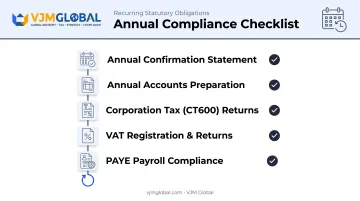
The firm handles these steps using the UK's own regulators and processes—not a US-structure workaround. Recurring obligations typically include:
- Annual Confirmation Statement filings with Companies House
- Annual accounts preparation
- Corporation Tax returns filed on form CT600 with HMRC
- VAT registration and returns when required, including immediate registration for non-established taxable persons
- PAYE payroll compliance, if you hire UK-based staff
How to Start Your UK E-Commerce Business From the USA – Step by Step
With the legal groundwork clear, here's the practical sequence.
The most common mistake at this stage: assuming your US LLC paperwork or US tax habits translate directly. They don't. Treating this as a UK-native process from day one saves real headaches later.
Step 1 – Validate Your Product and UK Market Demand
Before registering anything, confirm the demand exists:
- Research UK-specific competitor pricing in GBP, not converted USD figures
- Study seasonal buying patterns (Boxing Day, for instance, behaves nothing like US post-Christmas sales)
- Run a UK-targeted ad campaign or test a single listing on a UK marketplace before committing to full setup
This costs a few hundred dollars and a couple of weeks. It's far cheaper than discovering post-incorporation that your product doesn't resonate.
Step 2 – Register Your UK Company and Get Compliant
Online incorporation through Companies House costs £100 and typically completes within 24 hours. Same-day incorporation through approved software runs £156. You'll need:
- An approved company name
- A UK registered office address
- Director and shareholder details (you, most likely)
- Memorandum and Articles of Association filed with Companies House
Registration produces a Company Registration Number. You'll then register separately for Corporation Tax with HMRC to get your Unique Taxpayer Reference.
Many non-resident founders bundle this with VAT registration through a formation partner like VJM Global to cut filing errors common when working from overseas.
Step 3 – Set Up UK Banking, Payments, and Currency Management
Traditional UK banks, Lloyds being one example, typically require the account holder to be a UK resident with a UK mobile number. That rules most Americans out immediately.
Fintech alternatives fill the gap:
- Wise Business: offers UK account details entirely online, no UK travel required
- Payoneer: provides GBP receiving details (explicitly not a full UK bank account, but functional for receiving payments)
- Revolut Business: accepts applicants residing in the US for a UK-registered company, subject to standard checks
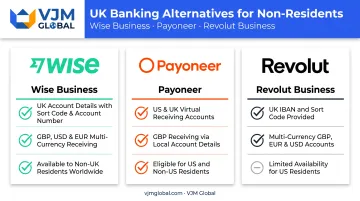
Whichever you choose, make sure your payment gateway settles in GBP and supports local card schemes. Constant currency conversion eats into margins fast if you're pricing in GBP but settling in USD.
Step 4 – Build Your Online Store and Choose Sales Channels
You've got two broad paths: your own store or a marketplace, and most serious sellers eventually use both.
- Shopify: most popular choice for UK direct-to-consumer stores, starting around £19/month on the Basic plan
- WooCommerce: free, open-source, better suited to technically confident founders comfortable managing hosting
- Amazon UK / eBay UK: faster access to built-in traffic, less control over branding
Whatever you pick, localisation basics matter: GBP pricing (not USD converted at checkout), a .co.uk domain, and VAT-inclusive checkout totals so UK shoppers see the real price upfront.
Step 5 – Handle Fulfilment, Shipping, and Launch Marketing
For a US-based owner, fulfilment options generally break down three ways:
- Fulfilment by Amazon UK: Amazon handles storage and shipping, but triggers immediate VAT registration and requires a GB EORI number for customs
- A UK-based 3PL: more control than FBA, still avoids shipping every order from the US
- Shipping direct from US inventory: workable at low volume, but customs declarations, duty, and import VAT add friction and delay
For launch marketing, keep initial spend UK-focused and modest. Monitor performance closely before scaling budget; the ad platforms and buyer behaviour patterns don't map 1:1 with what worked in the US market.
What It Costs and How Long It Takes to Get Running
Budget in two buckets: one-time setup and recurring operational costs.
One-time costs:
- Companies House incorporation: £100 online (or £156 for same-day)
- Store setup, branding, and initial inventory: varies widely by business
Recurring costs:
- Registered office/formation service: from roughly £39 plus VAT per year
- Accounting support: commonly £200–£400/month for a limited company (some providers from ~£94/month)
- VAT filing: often bundled, or a few pounds monthly as an add-on
- Platform fees: Shopify subscription plus transaction fees, or Amazon referral fees (typically 8–15%) plus the professional selling fee
Realistic timeline:
- Company registration: within 24 hours to a few days
- Bank/fintech account setup: 1–2 weeks
- VAT registration and store build: several weeks before you're launch-ready
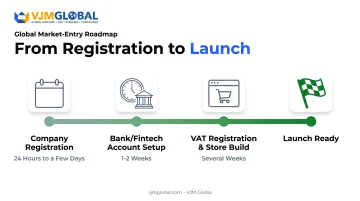
Cost and timeline both drop when one formation and compliance partner handles incorporation and VAT together, instead of you coordinating multiple providers.
Choosing the Right Platform and Selling Channels for the UK Market
Your selling channel shapes fees, reach, and how much control you keep over branding and customer data.
| Channel | Best for | Fee snapshot |
|---|---|---|
| Shopify | D2C brands wanting full control | ~£19/month + transaction fees |
| WooCommerce | Technical founders, custom builds | Free core, hosting from ~£20–280/month |
| Amazon UK | Fast access to built-in traffic | 8–15% referral + £25/month professional plan |
| eBay UK | Lower-barrier marketplace entry | Category-based fees + 0.35% regulatory fee |
Amazon UK and eBay UK reach 43.2 million and 30.7 million UK online adults respectively, according to Ofcom's 2025 Online Nation report, which explains why so many founders launch there before building a standalone store.
Two compliance basics apply regardless of platform:
- VAT-inclusive pricing: every price shown to consumers must include VAT and other compulsory charges
- 14-day cancellation right: UK consumer law requires you to allow cancellations up to 14 days after delivery, without requiring a reason
UK shoppers lean heavily on cards (46% of online spend) and mobile wallets, with 57% of UK adults using mobile wallets for online or contactless payments in 2024. Make sure your checkout supports Apple Pay and Google Pay alongside standard card processing, or you'll lose sales at the final step.
Frequently Asked Questions
How much does it cost to start an online business in the UK?
Incorporation runs around £100–£156 one-time, plus a registered address from roughly £39/year. Ongoing accounting, VAT support, and platform fees typically add £200–£400/month depending on complexity.
Can an American start a business in the UK?
Yes. There's no residency or citizenship requirement to own or direct a UK company. The only physical requirement is a UK registered office address.
How do I sell in the US from the UK?
This is the reverse journey, requiring US entity formation, an EIN, and state-by-state sales tax registration. VJM Global supports founders moving in either direction, UK-to-US or US-to-UK.
Which platform is best for ecommerce in the UK?
Shopify is the most popular choice for UK direct-to-consumer brands wanting full control. Marketplaces like Amazon UK and eBay UK suit sellers prioritising faster access to existing traffic.
Do I need to visit the UK to register my company or open a business bank account?
No. Company registration is entirely remote through Companies House. Fintech banking alternatives like Wise and Revolut also let you set up accounts without a UK visit.
Do I need a UK VAT number before I start selling?
Only once your taxable turnover crosses £90,000, with one major exception: if you store inventory in a UK fulfilment centre, VAT registration is required immediately, regardless of turnover.