Introduction
The UK's marketplace economy is shifting fast. Etsy-style product platforms and Airbnb-style service marketplaces are pulling ahead of single-brand e-commerce stores, and US founders are noticing.
Online sales made up 28.3% of all UK retail spending in December 2025, up from 28.0% the month before, according to ONS retail sales data. That's a market with real digital appetite.
Why the UK, specifically? It's English-speaking, sits next to the EU, offers remote-friendly incorporation, and has payment infrastructure built for multi-party platforms. US e-commerce sellers pivoting to platform models, SaaS founders building niche marketplaces, and agencies launching for UK clients all want in. Most hit the same blockers once they start: UK entity choice, VAT, and multi-party payments run from the US.
This guide walks through entity structure, tax and VAT, multi-party payments, and platform build so you can launch a marketplace in the UK legally and practically, without relocating.
Key Takeaways
- Marketplaces face distinct tax, VAT, and reporting rules that single-seller stores don't. Plan for these before writing code
- US founders can be 100% directors and shareholders of a UK Ltd company with no visa or residency required
- HMRC's digital platform reporting rules require seller data collection from day one, not after growth
- A compliant launch (VAT, payments, seller onboarding) takes 6-12 weeks, even though incorporation takes 24-48 hours
- Cross-border formation specialists can shorten this timeline and reduce regulatory exposure
What Is a Marketplace Business?
A marketplace business is a platform that connects independent third-party sellers or service providers with buyers. It earns money through commissions, listing fees, or subscriptions, not by selling its own inventory.
This is the core difference from a standard e-commerce store: the marketplace doesn't own what's being sold. It sells trust, discovery, and the transaction infrastructure that makes a deal possible between two separate parties.
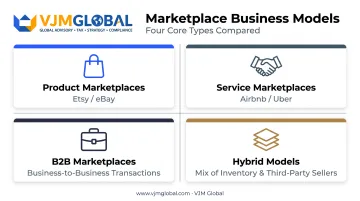
Common structures include:
- Product marketplaces — third-party goods sellers (think Etsy or eBay)
- Service marketplaces — independent providers offering labour or expertise (think Airbnb or Uber)
- B2B marketplaces — businesses transacting with other businesses
- Hybrid models — a mix of the above, often with the platform holding some inventory too
That distinction has real operational consequences. It changes which tax rules apply, how payments must be structured, and what compliance obligations kick in — all covered in the sections ahead.
Why Start a Marketplace Business in the UK as a US Founder?
The UK works for marketplace founders when genuine two-sided demand and supporting infrastructure are both in place. For most marketplace models, it delivers on both.
The Market Opportunity Is Real
UK online retail penetration has climbed steadily, hitting 28.3% of total retail sales in December 2025, a 1.3 percentage point rise from the same month a year earlier. That is a large, digitally mature consumer base already comfortable buying from unfamiliar sellers—the trust dynamic every marketplace depends on.
Setup Is Fast, Remote-Friendly, and Credible
Non-UK residents can be sole directors and sole shareholders of a UK Ltd company. No residency, no visa, and no UK personal address for the founder—only a registered office address for the company itself.
- Digital incorporation typically completes within 24 hours
- The Companies House digital filing fee is £100 as of February 2026
- Director identity verification can be completed remotely via an authorised agent
A UK Ltd caps founder liability at share value and needs minimal share capital to form. It also signals seriousness to investors or acquirers in a way sole-trader or informal structures do not. English contracts, English-language support, and a familiar "Ltd" suffix reduce friction when onboarding sellers across the UK and wider Europe.
Payment Infrastructure Built for Marketplaces
The UK fintech stack supports genuine multi-party payment flows. Stripe Connect, GoCardless, and Wise Platform all operate in the UK with tooling for split payments and seller payouts, which many markets still lack.
Key Considerations Before You Start
Most failed cross-border marketplace launches don't fail from lack of demand. They fail because founders underestimate how much multi-party compliance complexity a marketplace carries compared to a normal online store.
Entity Structure: UK Ltd vs. US Entity with UK Registration
You can operate through a US LLC or C-corp with UK registration, or set up a standalone UK Ltd. The UK Ltd route generally wins on local banking access, seller trust, and clean tax residency.
A US entity trading in the UK can trigger permanent establishment questions and add avoidable tax complexity.
Digital Platform Reporting Is Marketplace-Specific
This is the rule most US founders miss entirely. Since 1 January 2024, HMRC requires digital platforms to collect and report seller and transaction data, with first reports filed in January 2025.
What this means in practice:
- Collect seller information (name, address, tax ID, business registration number) starting from your first onboarded seller
- Verify that data; you remain responsible even if a third party performs the check
- Report payment totals, fees withheld, and transaction counts annually (with period breakdowns)
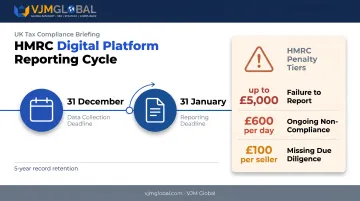
- Deadline: collect by 31 December, report by 31 January the following year
- Keep records for 5 years
Penalties aren't trivial: up to £5,000 for failing to report, then £600 per day it continues, plus £100 per seller for missing due diligence.
There's a small carve-out: sellers who make 30 or fewer goods sales and receive €2,000 or less annually don't need reporting. It doesn't apply to services or rentals though.
VAT Threshold and Marketplace Liability
UK VAT registration kicks in at £90,000 of taxable turnover in a rolling 12-month period. Marketplaces face an extra wrinkle beyond that threshold.
If you facilitate sales of imported goods valued at £135 or less from overseas sellers to UK consumers, you (the marketplace) become liable for collecting that VAT, regardless of your own turnover.
For goods already sitting in the UK and sold by an overseas seller through your platform, you're treated as the "deemed supplier" and must account for VAT on their behalf.
Payment Facilitation and KYC/AML
Handling multiple parties' money is where marketplaces diverge sharply from single-seller stores. If your platform receives buyer funds into an account it controls before remitting to sellers, you're likely providing a regulated payment service.
That may require FCA registration or authorisation unless you rely on a regulated payment facilitator that takes on that regulated function itself.
Using Stripe Connect doesn't automatically exempt you. The exemption applies only when the provider — not your platform — actually controls the fund flow.
Who Manages the UK Side Year-Round?
Confirmation statements, annual accounts, Corporation Tax filings, VAT returns — someone needs to own these while you're based in the US. Decide this before incorporating, not after your first filing deadline passes.
How to Start a Marketplace Business in the UK from the USA — Step by Step
The launch path below is built for a two-sided platform, not a single-seller store. The mistakes that sink most US founders: incorporating before validating demand, ignoring digital platform reporting, and underestimating how long payment and KYC setup take.
Step 1: Validate Two-Sided Demand and Choose Your Niche
Before anything else, confirm both sides of your marketplace actually exist in the UK.
- Identify the specific seller-side gap (who's underserved, overpriced, or hard to find)
- Identify the buyer-side gap (what are people struggling to source or book)
- Test willingness to list and willingness to pay — not just interest
The classic failure mode: strong buyer signal but thin seller supply, or vice versa. A marketplace with only one side stocked is just an idea, not a business.
Step 2: Choose Your Entity Structure and Register with Companies House
For most US founders, a UK private limited company beats operating solely through a US entity: better banking access, cleaner tax treatment, and more seller trust.
Key facts:
- Non-UK residents can be 100% directors and shareholders
- You need only a UK registered office address, not a personal UK address
- Digital incorporation typically completes within 24 hours for a £100 filing fee (as of February 2026)
- New directors must verify their identity through Companies House, which can be done remotely via an authorised agent
Firms like VJM Global support US founders through UK entity formation, registered office provision, and Companies House filings end-to-end, without requiring the founder to set foot in the UK.
Step 3: Set Up UK Tax, VAT, and Digital Platform Reporting
Register for Corporation Tax immediately after incorporation and obtain your UTR. Then build your compliance systems before you need them:
- Monitor turnover against the £90,000 VAT threshold, and separately assess marketplace-specific VAT liability if you're facilitating overseas seller sales
- Build seller data collection into your onboarding flow from your very first listing, since HMRC's digital platform reporting duty starts on day one of operation
- Set calendar reminders for the 31 December data collection deadline and 31 January reporting deadline
Founders often treat tax and VAT registration as a "later" problem once volume justifies it. That creates backdated exposure that is far more painful to unwind than setting systems up correctly from day one.
Step 4: Set Up Multi-Party Payments, Escrow, and KYC/AML
Your payment infrastructure needs to handle split payments, seller payouts, and identity verification simultaneously.
| Provider | Split payment capability | KYC handling |
|---|---|---|
| Stripe Connect | Separate charges and transfers across connected accounts | Manages identity/sanctions checks during onboarding |
| GoCardless Partner API | Deducts platform fees from merchant payments | Verifies merchants before payout via hosted onboarding |
| Wise Platform | Batch payouts up to 1,000 transfers | Hosted KYC data collection |
Before choosing, determine whether your platform itself will hold and control buyer funds (which pushes you toward FCA registration) or whether your payment provider takes on that regulated role entirely. Don't assume a PSP relationship automatically covers this — verify who's actually controlling the money.
Building custom payment flows in-house without AML/KYC checks baked in is a direct regulatory breach waiting to surface.
Step 5: Build the Platform and Onboard Your First Sellers
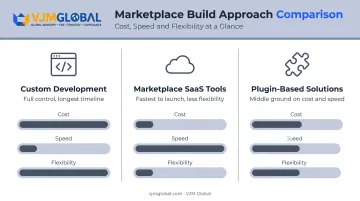
Decide your build approach:
- Custom development: full control, longest timeline
- Marketplace SaaS tools: fastest to launch, less flexibility
- Plugin-based solutions: middle ground on cost and speed
Whichever route you pick, your seller onboarding flow needs to cover listing standards, your commission structure, and a clear dispute/review policy before you invite anyone in.
Resist the urge to launch across multiple seller categories at once. Prove the model in one niche first; spreading too thin before the core loop works is how early marketplaces stall.
Step 6: Launch, Market, and Scale in the UK Market
Marketplace growth requires marketing both sides simultaneously, not just buyers.
Track these core metrics:
- Liquidity: how often buyers actually find and transact with sellers
- Take rate: your revenue as a share of gross merchandise value
- Repeat usage: how many buyers and sellers come back, not just show up once
According to a16z's marketplace metrics framework, there's no universal benchmark for these numbers. They vary widely by category, so track your own trend over time rather than chasing a generic target.
Pouring all marketing budget into buyer acquisition while seller supply quietly dries up breaks the loop the whole model depends on.
Conclusion
Starting a UK marketplace from the US comes down to getting entity, tax, and payment compliance right early. These carry marketplace-specific obligations that a standard e-commerce store never faces.
Validated two-sided demand and disciplined execution matter more than how fast you launch. Rushing to incorporate before proving both sides of your marketplace is the single most common way founders waste six months.
Partnering with a cross-border firm such as VJM Global for entity formation, VAT and tax compliance, and ongoing accounting gives US founders a path to launch and operate compliantly in the UK without relocating.
Frequently Asked Questions
Can an American start a business in the UK?
Yes. Non-UK residents can be 100% directors and shareholders of a UK Ltd company and can incorporate remotely through Companies House. They don't personally need a visa; the company only needs a UK registered office address.
Do I need a licence to sell online in the UK?
Most retail and marketplace selling doesn't require a general licence. However, regulated categories (alcohol, food) or payment facilitation activities may require FCA registration or local authority licensing.
Do I need to live in the UK to register a company there?
No. Incorporation can be completed fully remotely using a UK registered office address. The founder never needs to relocate or visit in person.
What's the difference between an e-commerce store and a marketplace business model?
An e-commerce store sells its own inventory directly to customers. A marketplace connects independent third-party sellers with buyers and earns revenue through commissions or fees, without owning the products sold.
How much does it cost to register a UK company as a US founder?
The Companies House digital filing fee is £100 as of February 2026. On top of that, expect additional costs for a registered office address and professional formation support, which vary by provider.
Do I need to register for VAT immediately when I incorporate my UK marketplace?
No — VAT registration is tied to crossing the £90,000 turnover threshold, not incorporation itself. That said, marketplace-specific VAT liability rules for overseas sellers should be reviewed early regardless of your own turnover.