That growth isn't accidental. The India-UAE Comprehensive Economic Partnership Agreement (CEPA) has cut duties on most Indian goods, Dubai's free zones offer 100% foreign ownership, and a resident Indian population of over 4 million gives new exporters a built-in customer base before they even sign their first buyer.
Manufacturers, first-time exporters, and Indian businesses looking to formalise a UAE presence are all asking the same question right now: what does it actually take to start? This guide walks through the documentation, licensing, costs, and execution steps involved.
Key Takeaways
- Start with an IEC and export docs only—a UAE entity is optional but helps local distribution
- CEPA removes or cuts duties on most Indian goods entering the UAE
- Core path: HS codes, IEC/RCMC, mainland vs free zone, customs registration, logistics
- Direct export can begin within weeks; a UAE entity typically takes 30–60 days
What Is an Export Business to Dubai?
An export business to Dubai is one that manufactures, sources, or trades goods in India and sells or ships them into the UAE market, either directly from India or through a locally registered entity. The real payoff is building repeatable supply from India to meet steady GCC demand, not one-off consignments.
There are two common formats businesses use:
- Direct export from India – You hold an Import Export Code (IEC), ship against a sales contract, and clear customs on the UAE side through your buyer or their agent. No UAE entity required.
- Dubai-based trading entity – You register a mainland or free zone company in Dubai to warehouse stock, handle re-export to other GCC or African markets, and manage buyer relationships closer to the ground.
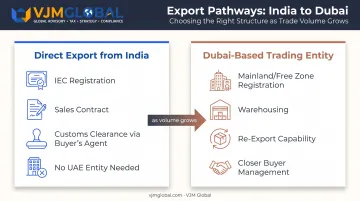
Most first-time exporters start with the first format and move to the second once order volumes justify a local presence.
Why Dubai Is a Strategic Export Market for Indian Businesses
Dubai combines tariff advantages, port infrastructure, and a tax structure few other Middle East markets can match.
CEPA has already reshaped the economics. UAE tariff preferences now cover over 97% of tariff lines, representing 99% of Indian export value. By February 2025, nearly 240,000 CEPA Certificates of Origin had supported USD 19.87 billion in Indian exports.
The actual duty rate still depends on your HS code and origin rules. Don't assume every product qualifies for zero duty automatically.
Infrastructure keeps pace with that trade volume. Jebel Ali Port handled 15.5 million TEU in 2024, its highest since 2015. Dubai International Airport moved 2.2 million tonnes of air cargo the same year, up over 20% from 2023. Both routes offer reliable, high-frequency connections from major Indian ports and airports.
The tax environment is favourable for trading entities:
- Corporate tax is 0% on income up to AED 375,000, and 9% above that threshold
- Standard VAT is 5%, with mandatory registration only above AED 375,000 in taxable turnover
- Free zones like JAFZA and DMCC allow 100% foreign ownership and keep goods duty-exempt as long as they stay within the zone
Dubai also functions as a re-export hub. Goods landed in a free zone can move onward to GCC, African, or European buyers without entering UAE mainland commerce, so one shipment can serve multiple markets.
Demand is concentrated in a few categories:
- Gems and jewellery exports rose from USD 4.95 billion in FY2022 to USD 8.04 billion in FY2024—over 60% growth
- Smartphone exports touched USD 2.57 billion in FY2023-24
- Textiles, food and spices, pharmaceuticals, and engineering goods round out the strongest categories
The 4.3 million-strong Indian expatriate population in the UAE adds another advantage: less market education is needed for products already trusted at home.
What You Need Before You Start: Documents, Registrations & Costs
Before your first shipment moves, you need three things sorted: documentation, registrations, and a realistic budget.
Documents You'll Need for Export Clearance
Every shipment, regardless of product, needs a core set of paperwork:
- Commercial invoice and packing list – Establishes value, terms, and contents
- Certificate of Origin (CoO) – Required to claim CEPA duty benefits
- Bill of lading or airway bill – Your transport record
- Shipping bill/bill of export – The customs declaration on the Indian side
- Sales contract and insurance certificate – Support payment terms and risk allocation
Product-specific requirements often catch first-time exporters off guard:
- Food items need FSSAI or halal certification
- Certain goods need phytosanitary clearance
- UAE-bound commercial invoices often need MOFA eDAS attestation (~AED 150 per invoice) before customs will accept them
That attestation step is one of the most commonly missed requirements.
Registrations & Licences Required
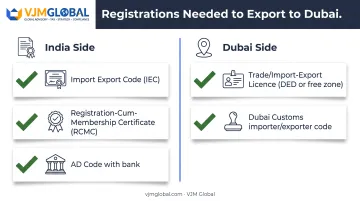
On the India side:
- Import Export Code (IEC) from DGFT — mandatory unless specifically exempt
- Registration-Cum-Membership Certificate (RCMC) from your product's relevant Export Promotion Council
- AD Code registration with your bank, linking your account to customs for foreign exchange purposes
On the Dubai side:
- A trade/import-export licence from the Department of Economic Development (mainland) or a free zone authority
- Registration with Dubai Customs for an importer/exporter code, using your trade licence, passport, and Emirates ID
Estimated Costs to Get Started
Costs vary sharply depending on whether you export directly or set up a UAE entity.
| Item | Approximate Cost | Notes |
|---|---|---|
| IEC registration | Nominal fee (~₹500) | One-time, via DGFT portal |
| RCMC membership | Varies by council | Often annual |
| Dubai Customs importer code | AED 120 | AED 100 + AED 20 Knowledge fee; 1 working day |
| Mainland trade licence (DED) | From AED 1,070 + AED 300 Chamber fee | Activity and premises add to this |
| JAFZA free zone licence | From AED 5,000 | Scales with activity count |
| DMCC free zone licence | Application AED 1,035 + registration AED 9,020 + annual licence AED 20,285 | Higher-end free zone option |
Beyond setup, budget for recurring costs: freight and insurance, VAT registration once UAE turnover crosses AED 375,000, and basic marketing to reach GCC buyers.
Free zone licences generally cost less to start than mainland setups. Mainland, however, gives you unrestricted access to the wider UAE domestic market.
How to Start an Export Business to Dubai – Step-by-Step
With documentation and costs in view, here's the practical sequence. Most delays at this stage come from skipping HS code verification or letting India-side registrations lapse, not from the process itself being complicated.
Step 1: Select Your Product and Verify HS Code & CEPA Eligibility
Match what you manufacture or source to genuine UAE demand rather than assuming interest. Then look up the 8-digit ITC(HS) code for your product on the DGFT portal and check the corresponding UAE preferential tariff line before you commit inventory or marketing spend. This single step prevents the most common CEPA mistake: assuming a product is duty-free when its specific tariff line isn't covered.
Step 2: Complete Your India-Side Registrations
Apply for your IEC through the DGFT portal, then secure your RCMC from the relevant Export Promotion Council and register your AD Code with your bank. IEC details must be confirmed or updated annually between April and June, even if nothing has changed. Non-updated IECs get deactivated, which stalls shipments at the worst possible time.
Step 3: Register Your Business Entity in Dubai and Obtain a Trade Licence
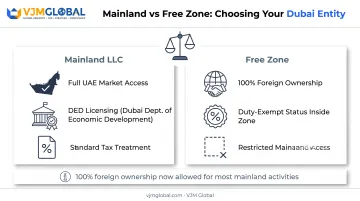
If you're moving beyond direct export, decide between mainland and free zone:
- Mainland LLC – Licensed by the DED, with full access to the UAE domestic market
- Free zone (JAFZA, DMCC, DAFZA, and others) – 100% ownership and duty-exempt status inside the zone; goods lose that exemption when they enter mainland commerce
UAE law allows 100% foreign ownership for most mainland activities, so a local partner is no longer a blanket requirement—though some activities still carry restrictions. The mainland vs free zone choice affects tax treatment, customer access, and ongoing compliance. Specialists like VJM Global help exporters match the structure to their sales channel using the UAE's own regulators and entity types.
Step 4: Register with Dubai Customs
Once your trade licence is issued, apply for a Dubai Customs importer/exporter code using your licence, passport copy, and Emirates ID or residency visa. The fee is AED 120, and processing typically takes one working day, making this one of the faster steps in the entire setup.
Step 5: Arrange Logistics, Freight, and Warehousing
Plan three pieces before the first shipment:
- Freight forwarder with real clearance experience at Jebel Ali Port or Dubai International Airport
- Duty exposure: standard 5% on CIF value, unless your product qualifies for a CEPA-reduced rate
- Free zone warehousing if you will re-export to other GCC or African markets (goods stay duty-exempt until they move to the final destination)
Step 6: Ensure Product and Labelling Compliance
Before you ship, confirm:
- Arabic labelling requirements for your specific product category
- Whether your product needs a UAE Certificate of Conformity from MoIAT (this applies only to products under specific technical regulations, not universally)
- That your goods aren't on the UAE's restricted or prohibited list, which includes items like certain agricultural products and specific chemicals
Skipping this step is a common reason shipments get held at customs rather than cleared on arrival.
Step 7: Set Up Banking, Accounting, and Ongoing Tax Compliance
Once goods are moving, the compliance work shifts from one-time setup to ongoing management. You'll need a UAE corporate bank account that handles international trade, VAT registration once your turnover crosses AED 375,000, and a bookkeeping system that tracks obligations on both sides of the border.
This is where most exporters underestimate the workload. Filing across two tax jurisdictions—with different fiscal years, currencies, and reporting formats—is more than most SMEs want to run in-house.
VJM Global handles cross-border accounting, payroll, and multi-jurisdiction tax compliance so Indian GST and UAE VAT stay accurate without a finance team on either side.
Realistically, direct export can begin within a few weeks once your IEC and documentation are in order. A UAE entity typically adds 30–60 days for registration, licensing, and customs code issuance. Most delays trace back to incomplete paperwork, not the process itself.
Conclusion
Exporting to Dubai rewards businesses that get documentation, licensing, and CEPA eligibility right from the start. Rushing a first shipment and fixing gaps later usually costs more than building compliance into the plan. Dubai's port infrastructure, tax environment, and re-export role make it a strong long-term base for Indian exporters, as long as compliance stays an ongoing responsibility, not a one-time checklist item.
For first-time exporters, partnering with advisors who know both the Indian and UAE sides of the process can cut setup time and reduce the compliance risks that often surface in year one. VJM Global supports Indian exporters with entity formation, tax compliance, and cross-border advisory across India and the UAE.
Frequently Asked Questions
Can I start an export business to Dubai from India?
Yes. You need an IEC from DGFT and proper export documentation at minimum; a UAE trade entity is optional. There's no citizenship restriction on Indian exporters selling into the UAE.
How much does it cost to export goods from India to Dubai?
Direct export costs are low, covering mainly IEC fees, RCMC membership, and shipping. Setting up a UAE entity adds licence and registration costs starting from roughly AED 1,070 for mainland or AED 5,000+ for free zone options.
What products does India export most to Dubai?
Gems and jewellery, textiles, food and spices, pharmaceuticals, and engineering goods lead the list. CEPA has improved price competitiveness across nearly all of these categories.
What is the India-UAE CEPA and how does it help exporters?
CEPA eliminates or reduces duties on the majority of Indian goods entering the UAE, covering over 97% of tariff lines. You need a valid Certificate of Origin to actually claim these benefits at customs.
How long does it take to start exporting to Dubai?
Direct export with just an IEC and documentation can start within a few weeks. Setting up a UAE entity, including licensing and customs registration, typically takes 30-60 days.
Do I need to register a company in Dubai to export from India?
No, direct export only requires an IEC. A UAE entity is useful if you want local distribution, faster payment cycles, or re-export access to other GCC and African markets.