Several forces are converging right now. The dollar-to-rupee exchange rate creates real cost arbitrage. Remote entity setup has gotten faster. India allows 100% automatic-route FDI in gems and jewellery. And certification standards have matured enough to reduce the authenticity risk that once scared off foreign buyers.
The people exploring this range widely — NRIs reconnecting with a family trade, US jewelry retailers wanting a direct sourcing arm, and first-time investors drawn by export potential. This guide walks through the legal, financial, and operational steps a US-based founder needs to set up and run a gemstone business in India.
Key Takeaways
- Starting this business means forming an Indian legal entity, not just importing stones as a buyer
- Gems and jewellery qualify for 100% FDI under India's automatic route — no prior government approval needed
- Entity choice (subsidiary, LLP, or branch/liaison office) depends entirely on your intended activity
- Expect parallel compliance obligations on both the Indian and US sides from day one
- Realistic setup timelines run 4-8 weeks; ongoing compliance remains a permanent cost centre
What Does Starting a Gemstone Business in India From the USA Actually Involve?
In plain terms, it means legally establishing a business presence in India as a foreign national or foreign company to source, manufacture, certify, or export gemstones, while you remain based in or operating from the USA.
That is not the same as simply importing gemstones into the US as a buyer. If you're just buying finished stones from an Indian exporter and reselling them stateside, you don't need an Indian entity at all. But if you want to trade, manufacture, certify, or export directly from India, you need:
- An Indian-registered legal entity
- FDI compliance filings with the Reserve Bank of India (RBI)
- Local tax registrations (GST, PAN, TAN, IEC)
Three common structures cover most use cases:
- Wholly Owned Subsidiary (Private Limited Company) — full operational control, suited to trading, manufacturing, or export-led models
- LLP — lighter compliance burden, workable for smaller-scale sourcing or trading operations
- Liaison or Branch Office — representation only; a liaison office cannot conduct commercial trading at all
Picking the wrong one at this stage is the single most common mistake US founders make. Step 2 covers how to choose the right one.
Why Start a Gemstone Business in India From the USA? (When It Makes Sense)
This isn't a guaranteed win just because your family has roots in the trade. It makes sense when there's a genuine sourcing or export need behind it, not sentiment alone.
The Market Opportunity Is Real
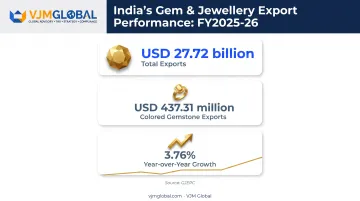
India's overall gem and jewellery exports reached USD 27.72 billion in FY2025-26, with coloured gemstone exports alone hitting USD 437.31 million. Rupee-denominated coloured gemstone exports grew 3.76% year over year, even as the sector works through a broader structural reset toward diversified export markets, according to GJEPC data. The sector is recalibrating where it sells, not contracting.
The Regulatory Tailwind
Gems and jewellery fall under 100% FDI on the automatic route, per IBEF's sector report. That means a US person or company can hold full ownership of an Indian gemstone entity without seeking prior government clearance. This is a lower barrier than sectors requiring case-by-case approval.
Cost and Infrastructure Advantages
- Skilled artisan labour for cutting and polishing costs a fraction of US equivalents
- Jaipur, Surat, and Hyderabad have decades-deep supplier and craftsman networks already in place
- You're plugging into existing infrastructure rather than building it from scratch
Long-Term Strategic Value
A properly structured Indian entity gives you direct supply-chain control, certification credibility, and export flexibility. Compare that to relying on middlemen who add markup and reduce your visibility into stone quality and provenance.
Early Decisions & Compliance Considerations Before You Start
Most US founders underestimate one thing: this is a dual-compliance business from day one. Your Indian entity has obligations. Your US tax status has separate obligations. They run in parallel, not sequentially.
The Real Cost Picture
Your budget needs to cover more than gemstone inventory:
- Incorporation fees and professional service costs
- FDI/RBI filing fees (FC-GPR and related reporting)
- GST and IEC registration costs
- A local CA/CS retainer for ongoing compliance
- Dual-country compliance costs that continue every year you operate
Import/Export Duty Exposure
Customs duty on gemstones depends on the exact stone type, whether it's rough or cut/polished, and the applicable exemption notification in effect at import time. There's no single flat rate you can quote and rely on.
Before you commit to landed-cost projections, check the current classification through DGFT's HS code lookup and cross-reference against current CBIC customs notifications. Rates shift, and duty exposure directly eats into your margins.
Certification Strategy
Decide early whether you'll rely on:
- India-based labs such as GJEPC's Gem Testing Laboratory in Jaipur (its largest colored-gemstone facility)
- International bodies like GIA, which rolled out updated colored-stone reporting standards starting January 1, 2026
US-bound buyers often lean toward internationally recognized paperwork. Build your certification pipeline around where your stones are actually going.
How Much Can You Really Run Remotely?
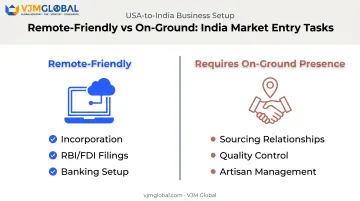
Incorporation, filings, and banking setup can largely be handled from the US through a local service provider. Sourcing relationships, quality control, and artisan management still need an on-ground presence: either your own periodic trips, or a trusted local director or operations partner on site full time.
How to Start a Gemstone Business in India From the USA – Step by Step
This sequence is for a US-based founder. It differs from a purely domestic Indian path because of added FDI and cross-border reporting layers.
Common mistakes to flag upfront:
- Choosing a subsidiary structure when a lighter LLP or simple trading relationship would do
- Skipping FC-GPR/RBI filings after share allotment
- Assuming import certification alone lets you trade legally
- Delaying US-side reporting until year-end, when deadlines have already passed
Step 1 – Define Your Market Entry Model
Before touching paperwork, decide what you're actually building:
- Sourcing/export to the US — you're buying and shipping stones to American buyers
- Local Indian retail/wholesale — you're selling within India
- Manufacturing — cutting and polishing rough stones
- Certification/consulting-led model — advisory or grading services rather than trading
Your end buyer determines everything downstream. Selling to US jewelers is a different regulatory and logistical path than selling to Indian retail customers or global wholesalers. A common miss here: setting up a full subsidiary for what's really a straightforward import-export relationship that a lighter structure could handle just as well.
Step 2 – Choose the Right Legal Entity and FDI Route
| Structure | Best For | Key Requirement |
|---|---|---|
| Wholly Owned Subsidiary | Full control, trading/manufacturing | 2 directors (1 Indian resident), 2 shareholders |
| LLP | Smaller-scale sourcing/trading | Notarized foreign-partner documentation |
| Branch Office | Same activity as US parent | RBI approval, 5-year profit track record, USD 100,000+ net worth |
| Liaison Office | Representation only | Cannot trade commercially at all |
A branch office requires your US parent to show a profitable track record for the preceding five years and a minimum net worth of USD 100,000 on audited financials. Many first-time founders can't clear that bar. A liaison office is even more restrictive: it can't trade, borrow, or lend, so it is out if actual gemstone commerce is the goal.
Confirm your activity qualifies for the FDI automatic route before you proceed. Most gems and jewellery trading and manufacturing does, but structural mistakes here are expensive to unwind later.
A cross-border formation specialist can flag activity-specific FDI conditions before you file. VJM Global structures Indian entity setups for US business owners and reviews those conditions as part of formation work.
Step 3 – Complete Indian Company Incorporation and RBI/FEMA Filings
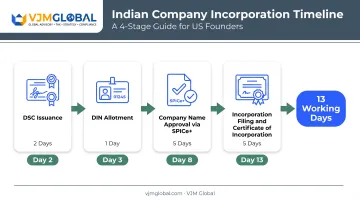
Foreign directors need a Digital Signature Certificate (DSC) and a Director Identification Number (DIN), both processed through MCA's SPICe+ portal. Typical sequencing looks like:
- DSC issuance — around 2 days
- DIN allotment — around 1 day
- Company name approval via SPICe+ or the MCA RUN service — around 5 days
- Incorporation filing and Certificate of Incorporation — around 5 days
That's roughly 13 working days end to end, assuming clean documentation and no resubmissions.
Once shares are allotted to you as a foreign shareholder, you must file Form FC-GPR with the RBI. The governing circular sets a 30-day window from the date of share issuance. Miss it, and you're looking at penalties under FEMA — this is the single most common compliance gap among first-time foreign founders.
Step 4 – Obtain Tax, Trade, and Gemstone Certification Registrations
Baseline registrations for legal trade:
- PAN and TAN — now integrated into the SPICe+ incorporation process
- GST registration — required for most trading activity; exports qualify as zero-rated supplies, letting you export under bond/LUT without paying IGST upfront
- Import Export Code (IEC) — a 10-digit code issued by DGFT, tied to your entity's PAN, mandatory for import or export activity
IEC details need annual confirmation on the DGFT portal between April and June — skip it, and your code can be deactivated without warning.
For certification credibility, pursue reports through GJEPC-recognized domestic labs for local trade, and internationally accredited bodies like GIA for anything US-bound. Buyers on the American side typically expect the latter.
Step 5 – Set Up Sourcing, Banking, and On-Ground Operations
You'll need an Indian business bank account under the entity's name. Most incorporation packages include account-opening support; VJM Global provides this alongside formation. From there:
- Build direct supplier relationships in Jaipur, Surat, or Hyderabad rather than working through layers of middlemen
- Hire a local operations lead or trusted partner to manage day-to-day sourcing while you stay US-based
- Establish a logistics partner early — gemstone shipping has its own insurance and customs documentation quirks
This is the step where remote-only management starts to show its limits. Someone on the ground needs to inspect stones, manage artisan relationships, and catch quality issues before they become shipped problems.
Step 6 – Manage Ongoing Cross-Border Compliance and Repatriation
India-side recurring obligations:
- GST returns (monthly/quarterly depending on structure)
- ROC annual filings and statutory register updates
- Statutory audit under the Companies Act, 2013
US-side recurring obligations:
- FBAR (FinCEN Form 114) — required when your aggregate foreign financial accounts exceed USD 10,000 at any point during the year, due April 15 with an automatic extension to October 15
- Form 5471 — applies to US persons with 10%+ ownership in a foreign corporation, with additional reporting categories triggered at controlling ownership levels
Dividend repatriation adds another layer. India's domestic withholding rate on dividends to nonresidents is 20%. The US-India tax treaty caps it at 15% for qualifying corporate shareholders with at least 10% voting ownership.
US recipients may claim a foreign tax credit via Form 1116 (individuals) or Form 1118 (corporations) against that Indian tax. The credit is limited and needs careful calculation, not assumption.
Staying compliant on both sides without an in-house finance team is difficult. Most US founders use a firm for ongoing dual-country work, not only setup. VJM Global covers entity formation and multi-jurisdiction compliance for that continuing obligation.
Conclusion
Starting a gemstone business in India from the USA is a dual-compliance venture. Success depends on getting your entity structure, FDI filings, and certification strategy right from day one, not just on sourcing good stones.
Clarity on your market entry model—and realistic cost and compliance planning—matters more than rushing to buy inventory. Treat Indian compliance and US reporting as one continuous system, not two separate projects, and you'll avoid the penalties and structural headaches that catch most first-time foreign founders.
VJM Global helps US founders with India entity formation, FEMA/FDI filings, and ongoing cross-border tax compliance from setup through day-to-day reporting.
Frequently Asked Questions
How to start a gemstone business in India?
Choose an entity structure suited to your activity, complete FDI/RBI filings like FC-GPR, register for GST and IEC, and secure gemstone certification. See the step-by-step section above for the full sequence.
What is the current import duty on gemstones in India?
Duty depends on the exact stone type, whether it's rough or cut/polished, and the applicable exemption notification at import time. Check DGFT's HS code classification and current CBIC notifications before finalizing landed-cost estimates.
Which certification is best for gemstones in India?
GJEPC-recognized Indian labs, such as GTL Jaipur, are commonly used for domestic trade. GIA and similar international bodies carry stronger recognition among US-bound buyers.
Can a US citizen or company own 100% of a gemstone business in India?
Yes. Gems and jewellery fall under India's 100% FDI automatic route, allowing full foreign ownership without prior government approval for most trading and manufacturing activities.
Do I need to visit India to set up and run my gemstone business?
Incorporation and most filings can be handled remotely through a local service provider. That said, periodic visits help enormously with supplier relationships and quality control.
What are the US tax obligations for owning a gemstone business in India?
US persons owning a foreign entity typically must file FBAR and Form 5471, depending on ownership percentage. Repatriated dividends may qualify for a foreign tax credit against US tax liability, subject to IRS limits.