Introduction
USA-based NRIs, OCIs, and Indian-American doctors are investing in India's outpatient healthcare market. Middle-class demand for quality, affordable care back home, NRI-friendly investment rules, and the chance to own an income-generating asset in India are driving that shift.
Interest spans several groups:
- Practicing US physicians of Indian origin
- Non-medical NRI investors and HNIs
- Second-generation Indian-Americans diversifying into healthcare assets
They hit the same wall: entity setup, licensing, capital routing, and day-to-day operations get hard when you are thousands of miles away.
Most "start a clinic in India" guides assume you already live there. This one doesn't. It covers the legal, financial, and remote-management steps that matter when you found a polyclinic while based in the USA.
TL;DR
- A polyclinic sits between a solo clinic and a hospital, with multiple specialists and diagnostics under one registration.
- Your biggest early decision is legal structure and entry route, not location or equipment.
- FEMA/RBI compliance and cross-border fund movement are hurdles a domestic founder never faces.
- An India-registered doctor must anchor the clinical establishment registration, regardless of who funds it.
- A trusted on-ground compliance partner makes remote ownership workable.
What Is a Polyclinic & Why It's a Compelling Opportunity for USA-Based Investors
A polyclinic is a multi-specialty medical center operating under a single registration. Patients can see a general physician, a cardiologist, and a diagnostics lab in one visit, one building, one bill.
The real draw is convenience and shared infrastructure economics. A polyclinic sits between a single-doctor clinic and a full hospital in both scale and capital required.
Two Common Ownership Formats
- Doctor-led group practice: specialists co-invest and actively practice inside the clinic.
- Investor-backed model: a non-medical NRI funds the venture and partners with practicing, India-registered doctors who run the clinical side.
Why the Timing Works in Your Favor
India's push toward digitizing and formalizing healthcare access is accelerating. As of mid-2026, the Ayushman Bharat Digital Mission's Health Facility Registry had 5.36 lakh registered public and private facilities, according to government data released via the Press Information Bureau. That growth shows how fast formal, trackable outpatient infrastructure is expanding across the country.
For a USA-based investor, the appeal comes down to three practical factors:
- Lower capital entry point than a hospital, since you're not funding inpatient beds, ICUs, or surgical theaters.
- Rupee-cost advantage: your dollar income stretches further on Indian construction, staffing, and equipment costs.
- A stable, home-market asset you can build while continuing to earn and live in the USA.
Legal Structures & Compliance Requirements for NRIs and US-Based Founders
This is the decision that matters most more than location or which specialties you offer. Get the entity structure wrong, and everything downstream gets harder.
Choosing Your Entity
Your realistic options are:
- Private Limited Company with foreign investment (most common for US-based founders)
- Limited Liability Partnership (LLP) where sectoral FDI rules allow it
- Investment or partnership in an existing entity already run by a resident doctor
What the FDI Rules Actually Say
There's no separate FDI category listed for clinics or polyclinics. The default rule applies: up to 100% foreign investment is permitted under the automatic route, according to India's Consolidated FDI Policy from the Department for Promotion of Industry and Internal Trade (DPIIT).
"Automatic route" means you don't need prior government approval for the investment itself. Sectoral, state, and local healthcare laws still apply in full.
One rule doesn't bend, regardless of funding: an India-registered medical practitioner must anchor the Clinical Establishment registration. Foreign ownership never substitutes for professional medical registration.
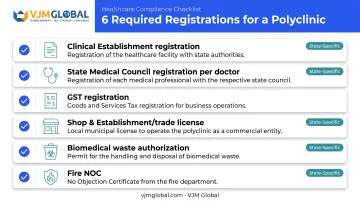
Registrations Every Polyclinic Needs
- Clinical Establishment registration (state-specific)
- State Medical Council registration for each treating doctor
- GST registration (where applicable)
- Shop & Establishment / municipal trade license
- Biomedical waste authorization
- Fire NOC (requirement varies by state and premises size)
The Extra Layer: FEMA/RBI Reporting
A domestic-only clinic never touches this. A foreign-remittance-funded entity does. Equity inflows must be reported to the RBI through Form FC-GPR, and there's an annual Foreign Liabilities and Assets return to track too. Miss these, and you complicate future capital raises or profit repatriation.
Cross-border advisory firms handle this layer so founders don't learn Indian bureaucracy from scratch while based in New York or California. VJM Global manages entity formation, FEMA/RBI compliance, and tax structuring for NRIs and foreign nationals entering India, working directly with Indian regulators on the filings above.
How to Start a Polyclinic in India from the USA — Step by Step
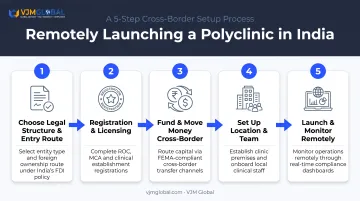
Remote polyclinic setup runs through five stages, all built around one core challenge: you're not physically present in India. The most common mistake founders make is assuming remote setup mirrors local setup, or committing capital before legal structuring is finalized.
Step 1: Choose Your Legal Structure and Entry Route
Decide upfront: are you incorporating a new Indian entity funded from the USA, or investing in an existing polyclinic run by a resident doctor-promoter? If it's the latter, lock down ownership percentage, control rights, and profit-share terms in writing before any money moves.
A frequent trap here is defaulting to a sole proprietorship. That structure legally requires the promoter to be an India resident, a non-starter for most USA-based founders.
Step 2: Handle Registration and Licensing Remotely
You'll need a Power of Attorney holder or a cross-border advisory firm to file incorporation paperwork, Clinical Establishment registration, and professional council documentation on your behalf. Secure the anchor doctor's medical council registration and clinic license before committing to any infrastructure spend.
Founders consistently underestimate how many state-specific licenses (fire, biomedical waste, GST, trade license) require an actual in-person local liaison, not just an online form.
Step 3: Plan Funding and Manage Cross-Border Money Movement
Three routes exist for getting capital into the entity:
- Equity infusion reported under FEMA (Form FC-GPR, filed within 30 days of share allotment under RBI's foreign investment reporting rules)
- NRE/NRO account transfers
- Loan from a local bank or NBFC taken by the Indian entity
Industry estimates for a small-to-mid-size polyclinic setup typically fall in the range of $50,000 to $180,000 in one-time costs. The range depends on city tier, number of specialties, and whether you lease or purchase premises.
Monthly running costs vary just as widely based on staffing and rent. Factor in currency conversion timing too, since India's repatriation rules govern how you eventually pull profits back to the USA.
The most damaging mistake here is transferring funds without proper FEMA reporting. It seems harmless in the moment, but it snowballs into real complications for future capital infusions or profit repatriation later.
Step 4: Set Up Location, Infrastructure and Build the On-Ground Team
Pick a high-footfall location with a local partner's input. Residential-commercial mix, easy accessibility, and parking availability all matter more than a flashy address. Hire a practice manager or clinic administrator early. This person becomes your eyes and ears for daily operations.
Recruit anchor specialists first; they define your core specialty mix. Support and admin staff come after. Founders often over-invest in interiors and equipment while under-planning staffing and patient workflow, a mismatch that shows up fast once patients start walking in.
Step 5: Launch, Monitor Remotely and Scale
Cloud-based clinic management software gives you real-time visibility into patient volume, billing, and operations from the USA. Set a monthly reporting cadence with your practice manager and accountant covering revenue, patient numbers, and compliance renewals.
Don't treat launch day as "set and forget." A polyclinic you're not actively reviewing from abroad is a polyclinic that drifts.
Funding, Costs and Financial Planning From Abroad
Sizing your commitment starts with understanding where a polyclinic sits on the investment spectrum:
| Model | Relative Investment | Complexity |
|---|---|---|
| Solo clinic | Lowest | Single doctor, single registration |
| Polyclinic | Moderate | Multi-specialty, shared infrastructure |
| Hospital | Highest | Inpatient beds, surgical facilities, larger staff |
Outpatient-focused polyclinics generally reach break-even faster than hospitals, since there's no inpatient overhead to absorb. Timeline still hinges on patient volume, payer mix, and how quickly your anchor specialists build a local reputation.
For a USA-based owner, setup cost is only part of the picture. The harder risk to manage is the reconciliation gap: GST filing, payroll, and tax compliance run on India clocks while you operate 10 to 13 hours away. Handled manually, that lag often leads to missed deadlines.
An India-based accounting and compliance partner keeps filings current so you review summarized reports instead of chasing paperwork. VJM Global pairs bookkeeping with FEMA reporting under one roof, which fits split-timezone ownership of an Indian polyclinic.
Common Mistakes and Challenges Unique to USA-Based Founders
USA-based founders hit a few traps local operators rarely face:
- Assuming a US entity can directly own or operate an Indian clinic. It can't. You need a properly structured Indian entity first.
- Underestimating time-zone friction. A same-day decision in India can sit unanswered for 12+ hours if you're asleep in New York.
- Relying on informal family or friend networks for paperwork. Skipping a formal legal or compliance partner often costs more to fix later than it saved upfront.
- Delaying FEMA/RBI filings in the early months. It feels low-priority until you try to raise capital or repatriate profits—then it becomes a blocker.
Frequently Asked Questions
How much does it cost to start a clinic in India?
Setup costs for a small-to-mid-size clinic or polyclinic vary widely by city, size, and specialties offered, generally running from tens of thousands to well over $150,000. Get a location-specific cost estimate before committing capital.
Who can open a clinic in India?
A registered doctor can open a clinic solo. Non-doctor investors, including NRIs, must partner with or hire a registered practitioner to anchor the clinical establishment registration.
Can an NRI or US citizen legally invest in or open a polyclinic in India?
Yes. This is legal through a properly structured Indian entity using the applicable FDI route, subject to FEMA/RBI compliance and a resident registered doctor anchoring the clinic.
How do I start a healthcare business in India?
Choose your legal structure, register the entity and clinical establishment, secure funding through a compliant route, build your on-ground team, and launch only once compliance requirements are fully in place.
What is the most profitable medical business in India?
Multi-specialty outpatient care and diagnostics tend to show strong, recurring patient volumes due to repeat visits and referral chains. Actual profitability still depends heavily on local catchment and specialty mix.
Do I need to be physically present in India to set up and run a polyclinic?
Setup can be managed remotely through a Power of Attorney, a local practice manager, and cross-border advisory support. That said, periodic visits are strongly advisable, especially during the early operational phase.