Remittances to India hit an estimated $129 billion in 2024 according to the World Bank, and a growing slice of that capital is chasing something more productive than a savings account. A mini supermarket appeals because demand for groceries doesn't dip when the US economy wobbles, entry costs sit below most other retail formats, and the asset stays rooted in India for whenever you're ready to use it.
This guide is written for three types of readers: first-generation immigrants eyeing an eventual return, second-generation NRIs redeploying family capital, and working professionals who want a passive income stream in rupees. Here's the step-by-step version, covering ownership rules, compliance, and how to actually run this from Ohio, New Jersey, or California.
Key Takeaways
- NRIs and OCIs can own a mini supermarket (400–1,000 sq. ft.), but most structures need a resident director, partner, or POA holder
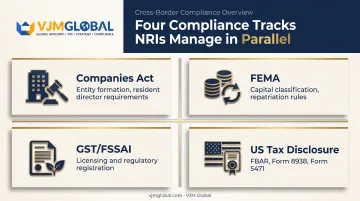
- Expect four compliance tracks at once: Companies Act, FEMA, GST/FSSAI, and US tax disclosure
- Remote success depends on trusted local management and real-time reporting, not your physical presence
- Budget scales with format and city tier: franchises usually cost more upfront than independent stores
- Set up NRE/NRO banking and RBI reporting from day one so profit repatriation stays compliant
What Is a Mini Supermarket and Can a USA-Based NRI Legally Own One in India?
A mini supermarket sits between a neighborhood kirana and a full-scale supermarket chain. Think 400 to 1,000 square feet, self-service aisles, packaged groceries, personal care items, and household essentials: more variety than a corner store, without the footprint of a big-box format.
Three common formats exist:
- Standalone owner-operated stores — full control, full responsibility
- In-society or apartment-complex stores — built-in footfall, lower marketing need
- Franchise models — brand support and supply chain, but less flexibility
The franchise route tends to be easier to run remotely since the franchisor often handles vendor relationships and store systems. Standalone stores demand more from your local team.
Can You Actually Own One From the USA?
Yes. NRIs and OCIs can legally invest in and own Indian retail businesses. That said, ownership structure and residency rules should be verified against current regulations before you commit capital, since requirements around resident directors and profit repatriation can shift.
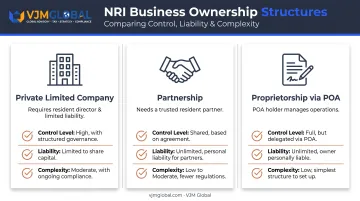
NRIs typically use one of these structures:
- Private Limited Company with at least one resident director
- Partnership with a trusted resident partner
- Proprietorship operated through a Power of Attorney holder
VJM Global regularly flags one non-negotiable for clients at incorporation: NRI-owned companies need at least one director who resides in India for 182 days during the financial year. Confirm the latest Companies Act position before you file.
There's a real difference between being a hands-on remote owner who reviews numbers weekly and directs strategy, versus a capital investor who hands everything (hiring, vendor negotiation, daily cash handling) to a local manager or partner. Decide which one you're being before you sign anything.
Why Start a Mini Supermarket in India While Based in the USA?
This only makes sense under specific conditions: you have investable capital, a genuinely trustworthy local contact, and you're willing to visit periodically. It's not a guaranteed win, and treating it that way is how owners lose money.
The market opportunity is real. India's retail sector was valued at $1.06 trillion in 2024 and is projected to reach $1.93 trillion by 2030, according to Deloitte India. FMCG consumption is climbing alongside it, driven by urbanization and rising disposable incomes.
For a founder based in the US, a few structural advantages stand out:
- Grocery demand holds up even when US markets weaken or jobs disappear
- An INR-denominated asset diversifies your portfolio into a growing consumption economy
- You can run it full-time if you relocate later, or keep it as passive income if you don't
None of this replaces due diligence. A mini supermarket is still a low-margin, high-volume business that lives or dies on execution.
Legal, Tax, and Compliance Roadmap for NRIs and OCIs
This is where most NRI store owners either set themselves up for smooth operations or create a mess that surfaces years later during an audit or repatriation attempt.
Entity Formation and the Resident Requirement
Whichever structure you choose (Private Limited Company, partnership, or POA-run proprietorship), someone physically present in India needs to handle registrations, banking signatures, and day-to-day legal paperwork. This isn't optional. It's the single point where most remote ownership plans fail before the store even opens.
FEMA: Capital Classification and Repatriation
This distinction matters more than most first-time NRI investors realize:
- Non-repatriation basis investment (under Schedule IV) is treated as domestic investment
- Repatriable investment is classified as foreign investment and carries separate entry conditions, reporting, and pricing rules
Decide which basis applies to your capital before the money moves. Retrofitting this decision later is far harder than getting it right at the start.
Moving profit from India to the USA runs through NRE or NRO accounts. RBI reporting requirements (such as Form FC-GPR for qualifying equity investment) apply depending on how your capital was classified going in.
Current income like dividends generally repatriates more easily than capital. NRO balances face additional conditions and annual limits.
Dual Taxation and US Disclosure
Income earned through your Indian entity is taxable in India, full stop. The India-US Double Taxation Avoidance Agreement (DTAA) then determines how much relief you get on the US side, generally through a foreign tax credit.
On the US side, don't overlook disclosure obligations. The FBAR filing threshold triggers once your aggregate foreign financial accounts exceed $10,000 at any point in the year, per IRS guidance on FBAR and Form 8938.
Form 8938 has separate, higher thresholds and applies to foreign company shares directly. Depending on your ownership percentage, a Form 5471 filing may also apply. This isn't a box you want to discover you missed after the fact.
Standard Licensing Still Applies
Residency status doesn't exempt you from operational licensing:
- FSSAI registration or license (mandatory for food retail)
- GST registration
- Shop & Establishment license (state-specific)
- Professional Tax registration (where applicable)
These apply the same way they would to a resident-owned store.
Given how many moving parts intersect here (Companies Act, FEMA, GST, and US reporting), this is the kind of setup where a firm like VJM Global tends to get involved early. VJM Global works with entity formation, FEMA compliance, cross-border tax filing, and ongoing bookkeeping for NRI and OCI clients, so you're not reconciling Indian and US rules alone from another time zone.
How to Start a Mini Supermarket in India From the USA – Step by Step
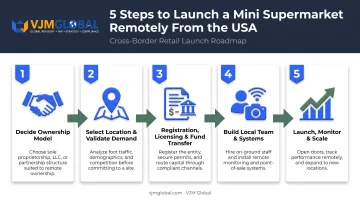
Here's the practical execution plan for someone who can't be on-site full-time. Skipping the "trusted local contact" step is the most common failure point, ahead of undercapitalization or a bad location.
Step 1: Decide Your Ownership and Involvement Model
Choose between an active remote-owner model (frequent visits, heavy but structured delegation) or a pure investor model (fully delegated to a hired manager). Then identify a resident — a family member, a POA holder, or a professional service — to handle signing and banking on the ground.
Common miss: assuming weekly phone calls substitute for an actual reporting structure with your local manager. They don't.
Step 2: Select a Location and Validate Demand Remotely
Use local scouts, real estate contacts, or family to shortlist sites, and insist on video walkthroughs before deciding anything. Validate residential density, nearby competition, and footfall using current online data, not your memory of the neighborhood from your last visit.
Common miss: signing a long lease based on outdated impressions of an area that's changed significantly.
Step 3: Complete Registration, Licensing, and Fund Transfer
- Register your business entity (a Private Limited company is the usual fit for US owners who want limited liability and cleaner FDI documentation)
- Apply for FSSAI, GST, and Shop & Establishment licenses before you stock inventory or open doors
- Route investment capital through documented NRE/NRO banking channels so FEMA compliance—and later profit repatriation—stay clean
Common miss: sending money informally through relatives instead of documented banking channels. This creates real problems during audits or when you try to repatriate profit later.
Step 4: Build Your Local Team and Remote-Management Systems
Hire a store manager who can independently run inventory, billing, and staff scheduling without daily hand-holding. Then set up cloud-based POS and CCTV systems that give you real-time visibility into sales and stock from wherever you are.
Common miss: hiring a manager without a clear incentive structure. No skin in the game means low accountability the moment you're not watching.
Step 5: Launch, Monitor, and Scale From Abroad
Set a weekly or monthly reporting cadence with your manager and accountant covering sales, stock levels, and cash position. Plan periodic in-person visits, especially in the first 6-12 months, to catch issues early rather than discovering them months later.
Common miss: going quiet for extended stretches. That's usually exactly when inventory shrinkage and cash discrepancies start piling up unnoticed.
Conclusion
Owning a mini supermarket in India while living in the USA is realistic when you prepare with care. Get your ownership structure, FEMA classification, and tax compliance right before you open the doors, and treat your reporting systems as a substitute for the physical presence you can't provide.
The owners who succeed at this treat this as an active remote investment. They review numbers regularly, visit when it matters, and fix small problems before they become expensive ones.
If you want help locking in entity structure, FEMA classification, or ongoing India tax compliance from the US, VJM Global supports cross-border owners on those exact steps so the remote model stays compliant from day one.
Frequently Asked Questions
How much investment is needed to start a mini supermarket in India?
Costs vary widely by city tier and format. Independent stores usually need less upfront capital than franchises. Franchise models add fees, mandated fit-out, and required opening inventory on top of rent, licensing, and staffing.
What is the 3-3-3 rule for groceries?
There's no established grocery-industry "3-3-3" layout standard. A related retail idea (three new things to sell, three new ways to sell them, three new ways to deliver them) is about innovation strategy, not store design.
Can a US citizen or NRI legally own a supermarket business in India?
Yes, through an appropriate entity structure that complies with FEMA and the Companies Act. Most structures require at least one India-resident director, partner, or authorized signatory.
Do I need to be physically present in India to start and run a mini supermarket business?
Not full-time. Initial visits help, but a trusted resident partner or POA holder combined with remote-monitoring systems (POS, CCTV, regular reporting) can reduce how often you need to be there.
How are profits taxed if I run a mini supermarket in India while living in the USA?
Your Indian entity's income is taxed in India first. The India-US DTAA helps prevent double taxation, but you'll still need to disclose the foreign business interest under US rules like FBAR and Form 8938.
Can I run a mini supermarket in India without a local partner or family member?
Yes. Accountants or POA-based managers can stand in for a family partner. Even so, one trusted local contact you know personally is strongly recommended.