Introduction
Singapore entrepreneurs are finding that the United States offers serious market access, investor credibility, and revenue opportunities that few other markets can match. With over $25 trillion in GDP, a US business presence opens doors to USD-denominated revenue, institutional venture capital, and the operational credibility that a US-registered entity carries.
The barrier to entry is lower than most founders expect. You don't need a US visa, citizenship, or physical presence in America to own and operate a US company. Delaware processed over 211,000 LLC formations in 2024 alone — many from non-resident founders.
This guide covers what you need to know:
- Choosing between an LLC and C-Corporation
- Selecting the right state for registration
- Navigating the EIN application process
- Opening a US bank account remotely
- Maintaining compliance from Singapore
Key Takeaways
- Legal ownership without a visa: Form a US LLC or C-Corporation entirely remotely—no citizenship, residency, or US visit required
- Two practical structures: LLC (pass-through tax, simpler compliance) or C-Corporation (VC-ready, 21% flat tax); S-Corps are unavailable to non-residents
- Delaware dominates venture-backed formations: 81.4% of 2024 US IPOs chose Delaware; Wyoming costs less ($100 formation) for non-VC businesses
- EIN by phone takes minutes: Call the IRS at 267-941-1099 for immediate processing—mail takes 4-5 weeks
- Singapore qualifies for E-2 visa: Treaty investor status lets you live and work in the US if your business meets investment thresholds
What Singapore Entrepreneurs Should Know Before Starting a US Business
Ownership vs. Physical Presence Are Separate Legal Questions
You can own a US company from Singapore without any visa. A visa is only required if you intend to physically work in the US for that business. This distinction matters because many Singapore founders assume they need immigration approval before incorporation—they don't.
US Formation Is Less Restrictive Than Singapore
Singapore's ACRA requires a local director and detailed incorporation filings. The US process is simpler:
- State-level registration (not federal)
- No nationality restrictions on ownership
- Registered agent requirement instead of local director
- Formation typically completes in 1-5 business days
Realistic Timeline and Budget Expectations
| Item | Timeline | Cost |
|---|---|---|
| State formation filing | 1-5 business days | $90-$425 depending on state |
| EIN (by phone) | Immediate | Free |
| EIN (by mail) | 4-6 weeks | Free |
| Registered agent (annual) | Ongoing | $125/year |
| Delaware LLC franchise tax (annual) | Due June 1 | $300 |
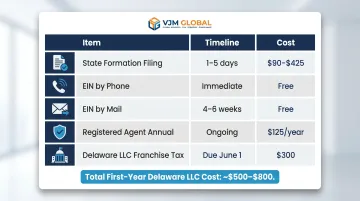
Total first-year costs for a Delaware LLC: approximately $500-$800 including formation, registered agent, and annual tax.
Why Singapore Founders Choose US Entities
Beyond market access, practical reasons include:
- Stripe, PayPal, and US merchant accounts require a US business entity to operate
- US venture capital overwhelmingly prefers Delaware C-Corporations for investment
- Amazon Seller Central, Shopify Payments, and similar platforms favor US-registered businesses
- USD revenue insulates against Singapore dollar fluctuations
With the structural basics clear, the next step is choosing the right entity type — and for Singapore founders, that choice usually comes down to LLC versus C-Corporation.
Choosing the Right US Business Structure as a Singapore Non-Resident
This decision affects your tax bill, fundraising ability, and compliance burden for the life of your business. Non-residents have fewer options than US citizens—S-Corporations explicitly exclude non-resident alien shareholders.
Limited Liability Company (LLC)
The LLC is the default choice for most Singapore non-residents who aren't raising venture capital:
Core Benefits:
- Personal liability protection separates business and personal assets
- Pass-through taxation flows profits directly to your personal tax return
- Minimal annual compliance—no mandatory board meetings or shareholder resolutions
- Can elect C-Corporation tax treatment later if your circumstances change
The Tax Complexity You Must Understand
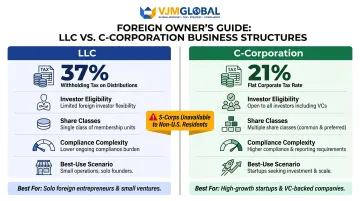
Pass-through taxation sounds straightforward until you factor in IRC Section 1446. When your LLC generates US-sourced income, the entity must withhold tax on your share of effectively connected taxable income at 37% for individual foreign owners, which is higher than the 21% C-Corporation rate.
You'll also need to file Forms 8804, 8805, and 8813. That compliance overhead erodes the simplicity advantage most people assume an LLC provides.
VJM Global's team of CPAs helps Singapore entrepreneurs navigate these withholding obligations and optimize tax structures based on your specific revenue model.
C-Corporation
If you plan to raise venture capital, bring on US investors, or eventually pursue an IPO, the C-Corporation is the structure investors will require:
Why Investors Require C-Corps:
- Issues multiple share classes (common stock, preferred stock)
- No restrictions on foreign shareholders
- Standardized structure accelerators and VCs expect
- 81.4% of US-based IPOs in 2024 chose Delaware incorporation
The Trade-Off: Double Taxation
C-Corporations pay 21% federal tax on profits, then shareholders pay tax again on dividends. If you're reinvesting profits for growth rather than taking distributions, though, you only face the 21% rate. That's meaningfully lower than the 37% LLC withholding rate that applies to non-corporate foreign partners.
Delaware's Legal Infrastructure
That taxation advantage is one reason Delaware dominates C-Corp formations. The legal infrastructure reinforces the choice:
- The Delaware Court of Chancery has written most modern US corporate case law
- Appeals go directly to the state Supreme Court, making outcomes predictable
- Over 66% of Fortune 500 companies are incorporated in Delaware
Sole Proprietorship and S-Corporation — What Singapore Residents Cannot Use
Skip these entirely:
- Sole proprietorships require physical US work presence, conflicting with non-resident status
- S-Corporations are restricted by law to US citizens and resident aliens—non-residents are ineligible
How to Start a US Business as a Singapore Non-Resident – Step by Step
Every step below can be completed without traveling to the US, though banking may require additional identity verification steps remotely.
Step 1: Select Your State of Incorporation
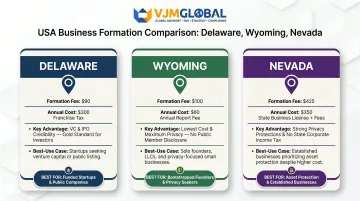
Delaware: Best for VC-backed businesses. The Court of Chancery, 200+ years of corporate precedent, and global recognition make it the gold standard. Costs: ~$90 formation + $300 annual LLC franchise tax (or $50 + minimum $175 for corporations).
Wyoming: Lowest ongoing costs. $100 formation fee, $60 annual report, no state income tax, strong privacy protections (no public disclosure of LLC members). Ideal for bootstrapped businesses not seeking venture capital.
Nevada: No state income tax and privacy-friendly, but costs approximately $425 to form ($75 + $200 business license + $150 initial list) plus $350 annual renewal—nearly 5x Wyoming's expense.
Physical Presence Triggers Nexus
If you plan to hire US employees, lease office space, or store inventory in a specific state, you must also register there via "foreign qualification"—even if incorporated in Delaware. A Delaware LLC with a California warehouse must register in California and pay California taxes. This matters when you scale.
Step 2: Appoint a Registered Agent
Every US LLC and Corporation legally requires a registered agent — an individual or service with a physical US street address available during business hours to receive legal documents and government correspondence. PO Boxes are prohibited in all 50 states.
As a Singapore resident, you cannot serve as your own registered agent. Registered agent services cost approximately $125/year from providers like Northwest Registered Agent. Choose a reputable service—this agent receives official legal correspondence, including lawsuits and tax notices.
Step 3: File Formation Documents and Obtain Your EIN
Formation Filing
Submit Articles of Organization (LLC) or Articles of Incorporation (C-Corporation) to your chosen state's Secretary of State office. Required information typically includes:
- Business name
- Registered agent details
- Principal office address (your Singapore address is acceptable)
- Member/director information
Processing takes 1–5 business days in most states. Once your formation is confirmed, the next immediate priority is obtaining your Employer Identification Number (EIN).
EIN Application for Non-Residents
Singapore residents cannot use the IRS online EIN system. You have two options:
| Method | Processing Time | Details |
|---|---|---|
| Phone | Immediate | Call 267-941-1099 (Mon–Fri, 6am–11pm ET) |
| 4–5 weeks | Mail Form SS-4 to IRS, Cincinnati, OH 45999 |
Phone application is the clear winner—you'll receive your EIN during the call. The EIN is essential for opening a US bank account, hiring employees, and filing taxes.
Step 4: Open a US Business Bank Account
This is the most practically challenging step. Traditional banks (Chase, Bank of America) typically require in-person passport verification. Digital-first banks now offer fully remote onboarding for non-residents:
Mercury (recommended for non-residents):
- Accepts international passports
- Required documents: State-filed formation documents, EIN confirmation (CP575/147c/SS-4), Operating Agreement, and passport
- Remote onboarding with no US visit required
- Supports non-US applicants explicitly
Wise Business and Relay also offer non-resident onboarding, though document requirements vary. Have all formation documents and your EIN ready before applying—this speeds approval significantly.

Step 5: Address Visa Requirements If You Plan to Work Physically in the US
Owning a US company requires no visa. Working physically inside the US does. If you plan to be present and actively managing operations on the ground, here are the three visa routes most relevant to Singapore residents.
E-2 Treaty Investor Visa (Singapore-Specific Advantage)
Singapore has been a designated E-2 treaty country since January 1, 2004. The E-2 allows you to develop and direct a US business in which you've made a substantial investment. There's no fixed minimum, but typically $100,000+ depending on business type. It's a non-immigrant visa, renewable indefinitely.
EB-5 Immigrant Investor Visa (Green Card Path)
Invest $1,050,000 ($800,000 in a Targeted Employment Area) and create at least 10 full-time US jobs. This leads directly to conditional permanent residency.
L-1A Intracompany Transferee Visa
If you have an existing Singapore company and want to open a US subsidiary, the L-1A allows you to transfer yourself to manage the US operation. Requires 1 continuous year of work for the foreign entity within the preceding 3 years.
For visa-specific guidance, consult a licensed US immigration attorney.
Taxes, Banking & Ongoing Compliance
Federal and State Tax Obligations
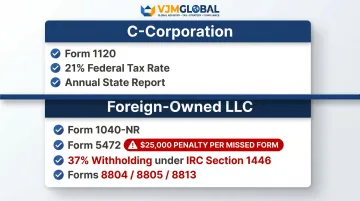
C-Corporations pay 21% federal tax on profits. LLCs with foreign owners face 37% withholding on effectively connected income under IRC Section 1446. Both structures must file annual returns:
- C-Corps: Form 1120
- Foreign LLC owners: Form 1040-NR
- Foreign-owned entities: Form 5472 (penalty for missed filing: $25,000 per form)
State-level fees vary by formation state:
- Delaware LLCs: $300 annual franchise tax due June 1
- Wyoming LLCs: $60 annual report
- Nevada LLCs: $350 total ($200 license + $150 list)
VJM Global's CPAs and compliance professionals support Singapore entrepreneurs with US tax filings, bookkeeping, and annual reporting — so deadlines don't slip through the gap between US and Singapore business hours.
Operating Agreements and Bylaws
Banks and investors require these documents even though states don't. They define:
- Ownership percentages
- Management structure
- Profit distribution
- Dissolution procedures
For Singapore founders managing remotely, clear governance documentation prevents disputes and simplifies the banking process.
Compliance Timelines
| Entity | Filing / Fee | Deadline |
|---|---|---|
| Delaware LLC | $300 franchise tax | June 1 |
| Delaware C-Corp | Annual report + franchise tax | March 1 |
| Wyoming LLC | Annual report | Anniversary month |
| Nevada LLC | License renewal + annual list | Anniversary month |
Maintain a calendar of US deadlines — missing filings can result in administrative dissolution or loss of good standing.
Conclusion
Starting a US business as a Singapore non-resident is achievable, affordable, and increasingly common. The legal framework welcomes foreign ownership, formation can be completed entirely online in under two weeks, and Singapore nationals have E-2 visa eligibility if you later decide to work in the US physically.
The decisions you make early on structure and state of incorporation carry real long-term tax and compliance consequences. Two choices dominate:
- Delaware C-Corporation — the standard for venture-backed startups seeking US investors
- Wyoming LLC — lower cost, simpler compliance, better suited to bootstrapped or service businesses
Work with advisors who understand both Singapore tax residency rules and US federal obligations. The right cross-border guidance at formation — covering EIN registration, registered agent requirements, and treaty implications — prevents costly restructuring later.
Frequently Asked Questions
Can a non-citizen start a business in the US?
Yes. Non-US citizens including Singapore nationals can legally form an LLC or C-Corporation in any US state without citizenship, residency, or a visa. There are no nationality restrictions on US business ownership, and the formation process is identical to that for US citizens.
What do I need to start a business in the US as a foreigner?
The core requirements are:
- A registered business name and US registered agent (physical address required)
- Filed formation documents — Articles of Organization (LLC) or Articles of Incorporation (C-Corp)
- An EIN from the IRS
- A US business bank account and governance documents (Operating Agreement or bylaws)
How much will it cost to register a company in the USA?
State filing fees range from approximately $100 (Wyoming) to $90 (Delaware) to over $425 (Nevada). Add registered agent fees (~$125/year) and ongoing annual costs such as Delaware's $300 LLC franchise tax. Total first-year costs typically range from $500 to $1,500 depending on state and structure.
How hard is it to start a business in the USA?
Formation completes in days and is largely procedural. The two friction points for Singapore non-residents are the EIN (available immediately by phone at +1-267-941-1099, or 4–6 weeks by mail) and opening a US bank account — both manageable through digital banks like Mercury.
Is $5,000 enough to start a business in the USA?
$5,000 covers formation costs, registered agent fees, EIN assistance, and first-year compliance ($500–$2,000 total), with money left for early operations. Formation costs are fixed and predictable; operational costs depend on your business model.
Can I get a green card if I have $1 million dollars?
The EB-5 Immigrant Investor Visa requires a $1,050,000 investment (or $800,000 in a Targeted Employment Area) in a new commercial enterprise that creates at least 10 full-time US jobs. Meeting these requirements provides a direct pathway to conditional permanent residency (green card).