A project management business in Dubai does exactly what it sounds like: it plans, coordinates, and oversees client projects across construction, IT rollouts, events, or corporate change initiatives, on someone else's behalf and payroll.
For US-based project managers, PMO leads, and entrepreneurs, the pull is straightforward. There's steady recurring demand, tax-free UAE income potential, and US-recognized credentials like the PMP that genuinely carry weight with UAE clients.
This guide walks through exactly how to set up and run that business legally from the United States, without relocating.
Key Takeaways
- Dubai's construction, tech, and government megaprojects create consistent demand for outsourced project management
- US founders can retain 100% ownership through Free Zone or mainland structures without relocating
- Setup often finishes in a few weeks; total cost depends on Free Zone vs mainland structure
- US citizens still face FBAR, FATCA, and GILTI reporting even while running a tax-free UAE company
- Pick the right jurisdiction and validate demand before you spend on licensing
Why Start a Project Management Business in Dubai as a US Entrepreneur?
This move makes sense under specific conditions: when UAE clients need scoped, professional project delivery and you can validate that demand before committing real capital. It's a poor fit if you're hoping for instant contracts with no groundwork.
The Numbers Behind Dubai's Project Management Demand
Dubai's 2025-2027 government budget cycle totals AED 272 billion, with 46% of the 2025 allocation going toward infrastructure and related construction, roughly AED 39.68 billion (about $10.8 billion) in a single year.
The D33 economic agenda aims to double Dubai's GDP by 2033 and lift economic productivity by 50% through innovation and digital adoption.
That ambition is reflected in the tools consultancies use daily. The UAE's project management software market is projected to grow from $120.5 million in 2023 to $284.7 million by 2030, a 13.1% annual growth rate. Meanwhile, the broader Gulf consulting market that includes UAE project management firms was forecast to grow 14% to $1.8 billion in 2025.
Why US Credentials and the Dollar Peg Work in Your Favor
Certified project managers in Dubai earn well. According to the Hays GCC Salary Guide, monthly salary benchmarks run:
- Project Manager: AED 30,000-45,000 (about $8,169-$12,253), averaging AED 40,000 (~$10,900)
- Senior Project Manager: AED 35,000-50,000 (about $9,529-$13,614), averaging AED 45,000 (~$12,250)
- Head of PMO: AED 45,000-65,000 (about $12,253-$17,699), averaging AED 55,000 (~$15,000)
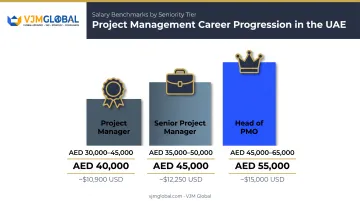
Those numbers give you a sense of what UAE clients are already paying internally, and what an outsourced consultancy can reasonably charge. Two factors tilt things further in your favor as a US founder:
- PMP certification carries real weight with UAE employers and clients, and most US-based project managers already hold it
- The AED-dollar peg plus zero personal income tax keeps UAE revenue conversion predictable and untaxed locally, improving take-home economics before US tax obligations
Run your own license, and you set your own pricing, pick a sector focus, and build something you could eventually scale or sell. That's a different proposition than freelancing under someone else's brand.
What to Know Before You Start From the USA
Most US founders underestimate the operating rhythm. The first few months in Dubai aren't about closing deals. They're about building credibility in a market where remote trust takes longer to earn than local trust.
Before you commit, decide honestly:
- Can you run this business remotely long-term, with occasional UAE visits for client meetings and visa formalities?
- Or will you need a more consistent physical presence to win the kind of work you're targeting?
Whichever model you choose, US tax obligations travel with you. US persons remain fully subject to FBAR reporting on foreign accounts, FATCA disclosure, and potential GILTI or Subpart F exposure on income earned through a foreign company, even though the UAE itself imposes no personal income tax.
A cross-border advisory firm like VJM Global coordinates UAE entity compliance (corporate tax registration, VAT, payroll) alongside the US-side reporting so both systems stay aligned.
Set your working capital expectations accordingly. Most solo consultants need several months post-licensing before landing their first paying UAE client. Build your runway around that timeline, not a best-case forecast.
Business Structure, Licensing & Costs: Mainland vs Free Zone for US Founders
This is the single most consequential early decision, because it determines exactly which clients you can legally serve.
Mainland gives you unrestricted access to UAE clients and government contracts, but it requires a physical office and generally costs more. It suits founders targeting large UAE corporates or public-sector work.
Free Zone offers 100% foreign ownership, faster setup, and lower upfront cost through flexi-desk options. The tradeoff: it restricts direct mainland trading without extra approval. It suits founders serving international or remote clients from the US.
| Factor | Free Zone | Mainland |
|---|---|---|
| Ownership | 100% foreign | 100% foreign for most activities |
| Client access | Free zone + international clients | Full UAE market, including government contracts |
| Starting cost | From AED 12,500 (~$3,404) for a zero-visa setup | Varies by activity; typically higher due to office requirement |
| Visa cost | Similar visa costs, plus office lease | |
| Approval time | Up to 14 working days | Days to weeks, depending on activity approvals |
Free Zone jurisdictions commonly used for professional services consultancies include DMCC, JAFZA, DIFC, ADGM, DAFZA, SHAMS, and RAKEZ. Mainland companies are licensed as LLCs through the Department of Economic Development (DED) in the relevant Emirate.
Certifications that strengthen your application and client trust:
- PMP — most widely recognized among UAE employers and clients
- PRINCE2 — strong fit for structured, process-driven engagements
- Agile/Scrum — especially useful for IT-sector project work
Credentials help the application, but you still need the licensing stack and US-side coordination handled in parallel. Typical UAE steps include:
- Trade name reservation and MOA drafting
- Ejari or Free Zone tenancy
- Establishment card, plus MOHRE and GDRFA registration
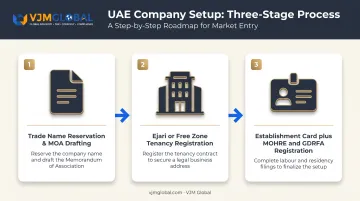
Most founders bring in a formation and compliance partner for that dual-track work. VJM Global supports US entrepreneurs with UAE entity setup alongside the accounting, tax, and compliance work that needs to happen on the US side at the same time.
How to Start a Project Management Business in Dubai From the USA – Step by Step
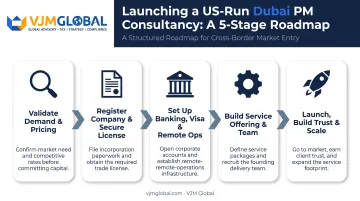
The remote setup process breaks into five practical stages. Two mistakes show up constantly: picking the wrong jurisdiction for your client base, and skipping demand validation before you spend on licensing.
Step 1 – Validate Demand and Pricing From the US
Before registering anything, confirm someone will actually pay you.
- Pick a niche (construction, IT, events, or corporate PMO) and target a UAE segment with both budget and urgency
- Validate remotely through UAE-based contacts, targeted LinkedIn outreach, or a small paid pilot project
- Sanity-check your pricing against local benchmarks (the Hays ranges above are a good starting point), rather than assuming US day rates translate directly
Step 2 – Register Your Company and Secure Your License
Once demand looks real, move on to licensing.
- Reserve a trade name and choose activity codes broad enough for your scope—general PM consultancy, construction, or IT
- Submit your application and documents (passport copies, business plan, MOA for mainland entities) through the DED or your chosen Free Zone authority
- Track the approval timeline closely so you can plan banking, travel, and client onboarding around it
Step 3 – Set Up Banking, Visa, and Remote Operations
This step tends to surprise US founders most.
- Open a UAE corporate bank account—and budget extra time; US persons often face added FATCA scrutiny
- Decide whether you need an investor or employee visa immediately, or whether you can start with remote operations plus periodic visits
- Put remote tools in place: video conferencing, cloud project management software, and e-signature platforms, so you can serve Dubai clients without being there full-time
Step 4 – Build Your Service Offering and Delivery Team
Package what you actually deliver.
- Define scope, methodology, and deliverables clearly—UAE clients without your track record need this spelled out, not implied
- Decide what you'll handle personally versus what needs a local hire, subcontractor, or associate PM on the ground
- Choose project management software and reporting templates that match UAE client expectations for transparency and stakeholder updates
Step 5 – Launch, Build Trust, and Scale
Dubai clients rarely award serious work off cold outreach alone.
- Invest in relationship-first marketing; expect video calls and in-person meetings to matter more than email campaigns
- Join professional bodies like the PMI UAE Chapter or Dubai Chamber of Commerce business groups to build local credibility as a US-based founder
- Track your early engagements closely, fix delivery or pricing gaps fast, and only add headcount or new sectors once your first client relationships are stable
Conclusion
Starting a project management business in Dubai from the USA is achievable without relocating, provided you choose the right structure and validate demand before you spend.
Clarity on jurisdiction, coordinated US-UAE tax compliance, and consistent delivery matter more than launch speed. Treat year one as a foundation-building phase. Refine your pricing and offering as the market clarifies. Year two usually runs smoother than year one.
Frequently Asked Questions
Is project management in demand in the UAE?
Yes. Construction, infrastructure, and digital transformation projects are driving sustained demand, and many UAE corporates prefer outsourcing project management to specialist firms rather than building costly in-house teams.
How much are project managers paid in Dubai?
Certified project managers earn roughly AED 30,000-45,000 per month, senior project managers AED 35,000-50,000, and heads of PMO AED 45,000-65,000, according to Hays' GCC salary data.
Can a US citizen fully own a project management business in Dubai?
Yes. 100% foreign ownership is available through Free Zone structures and most mainland activities under current UAE law, following the 2020 Commercial Companies Law reform.
Do I need to relocate to Dubai to run a UAE project management business from the US?
No. Many founders run their UAE consultancy remotely with periodic visits, though certain visa and banking steps may still require some in-person presence.
Do I still have to pay US taxes if I own a business in Dubai?
Yes. US citizens and residents must still report foreign income and accounts through FBAR, FATCA, and potentially GILTI, even though the UAE itself imposes no personal income tax.
What certification helps most when starting a PM consultancy in Dubai?
PMP is the most recognized credential among UAE employers and clients. PRINCE2 and Agile/Scrum certifications add value too, depending on your target sector.