But setting up remotely from the Netherlands isn't the same as registering a company down the road from your office. You're dealing with local partnership rules, document legalisation between two legal systems, and banking processes that often demand in-person verification.
This guide walks Netherlands-based founders through what's actually involved in registering a business in Kuwait while staying based at home, including where remote management works and where it doesn't.
TL;DR
- Full foreign ownership is route-specific: KDIPA approval can reach 100%; an ordinary WLL still needs Kuwaiti participation
- Under Law No. 1 of 2024, foreign firms can open a direct branch with no mandatory local agent
- Registration covers name reservation, MoA, capital deposit, Ministry of Commerce approval, and KDIPA if you want full ownership
- Banking and document attestation are the biggest remote-setup obstacles for Dutch founders
What Does Starting a Small Business in Kuwait from the Netherlands Involve?
Starting a small business in Kuwait from the Netherlands means holding an actual commercial registration there—not just selling to Kuwaiti clients from Amsterdam or Rotterdam. Exporting goods or servicing Kuwaiti customers remotely does not require a Kuwaiti entity at all.
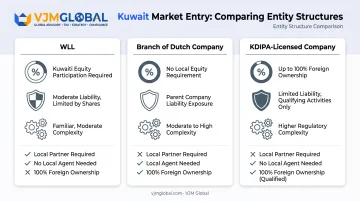
When you do need a real local presence, setup typically takes one of three forms:
- Ordinary WLL (limited liability company) – the standard local structure, generally involving Kuwaiti equity participation
- Branch of your Dutch company – now easier to establish since the 2024 amendment removed the mandatory local-agent rule
- KDIPA-licensed company – can carry up to 100% foreign capital, but only for qualifying activities and projects
A representative office is also possible, but it is limited to market research and cannot trade commercially, so it is not a substitute for full registration.
What to Know Before You Start a Business in Kuwait from the Netherlands
Many Dutch founders assume the process mirrors a Netherlands KvK registration done partly online. It doesn't. Several steps genuinely require either physical presence or a trusted person on the ground in Kuwait.
Foreign Ownership Isn't a Fixed 51/49 Rule
Ownership depends on the route, not a blanket law. A standard WLL outside the KDIPA framework generally involves Kuwaiti participation, but a KDIPA-approved company may hold up to 100% foreign capital for eligible activities. Confirm the current split for your specific activity directly with Kuwait's Ministry of Commerce and Industry (MOCI). Don't rely on older guides that quote a fixed percentage.
Residency Isn't Always Mandatory
Holding shares doesn't automatically require a Kuwaiti residence permit. However, branch and company registrations do require:
- A designated Kuwait-based manager
- Passport and power-of-attorney documentation
- Company registry and constitutional documents from the Netherlands
Realistic Timelines Run Longer Than Advertised
KDIPA's portal promises initial feedback within 3 business days and a decision within 30 working days of a complete application. That's the approval window, not the total setup time. Add weeks for document preparation, translation, MOCI registration, and bank account opening.
Banking Remains the Hardest Part to Do Remotely
Kuwaiti banks, including Kuwait International Bank, generally require the authorised signatory to appear in-branch to sign account-opening and KYC forms. Without a local representative, this step alone can stall a launch for weeks.
Document Attestation Adds Real Friction
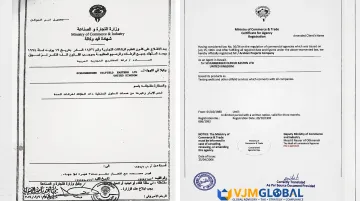
Dutch corporate and personal documents typically need translation into Arabic and certification by the relevant authorities in the country of incorporation before Kuwaiti bodies accept them. The Dutch government directs applicants to Netherlands Worldwide for the specific legalisation chain. Confirm exact requirements with the Kuwait Embassy in The Hague before you submit anything; apostille alone is not always enough.
Why Kuwait Appeals to Dutch Entrepreneurs and SMEs
Kuwait is not the right market for every Dutch SME. It fits when the commercial case, tax position, and sector match line up.
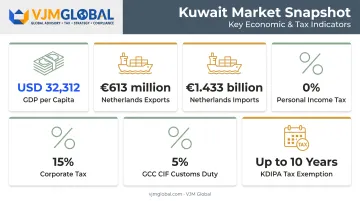
The commercial case is real. Kuwait's 2025 GDP per capita reached USD 32,312. Dutch–Kuwaiti trade is already substantial: the Netherlands exported €613 million in goods to Kuwait and imported €1.433 billion back in 2025.
That is an established commercial channel you can build on.
Other factors driving interest:
- No personal income tax on individuals in Kuwait, versus Dutch progressive rates
- 15% corporate tax on covered foreign business activity (exact exposure depends on your structure)
- GCC customs access via Kuwait’s Single Customs Tariff — 5% CIF duty on most goods across the bloc
- KDIPA incentives — up to 10 years’ tax exemption on approved projects, plus relief on qualifying machinery and inputs
Kuwait's New Vision 2035 strategy explicitly aims to grow non-oil sectors like logistics, renewable energy, and technology — all areas where Dutch expertise travels well.
Early Decisions That Matter When Setting Up from Abroad
Most delays with cross-border setups come from underestimating partner searches and document logistics, not from a lack of preparation.
Entity Type Decides Everything Downstream
Choosing between a WLL, branch, or KDIPA company shapes your ownership, liability, and compliance burden for years:
- WLL: Administratively familiar, but requires partner governance
- Branch: Avoids the old local-agent requirement, but keeps your Dutch parent exposed to liability
- KDIPA company: Strongest ownership potential, but demands a defensible business plan and project assessment
Vet Any Local Partner Before Committing Capital
If your route requires Kuwaiti participation, formalise the relationship with:
- Draft a written shareholder or joint-venture agreement covering profit share and control
- Obtain legal review in both jurisdictions before signing
- Define clear governance terms: who signs what, and when
Don't rely on informal arrangements. Verbal understandings about profit-sharing rarely survive a dispute.
Budget Beyond the Headline Capital Figure
A KWD 1,000 minimum capital requirement for WLLs is commonly cited, based on a 2015 Ministry decision reported by Kuwait's national news agency. That figure is the legal floor, not your total budget. Add:
- KDIPA application fees (KWD 300) and licence issuance fees (KWD 150), where applicable
- Translation and legalisation costs for Dutch documents
- Local legal and consultancy fees
- Office premises and bank setup costs
Decide: Relocate or Manage Remotely?
Some processes, such as bank signatory verification and in some cases manager appointment, genuinely require physical presence. If you're not relocating, you'll need someone trustworthy in Kuwait handling these steps on your behalf.
That creates a dependency risk: if your entire operation hinges on one local partner's availability, you've built a single point of failure into your business.
How to Start a Small Business in Kuwait from the Netherlands – Step by Step
Cross-border setup from the Netherlands adds attestation, dual-tax, and in-person banking steps a Kuwait-based founder never faces. Work through the six stages below in order so documentation and partner choices don’t stall registration later.
Common mistakes to avoid from the outset:
- Skipping legal review of the partnership agreement
- Underestimating attestation and translation timelines
- Assuming Kuwaiti banking works like Dutch online onboarding
Step 1 – Validate Your Business Idea for the Kuwaiti Market
Don't assume European demand patterns transfer directly. Research whether your product or service has real traction in Kuwait specifically. Talk to a local agent or consultant who understands your sector's regulatory and consumer norms before drafting a business plan.
Common miss: launching a Dutch business model unchanged, assuming Kuwaiti buyers behave like Dutch ones.
Step 2 – Choose the Right Legal Structure
Compare WLL, branch registration, and KDIPA company options against your ownership goals. Check whether your sector qualifies for higher foreign ownership under KDIPA (the negative list excludes activities like most real estate, security services, and labour hiring, but plenty of technology, logistics, and consulting activities remain eligible).
Common miss: defaulting to a WLL without checking whether KDIPA licensing suits your activity better.
Step 3 – Secure a Local Partner and Prepare Documentation
Formalise any partnership or sponsorship arrangement with legal counsel in both countries. Simultaneously, start preparing Dutch corporate and personal documents for translation and legalisation — this step alone can take several weeks.
Common miss: relying on a handshake agreement instead of a written contract specifying control and profit share.
Step 4 – Register the Company in Kuwait
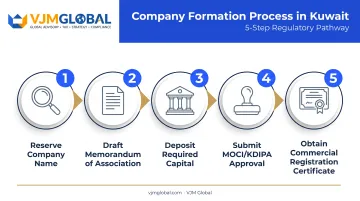
- Reserve your company name through the relevant Kuwaiti registry, checking it doesn't conflict with existing businesses in the same activity
- Draft the memorandum of association, authenticated as required by Kuwaiti company law
- Deposit the required capital into a Kuwaiti account
- Submit for MOCI or KDIPA approval, depending on your chosen route
- Obtain your commercial registration certificate once approved
Common miss: underestimating how long cross-border courier and attestation steps add on top of the official 30-day approval window.
Step 5 – Set Up Banking and Financial Operations
Opening a Kuwaiti business account typically requires the authorised signatory to appear in-branch with company documents, KYC forms, and signature verification. This is one area where remote-only setup genuinely struggles.
You'll also need a clear plan for how funds move between your Dutch and Kuwaiti accounts, since cross-border transfers carry their own compliance and reporting obligations on both ends.
VJM Global supports cross-border expansions with entity-formation groundwork, documentation coordination, and ongoing accounting and tax compliance so banking and reporting stay aligned on both the Dutch and Kuwaiti sides.
Step 6 – Plan for Compliance, Tax, and Ongoing Reporting
Kuwait's Income Tax Law applies a 15% rate to covered foreign business activity. Returns are due by the 15th day of the fourth month after the taxable period, with audited accounts.
As a Dutch tax resident, you must also declare worldwide income to the Belastingdienst. The Netherlands-Kuwait tax treaty may offer relief, depending on your entity structure and how income flows.
Common miss: assuming Dutch bookkeeping practices transfer directly. They don't — Kuwaiti accounting and audit requirements need local adaptation from day one.
Conclusion
Starting a business in Kuwait from the Netherlands is achievable, but it's not a copy-paste of domestic Dutch incorporation. Partnership rules, document attestation, and in-person banking requirements all add friction that a founder based entirely in the Netherlands can't fully sidestep.
Success comes down to choosing the right entity structure early and lining up reliable support on the ground, rather than trying to manage every step remotely. VJM Global’s entity formation and compliance support can cut down the back-and-forth that typically stretches these timelines.
Frequently Asked Questions
How much does it cost to start a business in Kuwait?
Minimum capital for a WLL is around KWD 1,000, plus KDIPA fees (KWD 300 for applications, KWD 150 for licence issuance) where applicable. Add translation, legalisation, and local consultancy costs on top.
Can a foreigner own a business in Kuwait?
Full foreign ownership is possible through an approved KDIPA company for eligible activities. Most ordinary WLLs outside that framework still involve Kuwaiti participation — confirm current rules for your activity with MOCI.
Which business is most profitable in Kuwait?
Sectors aligned with Kuwait's diversification push tend to perform well, including technology, logistics, renewable energy, and consulting services. These areas also often qualify for KDIPA ownership incentives.
Do I need to relocate to Kuwait to start a business there?
Not necessarily. A trusted local partner or agent can handle on-ground requirements, though bank account opening and certain manager appointments typically require in-person presence at some stage.
How long does it take to register a company in Kuwait from abroad?
KDIPA's stated decision window is 30 working days after a complete application, but document translation, legalisation, and cross-border logistics often extend the real timeline well beyond that.
Can I manage my Kuwaiti company's finances from the Netherlands?
Day-to-day oversight and bookkeeping can be managed remotely. However, opening bank accounts and certain regulatory filings typically require a local representative to appear in person.