Waste doesn't stop getting generated during a recession. That's part of the draw. Add a common-law legal system, English-language contracts, and no need to relocate immediately, and it's easy to see why American operators are circling this market.
Interest isn't limited to big corporates, either. US waste and recycling companies eyeing expansion, UK-connected diaspora entrepreneurs, and investors hunting for a hands-off international asset are all asking the same question: what does it actually take to set this up legally from the US?
This guide walks through that process step by step.
Key Takeaways
- A US citizen or company can own 100% of a UK limited company without residency or a visa
- Every operation needs Upper Tier Waste Carrier registration plus insurance before collecting a single bin
- Physical ops—drivers, trucks, disposal contracts—still need boots on the ground, even if ownership stays remote
- UK banking is often the hardest step for non-resident directors, not company formation
- Full setup, from decision to first paying customer, typically takes several months
What Is a UK Waste Management Business (and Why US Entrepreneurs Are Looking at It)
A UK waste management business is a regulated commercial operation that collects, transports, treats, recycles, or disposes of waste. It serves households, businesses, or construction sites under Environment Agency oversight (or the devolved equivalent in Scotland, Wales, and Northern Ireland).
The value on offer is simple: reliable, legally compliant waste removal. Not branding. Not a sustainability story. Customers pay for the truck showing up and the waste disappearing legally.
Common business structures include:
- Subscription-based residential collection
- Commercial contract servicing (retail, hospitality, offices)
- Construction and demolition debris removal
- Specialist niches like e-waste or medical/hazardous waste
Each carries different capital requirements and compliance demands. Hazardous waste, for instance, needs consignment notes instead of standard waste transfer notes, and typically a more involved permit.
Why the Market Has Room for New Entrants
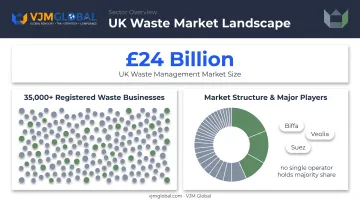
The UK's environmental services trade body, ESA, puts the broader UK recycling and waste market at £24 billion. It is a large revenue pool, and collection remains open to smaller operators.
Big names dominate certain segments. Biffa, Veolia, and Suez lead many commercial and industrial collection contracts. But this isn't a market with one company holding a majority share.
Waste collection is fragmented: over 35,000 registered businesses operate in the UK, and no single operator commands more than a small slice of the total. Focused regional operators still compete on service and local relationships rather than scale.
That structure is a large part of why US entrepreneurs look at the market. An English-speaking jurisdiction with familiar B2B contracts and clear national regulators is simpler to enter than many alternatives—if you set up the right UK entity and permits from day one.
What US Founders Need to Know Before Starting a UK Waste Business Remotely
UK company ownership does not require UK residency or citizenship. A US citizen or company can be a 100% shareholder and sole director of a UK limited company. There's no immigration test attached to owning shares.
The catch is more practical than legal. Every UK company needs a registered office address in the UK, and it has to sit in the same jurisdiction where the company is registered. Non-resident founders almost always arrange this through a formation agent or virtual office provider rather than using a friend's address.
Remote Ownership vs. On-the-Ground Operations
You can own a UK company from the US with relatively little friction. Running waste collection from overseas is much harder.
This business needs trucks on roads, drivers showing up, and disposal contracts honored daily. Founders generally pick one of three paths:
- Hire a UK-based operations manager to run day-to-day collection
- Partner with an existing local operator and handle sales/back office remotely
- Relocate personally to run early-stage operations hands-on
Banking, Visas, and Tax: The Three Sticking Points
Banking: Several high-street banks explicitly require UK residency for business account applicants. Lloyds and NatWest, for example, both state residency requirements on their business account pages. Fintech and EMI providers like Wise and Airwallex tend to be more flexible with non-resident directors, though due diligence still applies.
Visas: Passive ownership from the US needs no visa at all. A visa only matters if you plan to relocate and work in the business day-to-day. In that case, a route such as the Innovator Founder visa may apply—and it requires an endorsed business plan that is genuinely innovative.
Tax: Your UK entity pays UK Corporation Tax. But as a US owner, you may still face separate US reporting obligations on your foreign company interest, such as Form 5471 or FBAR filings. UK tax and US reporting both apply; one does not replace the other.
Early Decisions That Matter: Legal Structure, Licensing and Compliance
Here's the mistake that costs founders the most time and money: assuming foreign ownership somehow simplifies UK waste regulation. It doesn't. There is no lighter compliance pathway for non-UK founders. The rules apply identically.
Choosing Your Entity Structure
Most US founders form a UK Private Limited Company rather than registering a branch of their US parent. A UK Ltd gives liability protection, tends to read as more credible to UK commercial clients, and keeps UK compliance cleanly separate from US corporate obligations.
Licensing Is Separate From Company Registration
Registering your company at Companies House does not authorise you to collect waste. That's a distinct process:
- Upper Tier Waste Carrier, Broker or Dealer registration with the Environment Agency (England), NRW (Wales), SEPA (Scotland), or NIEA (Northern Ireland), required regardless of owner nationality
- In England, initial registration costs £191.02, lasts 3 years, and renewal runs £130.25
- Wales and Northern Ireland have comparable fees and 3-year terms
- Operating without registration can result in an unlimited fine
If you're running a fixed site, transfer station, or handling specialist or hazardous waste, you'll likely need a separate environmental permit on top of carrier registration. England's Environment Agency typically takes around 4 months to decide on a new permit application; Wales runs closer to 3 months.
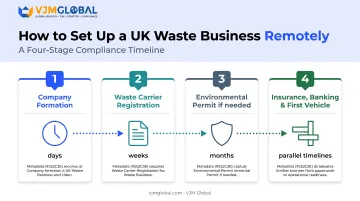
Realistic planning checklist:
- Company formation: days
- Waste carrier registration: weeks
- Environmental permit (if needed): months
- Insurance, banking, and first vehicle: overlapping timelines, but easy to underestimate
Many non-resident founders use cross-border specialists such as VJM Global for UK entity incorporation, the registered office, and initial Corporation Tax/VAT registration. Running that work in parallel with waste-carrier and environmental approvals keeps the legal foundation and the licences moving on the same clock.
How to Start a Waste Management Business in the UK from the USA – Step by Step
This sequence runs from market validation through to stable operations. The most common mistake at every stage is applying a US domestic playbook without adjusting for UK-specific competition and regulation.
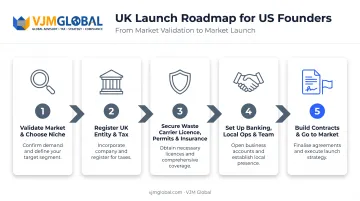
Step 1 – Validate the UK Market and Choose Your Niche
Research demand and existing competitors in your target region first. Check whether local council franchise agreements already lock up residential collection in your target area. Many UK councils run exclusive contracts that shut newcomers out of that segment entirely.
Common miss: Assuming a pricing model that works in a US market will transfer directly. UK councils, disposal costs, and customer expectations differ enough that this rarely holds up untested.
Step 2 – Choose Your UK Entity Structure and Register the Business
Register a UK Private Limited Company with Companies House remotely, using a formation agent for your registered office. Online incorporation costs £100 and usually completes within 24 hours.
Once formed:
- Appoint yourself (or a local partner) as director and obtain your company number
- Register for Corporation Tax with HMRC (you must notify HMRC within 3 months of starting to trade)
- Register for VAT if projected turnover will exceed the £90,000 threshold
- Set up UK-compliant bookkeeping from day one, not after your first invoice
Common miss: Registering the company, then delaying tax registration for months. That gap creates compliance exposure before you've even started trading.
Step 3 – Secure Your Waste Carrier Licence, Environmental Permits and Insurance
Apply for Upper Tier Waste Carrier registration before you touch a single customer's bin. If your operation includes a fixed site or specialist waste stream, submit your environmental permit application in parallel, since it takes longer to process.
Also lock in:
- Public liability insurance
- Employers' liability insurance (mandatory once you hire staff)
- Commercial vehicle insurance
Most commercial clients will ask for proof of all three before signing a contract.
Common miss: Starting collections while licence applications are still pending. This risks prosecution under the Environmental Protection Act 1990, plus the fines that come with it.
Step 4 – Set Up UK Banking, Local Operations and Your Team
Open a UK business bank account. If a high-street bank turns you down over residency, look at fintech or EMI alternatives. Several explicitly support non-resident directors, though onboarding still involves identity and compliance checks.
Then decide your operating model:
- Hire a UK-based operations manager
- Contract an existing local waste carrier
- Relocate personally for the early months
Whichever you choose, secure vehicles or equipment and lock in a disposal or transfer station contract before your first scheduled pickup, not after.
Step 5 – Build Compliant Contracts, Go to Market and Manage Ongoing Cross-Border Compliance
Draft UK-specific client agreements, supplier contracts, and employment contracts. US templates don't satisfy UK requirements, including obligations under the Consumer Rights Act 2015 for residential customers.
Build trust with local signals: your registered licence number, genuine local reviews, and council relationships where relevant.
Set up waste transfer note record-keeping (retained for at least 2 years). As revenue grows, add a system for dual UK/US financial reporting.
Common miss: Adding new routes or specialist waste streams before your core compliance and cash flow have stabilized. Growth on a shaky foundation tends to surface expensive gaps later.
Conclusion
Success here comes down to running two tracks in parallel: UK regulatory compliance and practical remote-operations logistics. Neither one on its own gets trucks moving and customers paying.
Clarity on entity structure, licensing, and who's physically running collections on the ground matters more than how fast you launch. Rushing past any of these tends to cost more time later than it saves upfront.
Long-term, the founders who do well keep building local partnerships and stay current on UK waste regulation as it shifts. They also revisit their cross-border tax setup as the business scales, rather than treating it as a one-time task.
If you want support on UK entity formation, licensing pathways, or ongoing cross-border tax compliance, VJM Global works with US businesses setting up and operating in the UK.
Frequently Asked Questions
Do I need a waste management licence in the UK?
Yes. Nearly every UK waste operation needs Upper Tier Waste Carrier, Broker or Dealer registration with the Environment Agency or devolved equivalent, plus a separate environmental permit for fixed sites or specialist waste handling.
Can a US citizen own and register a company in the UK without being a resident?
Yes. UK company law doesn't require directors or shareholders to live in the UK or hold UK citizenship. You will, however, need a UK registered office address.
Do I need a UK visa to run a waste management business from the USA?
No, not for passive ownership. A visa only becomes necessary if you plan to relocate and personally work in the business day-to-day.
How long does it take to set up a UK waste management company from abroad?
Company registration alone can take as little as 24 hours. Once you add waste carrier licensing, permits, banking, and insurance, the full setup usually stretches to several months.
Do I have to pay tax in both the UK and the US if I own a UK waste business?
Your UK entity pays UK Corporation Tax, and as a US owner you will also have US reporting duties, including FBAR filings once foreign accounts exceed $10,000. Arrange coordinated cross-border tax advice early.
Can I manage a UK waste collection business remotely from the USA?
Back-office and financial oversight can be managed remotely. Day-to-day collection, though, generally needs a local manager, staff, or operating partner physically on the ground.