Introduction
Singapore companies entering India face a challenge that goes beyond visa rules and regulatory filings: navigating India's deeply entrenched accounting ecosystem. While Xero and QuickBooks dominate in Singapore's SME market, they hold minimal traction among Indian accountants, compliance professionals, and small-to-medium enterprises. The platform that does? Tally.
With approximately 3 million paid users in India and presence in over 100 countries, Tally isn't just popular—it's the standard.
If your Singapore company establishes a wholly owned subsidiary, branch office, or joint venture in India, your Indian chartered accountant almost certainly uses Tally. Your vendors likely invoice through it. Your statutory auditor will expect Tally-generated reports.
This guide explains what Tally does, how it fits India's compliance framework, and what Singapore-based management needs to know to keep oversight tight across borders.
TLDR:
- Tally is India's dominant accounting and ERP software, used by millions of businesses and trained accountants
- TallyPrime (the current version) handles GST, TDS, payroll, inventory, and audit trail requirements in a single platform
- Singapore companies don't need to run Tally directly but must understand its role in Indian compliance
- Remote access capabilities enable Singapore-based management to view real-time Indian entity reports without being on-site
What is Tally? A Quick Overview for Singapore Business Owners
Tally Solutions Pvt. Ltd. is a Bangalore-based ERP accounting software company founded in 1986. The platform serves nearly 2.5 million businesses worldwide, with the company's Managing Director confirming approximately 3 million paid users in India alone as of 2025.
Evolution of the platform:
- Tally ERP 9 (launched 2009): The version that dominated India's SME accounting landscape for over a decade
- TallyPrime (launched November 2020): The current flagship product, featuring modernised interface, improved navigation, and updated compliance modules aligned with India's regulatory environment
While global accounting tools like Xero or QuickBooks are standard in Singapore, they have limited adoption in India's MSME (Micro, Small & Medium Enterprises) ecosystem. The reason is straightforward: Indian accountants are trained on Tally almost universally.
Tally Education has trained over 1 million learners through 3,500+ learning partners across 500+ Indian towns and cities. In practice, that means nearly every Indian accountant you hire will default to Tally — regardless of what software your Singapore office uses.
For Singapore companies managing Indian books or working with Indian finance teams, understanding how Tally works isn't optional — it's a practical necessity.
Why Singapore Companies with Indian Entities Need to Understand Tally
Singapore has been India's largest source of FDI equity inflows for seven consecutive years, contributing USD $171.92 billion (23.87% of total FDI) as of December 2024. This growing cohort of Singapore companies with Indian operations faces a common challenge: bridging two different accounting ecosystems.
Under Section 128 of the Companies Act, 2013, every company incorporated in India—including wholly owned subsidiaries of foreign companies—must maintain books of account compliant with Indian Accounting Standards (Ind AS) at its registered office. Your Indian entity cannot simply consolidate into Singapore-based Xero or QuickBooks and call it compliant.
Indian chartered accountants and bookkeepers predominantly use Tally for statutory work because it's purpose-built for India's compliance landscape:
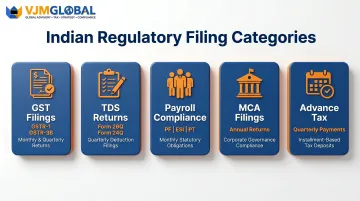
- GST filings: GSTR-1 (outward supplies), GSTR-3B (summary returns), filed monthly or quarterly
- TDS returns: Forms 26Q (non-salary TDS) and 24Q (salary TDS), filed quarterly
- Payroll compliance: PF (Provident Fund), ESI (Employees' State Insurance), Professional Tax
- MCA filings: Annual returns, director disclosures, audit trail requirements
- Advance tax: Quarterly tax payment calculations and reconciliations
When your Singapore finance team reviews P&L statements, balance sheets, or cash flow reports from the Indian entity, those reports originate from Tally. Knowing Tally's report formats makes consolidation into group accounts significantly more straightforward.
India's MSME vendor ecosystem—suppliers, distributors, and business partners—largely uses Tally for invoicing. Vendor audits and supplier account reconciliations will pull Tally-generated data as the primary source. For Singapore holding companies with complex Indian structures, TallyPrime's multi-company environment lets a single accounting firm manage your subsidiary and any regional branches within one instance.
Firms like VJM Global handle Tally-based accounting for Singapore companies' Indian entities, covering bookkeeping, GST filings, TDS returns, payroll, and MCA compliance. Singapore parent companies receive regular reporting exports for group consolidation without needing in-house Tally expertise.
Key Tally Features That Matter for India's Regulatory Compliance
TallyPrime functions as a compliance engine purpose-built for India's regulatory framework, covering GST, direct taxes, payroll, and audit requirements that Singapore companies frequently underestimate.
GST Compliance
TallyPrime is fully GST-ready, auto-generating GST-compliant invoices and calculating CGST (Central GST), SGST (State GST), and IGST (Integrated GST) based on transaction type. The platform produces GSTR-1 and GSTR-3B data with built-in exceptions and resolutions reporting.
Critical for Singapore companies: Misconfigured GST compliance leads to penalties under the GST Act and loss of eligible input tax credit (ITC) claims. Your Indian entity's ability to claim ITC directly impacts cash flow and profitability.
TDS and Direct Tax Management
Tally's TDS module automatically calculates tax deducted at source on vendor payments, salaries, and professional fees—a mandatory requirement under the Income Tax Act with stiff penalties for errors. The system generates Form 26Q (non-salary TDS) and Form 24Q (salary TDS) data needed for quarterly filings.
Features include:
- Challan reconciliation to match tax payments with deductions
- FVU-compatible export for direct submission to Income Tax Department
- Error detection before filing to prevent rejection
Payroll Processing
TallyPrime's payroll module handles statutory deductions governed by multiple Indian labour laws.
- Provident Fund at 12% of basic salary under the Employees' Provident Fund Act, 1952
- Employee State Insurance (ESI) at 0.75% under the ESI Act, 1948
- Professional Tax with state-specific slab calculations
- NPS contributions across Tier I and Tier II accounts
- TDS on salary calculated automatically per income tax slabs
This is a common compliance gap for Singapore companies entering India without prior Indian payroll experience—each of these carries separate filing deadlines and penalty structures.
Inventory and Stock Management
TallyPrime includes real-time inventory tracking and valuation, directly relevant for Singapore companies in trading, manufacturing, or distribution. Stock movement tracking is mandatory for two reasons: e-way bill generation applies to any goods movement exceeding ₹50,000 in value, and accurate stock records are required for GST reconciliation.
Financial Reporting and Audit Trail
TallyPrime generates standard Indian financial statements—Balance Sheet, Profit & Loss, Trial Balance—formatted per Indian accounting norms required for statutory audit, MCA filings, and income tax returns.
The TallyPrime Edit Log satisfies a mandatory audit trail requirement under the Companies (Accounts) Amendment Rules, 2021 (effective April 1, 2023). It records:
- Date and time stamps for every transaction
- User identification for creation, alteration, and deletion
- Master data changes
- Non-disableable logging (MCA requirement)
This addresses the Ministry of Corporate Affairs' mandate that accounting software used by companies must record a tamper-proof audit trail of each transaction.
TallyPrime vs. Tally ERP 9: What's Current in India Today
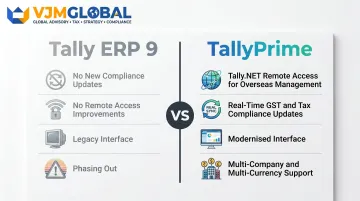
Tally Solutions is actively phasing out Tally ERP 9. While existing users can continue operating the legacy version, the company no longer updates it with new features or compliance requirements.
Upgrade path:
- Free upgrade to TallyPrime is available for users with active TSS (Tally Software Services)
- From July 2025 onward, upgrades are no longer free and cost 40% of the license fee
- Users with expired TSS need to renew before accessing upgrades
Why Singapore companies should insist on TallyPrime:
- Remote access via Tally.NET lets Singapore-based management view real-time financial reports from the Indian entity without traveling. Data stays on the Indian office server, which addresses data sovereignty concerns common for cross-border setups.
- Regular GST and tax compliance updates ensure your Indian entity stays current as regulations change — critical given how frequently India's indirect tax rules evolve.
- A modernised interface reduces onboarding time for Indian accounting teams and cuts day-to-day friction.
- Multi-company and multi-currency support within a single instance suits Singapore groups managing multiple Indian subsidiaries or projects.
When establishing a new Indian entity, ensure your Indian accountant or outsourced firm sets up TallyPrime directly, not ERP 9.
How Singapore Companies Typically Manage Tally for Their Indian Operations
Most Singapore companies choose one of two approaches:
Option 1: In-House Indian Accounting Team
Larger Singapore companies with substantial Indian operations hire a full-time Indian accountant or finance manager who operates Tally directly. This approach works well when transaction volumes are high and justify dedicated headcount.
Considerations:
- TallyPrime licensing costs (see pricing below)
- Staff training and ongoing professional development
- Office infrastructure and data security
- Direct compliance management responsibility
Option 2: Outsourcing to an Indian Accounting Firm
For companies with lean teams or early-stage Indian operations, the more practical path is outsourcing Indian accounting entirely to a local firm that operates Tally on their behalf.
Benefits:
- Cost-effective: Lower than hiring full-time staff
- No Tally expertise required from your Singapore team
- Compliance handled by India-qualified professionals (Chartered Accountants)
- Scalable as operations grow
Firms like VJM Global provide this service end-to-end, managing Tally-based bookkeeping, GST filings, TDS returns, payroll, and MCA compliance for Singapore companies' Indian entities. With 30+ years of experience and a 95% client retention rate across 15+ industries, the firm delivers structured reporting so Singapore finance teams stay informed without handling day-to-day operations.
Remote Access and Oversight
TallyPrime's Tally.NET remote access enables Singapore-based finance teams to log in and view:
- Real-time P&L and balance sheets
- Cash flow statements
- Outstanding receivables and payables
- Stock availability and valuation
- Audit trails and transaction logs
Security levels can be configured (Owner, User, Auditor) to control what remote users can see or modify.
Governance Best Practices
Establish clear reporting protocols between your Indian entity and Singapore parent company:
- Monthly: P&L and balance sheet exports from Tally
- Quarterly: Compliance status reports (GST filing confirmations, TDS certificates, payroll returns)
- Annual: Statutory audit reports, MCA filing confirmations, income tax return copies
This enables Singapore finance teams to consolidate Indian financials into group accounts and maintain oversight of compliance deadlines without operational involvement.
Tally vs. Alternative Accounting Software for India-Based Operations
Singapore companies often ask: "Can we just use our existing Singapore software for the Indian entity?"
The practical reality: While Xero, QuickBooks, Zoho Books, and SAP Business One are widely used globally, Tally dominates India's SME accounting space for three structural reasons:
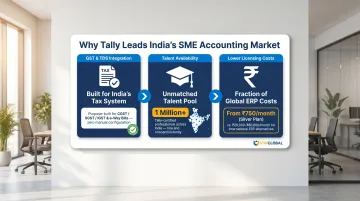
- GST and TDS integration: TallyPrime is purpose-built for India's tax architecture — CGST/SGST/IGST calculations, e-way bills, TDS sectional filings — while global platforms require manual workarounds or third-party plugins.
- Talent availability: Over 1 million Tally-certified professionals operate across India, versus a comparatively small pool of Xero or QuickBooks-trained accountants. Hiring becomes significantly easier.
- Lower licensing costs: TallyPrime Silver (single-user) starts at ₹750/month or ₹22,500 lifetime — substantially cheaper than international ERP solutions.
When Alternatives Make Sense
Large multinationals with existing SAP/Oracle implementations: If your Singapore parent already runs SAP Business One or Oracle Financials globally, rolling India into the group ERP can be justified — provided the Indian entity is large enough to absorb the cost.
However, this typically requires:
- Dedicated implementation partner in India
- Custom compliance modules for GST/TDS
- Higher licensing costs (₹3-5 lakhs+ annually)
- Longer setup timelines (3-6 months vs. 2-4 weeks for Tally)
For most Singapore companies running small-to-mid-size Indian subsidiaries or liaison offices, those tradeoffs rarely make sense. Tally gets you compliant and operational faster, at a fraction of the cost.
TallyPrime Pricing in India (2026)
All prices below are for India-only licenses, exclusive of 18% GST. Source: official Tally Solutions website.
| Edition | 1 Month | 3 Months (5% off) | 12 Months (10% off) | Lifetime (Perpetual) |
|---|---|---|---|---|
| Silver (Single User) | ₹750 | ₹2,138 | ₹8,100 | ₹22,500 |
| Gold (Multi-User) | ₹2,250 | ₹6,413 | ₹24,300 | ₹67,500 |
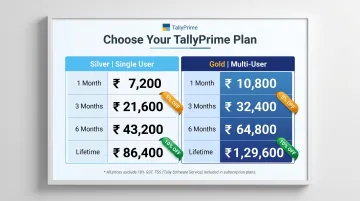
Key notes:
- All rental plans include TSS (Tally Software Services) for updates and connected services
- Lifetime licenses include 1 year of TSS; subsequent annual renewal required for compliance updates
- TallyPrime Cloud Access and WhatsApp integration are paid add-ons (cloud hosting runs on Oracle Cloud Infrastructure)
- Zero-cost EMI options available for lifetime licenses
To put this in context for Singapore companies: the annual rental cost of ₹8,100 to ₹24,300 typically amounts to less than a single month's co-working desk rental in Mumbai or Bengaluru. For most India subsidiary budgets, it's a minor operational line item rather than a meaningful cost decision.
Frequently Asked Questions
How much does Tally accounting software cost in India?
TallyPrime is available in two editions—Silver (single-user) at ₹22,500 lifetime or ₹750/month, and Gold (multi-user) at ₹67,500 lifetime or ₹2,250/month, plus 18% GST. Annual subscriptions offer 10% discounts. Check the official Tally Solutions pricing page for current offers.
Which Tally software is best for accounting in India?
TallyPrime is the current recommended version, having replaced Tally ERP 9 in 2020. It's best suited for Indian businesses due to built-in GST, TDS, payroll, e-way bill, and mandatory audit trail features aligned with current regulations.
Is Tally accounting software still used in India?
Yes, Tally remains India's most widely used accounting software with approximately 3 million paid users as of 2025. It remains popular due to tight GST/TDS compliance, low licensing costs, and a wide pool of trained accountants across India.
Can Singapore companies access Tally remotely for their Indian entity?
Yes, TallyPrime supports cloud hosting and remote access via Tally.NET services. Singapore-based management can view reports and dashboards of their Indian entity in real time, while data stays on the Indian office server.
Do Singapore companies need to hire a Tally expert themselves, or can they outsource?
Outsourcing Indian accounting to an India-based firm that uses Tally is a practical and cost-effective approach. Singapore companies can maintain oversight through regular P&L and balance sheet exports without needing in-house Tally expertise.
Is Tally compliant with India's GST and TDS requirements?
Yes, TallyPrime is fully GST-ready and includes a built-in TDS module. It auto-generates GST-compliant invoices, supports GSTR return preparation, and calculates TDS deductions as per Income Tax Act requirements.