Introduction
Expanding into the UK often means chasing talent your US team doesn't have on hand. Maybe it's a fintech engineer with FCA experience, or a healthcare specialist who knows NHS procurement inside out. Whatever the gap, many US businesses assume UK hiring works like an extension of their American HR playbook.
It doesn't.
Hiring foreign nationals into a UK operation runs on a completely separate legal system. Sponsor licences, salary thresholds, and skill-level rules have nothing to do with US immigration law. Get the entity structure or visa route wrong, and a promising hire stalls for months.
This guide walks through the exact steps to sponsor foreign workers through a UK entity, what needs to be in place beforehand, and the factors that decide success or failure. It also covers the mistakes US employers repeat most often, plus alternatives (including Employer of Record) for businesses not ready to incorporate yet.
Key Takeaways
- A UK sponsor licence must be in place before any Certificate of Sponsorship can be issued
- Skilled Worker visas need degree-level or shortage-list roles, with salary at or above the going rate
- HR systems and Right to Work checks must exist before recruitment starts, not after
- US firms without a UK entity can still hire locally through an Employer of Record
- Processing delays and misjudged salary thresholds are the top reasons sponsorships fail
How US Businesses Can Hire Foreign Employees in the UK (Step by Step)
Sponsoring a foreign worker in the UK follows a fixed sequence set by the Home Office. Skip a step or get the order wrong, and the whole process resets.
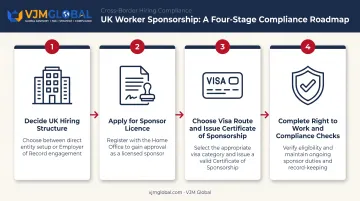
Step 1: Decide Your UK Hiring Structure
Before anything else, decide how you'll employ people in the UK. Three paths exist:
- Existing UK subsidiary or branch — already registered and trading
- New UK entity — set up specifically to support the hire
- No local entity — hiring through an Employer of Record instead
This decision alone determines whether a sponsor licence is even relevant.
A US business forming a new UK entity through a service like VJM Global's UK company formation support still faces a critical test: the entity must be genuinely trading, not a dormant shell set up purely to sponsor one employee. Home Office caseworkers look for real commercial activity, not paperwork built around a single hire.
Step 2: Apply for a UK Sponsor Licence
Once you have an operational entity, apply for the sponsor licence. Eligibility requires:
- No unspent convictions for immigration offences, fraud, or money laundering
- No licence revoked in the previous 12 months
- Suitable HR systems capable of managing sponsorship duties
Most applicants submit at least four supporting documents:
- PAYE or Corporation Tax registration
- Bank statements
- Ownership hierarchy
- Job details for each role you plan to sponsor
Start-ups trading under 18 months typically need a recent UK bank statement instead of full accounts.
The worker sponsor licence fee is £611 for small or charitable sponsors and £1,682 for medium or large sponsors. After submission, the Home Office may schedule a compliance visit, announced or unannounced, before granting the licence.
Step 3: Choose the Right Visa Route and Assign a Certificate of Sponsorship
Not every hire fits the Skilled Worker route. Match the role and worker circumstances to the correct pathway:
| Route | Best For |
|---|---|
| Skilled Worker | New hires in RQF Level 6+ roles |
| Global Business Mobility | Transferring existing US staff to a UK branch |
| Health and Care Worker | NHS or eligible care roles |
Once the route is confirmed, issue the Certificate of Sponsorship (CoS) with accurate job title, salary, and SOC occupation code. The CoS fee is £525, and it must generally be used within three months of issue.
Step 4: Complete Right to Work and Ongoing Compliance Checks
Right to Work checks apply to every hire, sponsored or not. This trips up more US employers than any other step, because they assume compliance duties only cover visa holders.
Retain check evidence for the duration of employment plus two years afterward. Once sponsorship begins, report certain events through the Sponsorship Management System within 10 working days, including:
- A worker failing to start
- An unexplained absence
- A salary change
What You Need Before Sponsoring Foreign Workers in the UK
Preparation determines whether an application succeeds on the first try or gets bounced back for missing evidence. Get three foundations in place before you recruit: a real UK entity and sponsor licence path, HR systems that meet UKVI rules, and a clear fee budget.
Entity and licence readiness. Your UK entity must be genuinely operational—not just a registered address—with staff who can manage day-to-day sponsorship duties.
HR and compliance systems. Before recruiting, confirm you can track visa expiry dates, report changes to UKVI on schedule, and keep accurate sponsored-worker records. Many US businesses underestimate this step, assuming existing US HR software covers it. It doesn't. UK sponsor record-keeping has its own documentation standards.
Budget for fees. Costs stack up quickly and vary by sponsor size:
- Sponsor licence: £611 (small/charitable) or £1,682 (medium/large)
- Certificate of Sponsorship: £525
- Immigration Skills Charge: £480–£1,320 for the first 12 months, depending on sponsor size
- Visa application and health surcharge: varies by visa length and applicant location
Businesses that also run UK payroll often outsource that admin. VJM Global's UK payroll support handles PAYE, Real Time Information submissions, and statutory documents such as P45, P60, and P11D forms once a sponsored employee starts work.
Key Factors That Affect Your UK Visa Sponsorship Success
Sponsorship outcomes hinge on a handful of variables, and recent rule changes have made some of them stricter.
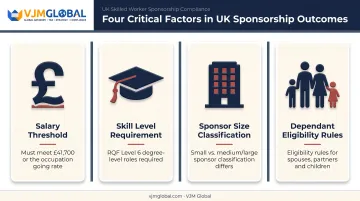
Salary Threshold
Most Skilled Worker sponsorships must meet the higher of the general minimum salary or the occupation's "going rate." Currently, that means salary must equal or exceed £41,700 annually and the role's specific going rate. Pay below this threshold, and the sponsorship is ineligible unless the role sits on a shortage list.
Skill Level Requirement
New Skilled Worker sponsorships generally require RQF Level 6 (degree-level) roles. Mid-skilled positions only qualify through narrow transitional provisions or Immigration Salary List placement, so a role that felt "sponsorable" two years ago may no longer be.
Sponsor Size Classification
Whether you're classed as small/charitable or medium/large changes both your licence fee and Immigration Skills Charge rate. A sponsor is usually small if it meets two of three:
- Turnover under £15 million
- Assets under £7.5 million
- 50 employees or fewer
Misclassifying this risks underpaid fees and compliance flags during audits.
Dependant Eligibility Rules
Only workers sponsored in graduate-level roles can generally bring new dependants. If you're relocating a mid-skilled specialist with their family, the visa route itself may block that option and weaken how attractive the offer looks.
Common Mistakes US Employers Make When Hiring Foreign Workers in the UK
Most sponsorship failures trace back to a handful of repeated errors:
- Assuming US HR reputation transfers: a strong US employer brand or existing HR practices don't substitute for a valid UK sponsor licence
- Underestimating timelines: setting a start date before accounting for licence processing plus visa processing
- Choosing the wrong visa route: using Skilled Worker for an intra-company move that's better suited to Global Business Mobility
- Skipping Right to Work checks on non-sponsored staff: wrongly assuming compliance duties only apply to visa holders
The illegal working penalty makes that last mistake especially costly. Employers without a statutory excuse from a compliant Right to Work check face a civil penalty of up to £60,000 per illegal worker. That applies whether or not the worker in question was ever meant to be sponsored.
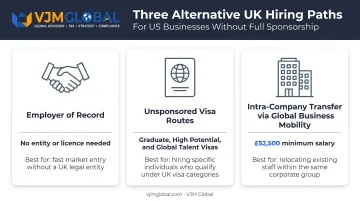
Alternatives to Direct UK Sponsorship for US Businesses
Incorporating and applying for a sponsor licence isn't always the fastest or cheapest route, especially for a first UK hire or a short-term project.
Employer of Record (EOR)
An EOR lets you hire UK-based talent without incorporating a local entity or securing a sponsor licence. The EOR becomes the legal employer on paper, handling contracts, payroll, and statutory contributions, while you manage day-to-day work.
Firms such as VJM Global provide EOR support so a US business can hire in the UK without a subsidiary, including:
- Compliant UK employment contracts and onboarding
- PAYE payroll and National Insurance
- Offboarding when the role ends
An ongoing per-employee service fee applies, so this route usually makes the most sense for smaller headcounts before a full entity is justified.
Unsponsored Visa Routes
Some candidates already hold visas that don't require employer sponsorship, including:
- Graduate visa
- High Potential Individual visa
- Global Talent visa
Hiring them removes the sponsor licence requirement entirely. You have no control over how long their permission lasts, and the eligible pool is narrower than the open market.
Intra-Company Transfer via Global Business Mobility
If you're moving an existing US employee into a new UK branch during market entry, this route fits better than Skilled Worker. It requires a salary of at least £52,500 and an established link between the US and UK entities.
It does not apply to fresh local hires, only staff already employed by the group.
Frequently Asked Questions
Can a US citizen live in the UK and work for a US company?
Short remote stints may not require a visa, but living in the UK long-term while working, even remotely for a US employer, generally requires UK immigration permission. It can also trigger UK tax residency obligations under HMRC's Statutory Residence Test.
Which companies in the UK sponsor work visas?
Thousands of organisations across tech, banking, professional services, and healthcare hold sponsor licences, from major tech firms to the NHS and Big Four accounting firms. The official Home Office register of licensed sponsors is the definitive source.
Does a US business need to set up a UK entity to hire foreign employees there?
An entity is only required for direct sponsorship. An Employer of Record lets a US company hire UK-based staff, including some foreign nationals, without incorporating a local subsidiary or branch.
How long does it take to get a UK sponsor licence?
Most applications are decided within 8 weeks once documents are ready, though a Home Office compliance visit can extend that timeline. A priority service is available for £750, targeting a decision within 10 working days.
How much does it cost to sponsor a foreign worker in the UK?
Costs include the sponsor licence fee (£611–£1,682), Certificate of Sponsorship fee (£525), Immigration Skills Charge, and visa or health surcharge costs. Totals vary significantly by sponsor size and visa length.
Can a US company hire in the UK without a sponsor licence?
Yes. This is possible through an Employer of Record, or by hiring candidates who already hold unsponsored visas like the Graduate or Global Talent visa, or existing UK right to work.