Introduction
Yes, an Indian founder can form a Wyoming company entirely from India, without ever setting foot in the United States. The state filing itself is straightforward: fill in a form, pay a fee, get a certificate.
But that certificate is just the starting point. Registering a US entity brings federal tax obligations, banking requirements, and a parallel set of Indian compliance rules under FEMA and the Income Tax Act.
A common misconception: Wyoming has no state income tax, so the company pays no tax at all. That's not how it works. Federal tax still applies, and so does Indian tax on the founder's share of income or control.
This guide walks through choosing an entity, filing with Wyoming, getting an EIN, opening a bank account, and staying compliant in both countries. You can then decide whether Wyoming genuinely fits your business, not just your budget.
Key Takeaways
- Non-residents can form a Wyoming LLC or corporation with a compliant registered agent and bank/IRS identity checks.
- LLC vs. corporation should be decided by taxation and fundraising plans, not just formation cost.
- FEMA, remittance limits, and Indian tax residency rules apply once money or control crosses the border.
- A Wyoming filing does not provide a US bank account, tax exemption, or multi-state operating rights.
How to Register a Company in Wyoming from India
Step 1: Decide Whether an LLC or Corporation Fits Your Business
This decision shapes everything downstream, from how you're taxed to whether investors will even consider writing you a cheque.
A single-member Wyoming LLC is, by default, treated as a "disregarded entity" for US federal tax purposes unless you file Form 8832 to elect corporate treatment. A multi-member LLC defaults to partnership taxation instead, filing Form 1065 and issuing Schedule K-1s to each member.
A C corporation is a separate taxpayer altogether, filing Form 1120.
Rough guide by business type:
- Solo online business or freelance-style operation: an LLC is usually simpler, with less paperwork and no separate corporate-level tax.
- Startup planning to raise from US venture investors: a C corporation is generally preferred, since standard equity financing and preferred-stock structures are built around corporate law.
- Indian company opening a US arm as a subsidiary: the choice depends on whether profits will be repatriated as dividends or reinvested.
If dividends do flow back to India, the India-US tax treaty caps US withholding at 15% for a corporate shareholder owning at least 10% of voting stock, and 25% otherwise, under Article 10 of the treaty.
LLC distributions don't automatically qualify as treaty "dividends" — the characterisation depends on your entity election and the facts. Get professional advice before locking this in; it's not a decision to reverse-engineer later.
Step 2: Choose and Verify the Company Name
Wyoming requires an LLC name to include an identifier such as "LLC," "L.L.C.," or "Limited Liability Company." Corporations need "Corp," "Corporation," "Inc.," or "Incorporated."
Your name must also be distinguishable from every other entity on record. Wyoming's rules mean that punctuation, capitalisation, spacing, and words like "The," "And," or "Company" generally don't count as distinguishing features. Singular and plural versions of the same word are treated as conflicting too.
Before filing, check three things:
- Wyoming's entity database — search the Secretary of State's filing search tool for conflicts.
- Trademark conflicts — a name can be available in Wyoming but still infringe someone's registered trademark elsewhere.
- Domain and brand availability — check your intended website domain and social handles.
Note the difference between your legal name (what's on the Articles), a DBA/trade name (used for marketing), and your brand name. You can trade under a different name than your legal entity name, but the legal name is what banks and the IRS will always ask for.
Step 3: Appoint a Wyoming Registered Agent
Every Wyoming entity needs a registered agent with a physical Wyoming street address, someone who consents to receive legal and state correspondence on the company's behalf.
What to look for:
- Consistent document forwarding, so you don't miss a lawsuit notice or annual report reminder
- Clear renewal terms and pricing, not a low first-year fee that jumps later
- Reasonable identity-verification practices
- A track record of actually being reachable when needed
One thing to be clear on: a registered agent address is not a business address, an office, an employee, or a licence to operate. It's purely a mail-receiving function required by state law. Don't let anyone imply it gives you a genuine Wyoming presence.
Step 4: Prepare and File the Formation Documents
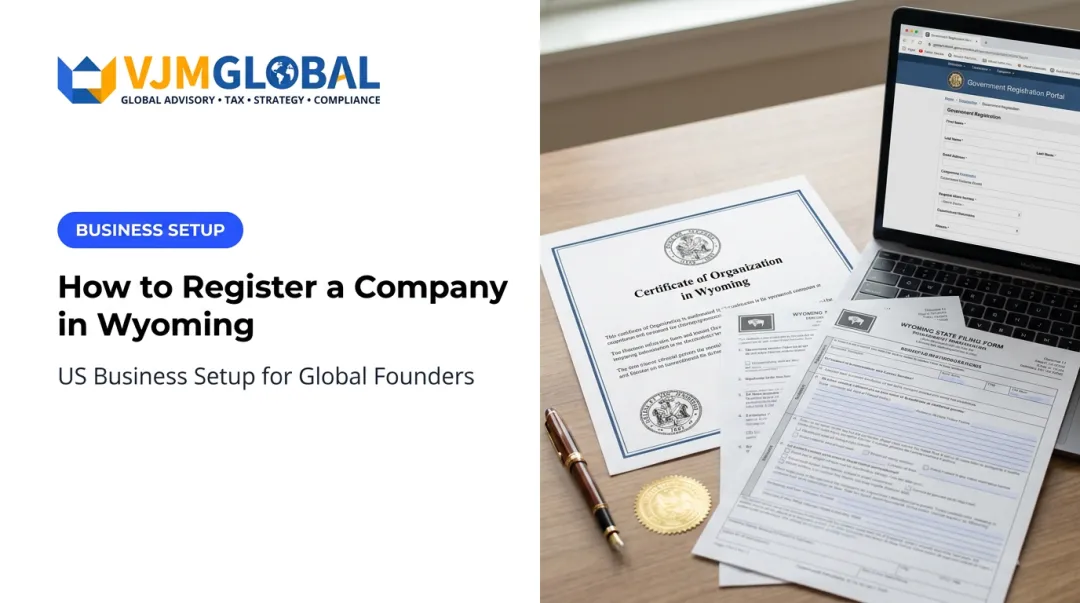
For an LLC, you'll file Articles of Organization; for a corporation, Articles of Incorporation. Both typically require:
- Entity name and type
- Registered agent name and address
- Principal or mailing address
- Management structure (member-managed or manager-managed, for LLCs)
- Organiser's name and signature
Wyoming allows both online and paper filing through the Secretary of State. As of the current fee schedule, LLC and corporation filings are each $100, though Wyoming's official fee schedule should always be checked before you pay, since fees are revised periodically. Online filings also carry a small card-processing surcharge on top of the base fee.
Processing times differ by method: online-filed domestic entities are generally activated almost immediately, while mailed filings can take longer to review.
Once approved, save the filed certificate, payment receipt, and any state correspondence in a dedicated company records folder. You'll need these documents repeatedly, for the EIN, for banking, and for any investor due diligence.
Step 5: Create Internal Company Documents
The Articles of Organization or Incorporation are public. Your internal governance documents are not, and they matter just as much.
For an LLC, draft an operating agreement covering:
- Ownership percentages and member contributions
- Management authority and decision-making rules
- Profit distribution mechanics
- Transfer restrictions and succession terms
- Dispute resolution procedures
For a corporation, prepare bylaws, an initial board resolution, share issuance records, and a register of directors and officers.
These documents prove ownership when a bank asks who actually controls the entity, and they matter enormously if you ever bring in investors or co-founders. They also help preserve the legal separation between you personally and the company, a distinction that protects your personal assets if something goes wrong.
Step 6: Apply for an EIN and Assess Federal Reporting
An Employer Identification Number (EIN) is your company's federal tax ID, and you need one before opening a bank account or filing federal returns.
The standard route is Form SS-4. If you don't have a US Social Security Number or ITIN, as most Indian founders won't, you enter "Foreign" on the relevant line and cannot use the IRS's online application.
Instead, international applicants generally submit Form SS-4 by fax or mail to the IRS's international operation, or apply by phone from outside the US. Processing by fax or mail takes considerably longer than the instant online option available to US residents, so build in a buffer.
Also check your current federal reporting obligations at formation, including beneficial ownership information (BOI) reporting to FinCEN. Rules here have shifted more than once in recent years, so verify the applicable exemptions and thresholds at the time you file rather than relying on older articles, including this one.
Step 7: Set Up Business Banking and Payment Infrastructure
This step trips up more Indian founders than any other in the entire process.
Banks typically ask for:
- Formation documents and EIN confirmation
- Operating agreement or bylaws
- Beneficial ownership details
- Passport and proof of Indian residential address
- A description of your business model and expected transaction volume
- Source-of-funds evidence
Approval is discretionary. Non-resident applicants often face enhanced due diligence, and some providers require a US visit or additional video verification before opening an account. Don't assume a Wyoming certificate guarantees a bank account; treat it as an application, not a formality.
It also helps to distinguish between your options:
- Traditional US bank account — full banking functionality, often the hardest for non-residents to open remotely
- Fintech or neobank account — sometimes more accessible remotely, but not universally available to Indian residents
- Merchant processor — for accepting card payments, separate from a bank account
- Multi-currency account — useful if you're invoicing in USD but need to move funds to India
Verify current eligibility for Indian residents with each provider directly; terms change frequently.
Step 8: Build a Recurring Compliance Calendar
Formation is a one-time event. Compliance is not.
On the Wyoming/US side, track:
- Wyoming annual report and licence tax, due on your entity's anniversary month
- Registered agent renewal
- Federal returns (Form 1120 for a corporation, or Form 5472 with a pro forma Form 1120 for a foreign-owned disregarded LLC)
- State sales tax registration, if you have nexus
- Payroll filings if you hire staff
On the Indian side, track:
- Authorised Dealer bank documentation for any remittance or investment
- FEMA/ODI filings tied to your capital contribution
- Indian income tax returns disclosing foreign assets and income
- Records of every contribution and distribution between you and the Wyoming entity
If juggling both calendars sounds like a lot, it is. This is exactly the coordination problem VJM Global's entity formation and compliance teams work on daily.
They help founders track US filings alongside Indian FEMA and tax reporting, without any promise of a fixed timeline or guaranteed outcome. It's a support option worth evaluating, not a substitute for your own diligence.

When Should You Register a Wyoming Company from India?
Wyoming formation makes sense when there's a genuine US-facing reason for it, not just a preference for the state's reputation.
Good fits include:
- Creating a US contracting or sales entity to invoice American clients directly
- Serving US customers who expect a domestic vendor
- Spinning off a US business line from an existing Indian company
- Building a digital product aimed primarily at the US market
- Executing a defined, funded US expansion plan
Premature scenarios:
- No validated business activity or customer demand yet
- No actual banking or payment need that an Indian entity can't already serve
- No tax analysis done on either side
- A business that will operate entirely from India, with the US entity existing only on paper
One detail founders overlook: physical operations outside Wyoming change the picture. If you later hire staff, lease property, or otherwise operate in another state, you will likely need foreign qualification there too.
Wyoming registration does not clear obligations elsewhere. The right jurisdiction depends on where your customers, investors, and operations actually sit, not on which state advertises the lowest filing fee.
What You Need Before Registering a Wyoming Company from India
Preparation here cuts down on filing rejections, banking delays, and tax surprises later.
Identity and Ownership Documents
- Valid passport
- Proof of Indian residential address
- Contact details for the responsible party
- Ownership percentages for each founder or member
- Details of any parent company, trust, or corporate shareholder involved
Business and Formation Information
Define these points before you file, not after:
- The proposed business activity and target markets
- Funding source and initial capital contribution
- Management structure and principal business address
- Whether the entity will have employees or contractors
Decide whether the entity will be owned by you personally, by an existing Indian company, or by another group entity, only after reviewing the FEMA/ODI, transfer-pricing, and reporting consequences of each option. This is not a detail to decide casually.
India-Specific Regulatory and Tax Readiness
Overseas investment by an Indian resident is governed by FEMA's Overseas Investment framework, administered through your Authorised Dealer bank. Before your first remittance, you'll typically need to file Form FC and obtain a Unique Identification Number through the bank.
Remittances for overseas investment currently fall under the Liberalised Remittance Scheme (LRS), capped at USD 250,000 per financial year for specified purposes, according to the RBI's LRS FAQ. Confirm the current limit before transferring funds, as RBI periodically revises these thresholds.

Separately, Indian tax residents must disclose foreign assets and foreign-source income in the relevant income tax return schedules. Tax residency and citizenship are not the same thing; your residency status for a given financial year determines whether these disclosure rules apply to you.
US-Specific Readiness
Before operations begin, understand:
- Your entity's federal tax classification (disregarded, partnership, or corporation)
- Whether you'll have US-source income or effectively connected income
- Sales tax nexus and payroll exposure in states where you have activity
- Any additional state registrations triggered by your actual business model
Talk to both an India-qualified tax professional and a US tax adviser before moving money or starting operations. This is not a box-ticking exercise. It changes your filing obligations on both sides.
Key Decisions, Compliance Variables, and Troubleshooting
The real-world outcome for any Wyoming entity depends on a handful of variables: entity type, ownership structure, where work actually happens, where customers sit, and who controls decision-making.
Entity Type and Tax Classification
An LLC's default classification can differ sharply from what you get after filing Form 8832 to elect corporate treatment. Pass-through treatment sounds simple, but for an Indian-resident owner it can create layered reporting obligations on both sides of the border.
A corporation offers a cleaner company-level tax structure, which matters if you're retaining earnings or bringing in outside investors. Neither option is universally better. Research the current treaty position for your specific facts.
Indian Management and Permanent-Establishment Risk
Running the Wyoming company's day-to-day decisions from an Indian office doesn't remove Indian tax exposure. Depending on the facts, it can raise questions about place of effective management, permanent establishment, or business connection under Indian tax law.
Keep a practical paper trail:
- Board decisions and where they were made
- Contracts and where they were negotiated and signed
- Invoices and where the work was actually performed
- Intercompany payments, capital contributions, and distributions
This recordkeeping habit is cheap insurance against a much more expensive dispute later.
Privacy and Asset-Protection Expectations
Wyoming limits public disclosure of ownership on the entity record. That is not the same as anonymity from banks, the IRS, RBI, or Indian tax authorities, all of whom can and do request beneficial ownership information directly.
Liability protection under an LLC or corporation also depends on you actually maintaining separate finances, accurate records, and proper contracts. It won't shield you from personal wrongdoing or every possible creditor claim, and courts can disregard the entity if you treat it as a personal wallet.
Common Mistakes and Troubleshooting
Frequent missteps founders run into:
- Filing a name that's unavailable or infringes an existing trademark
- Choosing the wrong entity type for the actual fundraising or tax goal
- Entering inconsistent ownership details across filings
- Using an address that doesn't match banking or IRS records
- Missing registered agent renewal, which can trigger administrative dissolution
- Commingling personal and company funds
If your EIN or bank application stalls, check consistency across your formation documents, passport, responsible-party details, operating agreement, and Indian address information. Mismatches are the most common cause of delay.

If a tax or payment issue surfaces unexpectedly, pause distributions and transactions until you've confirmed your position with qualified advisers covering US federal and state rules plus Indian FEMA and tax requirements.
Alternatives to Forming a Wyoming Entity
Wyoming isn't the only, or always the best, answer:
- Delaware can suit institutional fundraising plans, given investor familiarity and corporate-law precedent (franchise tax differs from Wyoming's)
- Expanding an Indian entity, or a branch or subsidiary abroad, may fit better if most operations remain in India
- A different US state may be right if founders, staff, or an office are based there; Wyoming formation does not remove obligations where you actually operate
Conclusion
Filing Wyoming's Articles of Organization is one of the easier steps in this whole process. The bigger commitment is everything that follows: EIN applications, banking due diligence, annual reports, and a parallel set of Indian obligations under FEMA and the Income Tax Act.
Getting this right comes down to a few fundamentals:
- Pick the structure that matches your actual tax and fundraising goals
- Keep your documents and finances properly separated
- Track both compliance calendars, not just the American one
If you'd rather have coordinated support across formation, accounting, tax, and cross-border compliance, VJM Global's teams work with founders on exactly this kind of India-US structuring.
Whatever route you take, get advice specific to your facts before you file or transfer funds. General guidance, including this article, is a starting point, not a substitute.
Frequently Asked Questions
Can I open an LLC in Wyoming as a non-resident?
Yes, non-residents can generally form a Wyoming LLC. You'll still need a compliant registered agent, accurate identity and ownership information, an EIN from the IRS, and to satisfy home-country compliance separately.
Is Wyoming better than Delaware for LLC?
It depends on your goals. Wyoming often costs less to maintain, but Delaware's legal infrastructure and investor familiarity make it the more common choice for startups planning to raise institutional funding.
Why is Wyoming a good place to set up an LLC?
Wyoming offers a straightforward, low-cost formation process and limited public ownership disclosure. That said, perceived tax or privacy advantages don't remove your federal, Indian, or operating-state obligations.
What documents do I need to register a Wyoming company from India?
You'll need your passport, proof of Indian address, proposed company and ownership details, registered agent information, and completed formation documents. Banks may later request source-of-funds evidence too.
Can an Indian resident get an EIN for a Wyoming LLC?
Yes. Since you won't have a US SSN or ITIN, you apply through the IRS's international route using Form SS-4, submitted by fax or mail rather than the online portal.
What are the ongoing compliance requirements after forming a Wyoming company?
You'll need to file the Wyoming annual report, maintain your registered agent, meet applicable federal filings, and keep banking records current. On the Indian side, track FEMA/ODI filings and tax return disclosures for foreign assets and income.