FoF will be operated through a Mother Fund and few daughter funds will help leverage Rs 50,000 cr of funds at daughter funds level
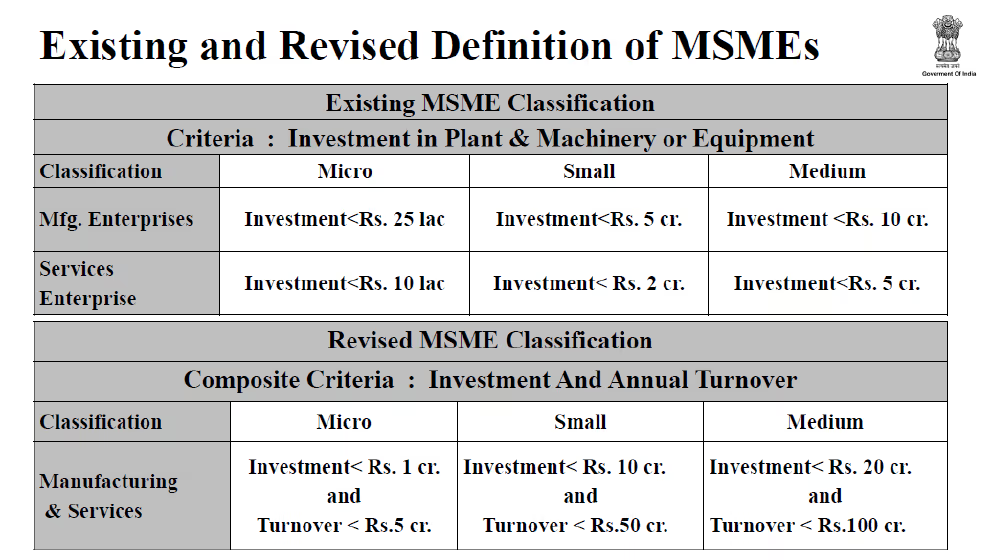
1.1.4 There’s a change in the definition of MSME sectors
The investment limit needs to be revised where new MSMEs have revised upwards. An additional criteria of turnover is added which will help the MSMEs to increase their production capacity without losing the advantages of being a small unit.
1.1.5 Global tenders Rs. 200 cr will be restricted
Global tenders will be disallowed in government procurement tenders up to Rs.200 crore as Indian business sectors get an unfair competition with foreign companies. To make a self reliant India the growth of local business sectors are quite essential and to eliminate competition from foreign companies.
1.1.6 Other initiative for MSMEs
The Union government and state ministry will clear every due to MSME in 45 days. E-market linkage will be acted as a replacement of trade fairs and exhibitions.
Rs 4000 crore partial credit guarantee to the banks allotted by the government for stressed MSMEs.
1.2 Extended EPF Support for Business & Workers
1.2.1 Rs. 2500 crore EPF ( Employment Provident Fund) facility for businesses and workers
The government will extend contribution to 24% EPF for the month of June, July and August. Under Pradhan Mantri Garib Kalyan Package ( payment of 12 of employer and 12 employee contributions was made into EPF accounts of eligible establishments.
A liquidity relief of Rs.2500 crore will be provided to 367,000 organisations and to 72.22 lakh employees of eligible firms.
1.2.2 Statutory PF contribution reduced for 3 months
A relaxation of statutory PF for both employers and employees shall be reduced to 10% each from the existing 12% each for every sector for 3 months covered under EPF. This implementation provides liquidity of Rs.6750 crore to employees and employers. Which will increase their take home salary for the next 3 months.
This scheme will be applicable for workers who are not eligible for 24% EPF support under PM Garib Kalyan Package and its extension
1.3 Direct Tax Measures
1.3.1 Refund to Income Tax
All pending refunds to charitable trusts and non corporate businesses professions including proprietorship, partnership, LLP and Co operatives would be issued on an immediate basis.
1.3.2 Rs 50,000 crores liquidity through TDS/TCS rate reduction
Under Top to Total initiative Rs 500 crore has been allotted to extend the Operation green from tomatoes, onions to other fruits and vegetables. 50% subsidy for transportation and cold storages.
3.2 Other Agricultural Reforms
The government of India is focusing on the legal framework in the agricultural sectors including making relevant amendments in the Essential Commodities Act, 1955.
The government will bring the agricultural marketing reforms to enhance the marketing choices of farmers through central law.
This will help the farmers to expand their business, in open markets, large retailers and exporters in a transparent way.
Sl.No
Schemes
Amount (Crores)
1
Fund for Micro Food Enterprises
10,000
2
Pradhan Mantri Matsya Sampada Yojana
20,000
3
Animal Husbandry Infrastructure Development Fund
15,000
4
Promotion of Herbal Cultivation
4,000
5
TOP to TOTAL Initiative - Operation Greens
500
6
Agricultural Infrastructure
1,00,000
7
Beekeeping Initiative
500
Total
1,50,000
4. Fourth Tranche (Rs8,100 crore) Schemes For 8 Sectors
Following the earlier schemes the government has announced the fourth tranche of it’s 20 lakh crore economic package in favour of 8 important sectors. Finance Minister Nirmala Sitharaman has added on her announcement about these 8 sectors and the complete break-up of the economic package.
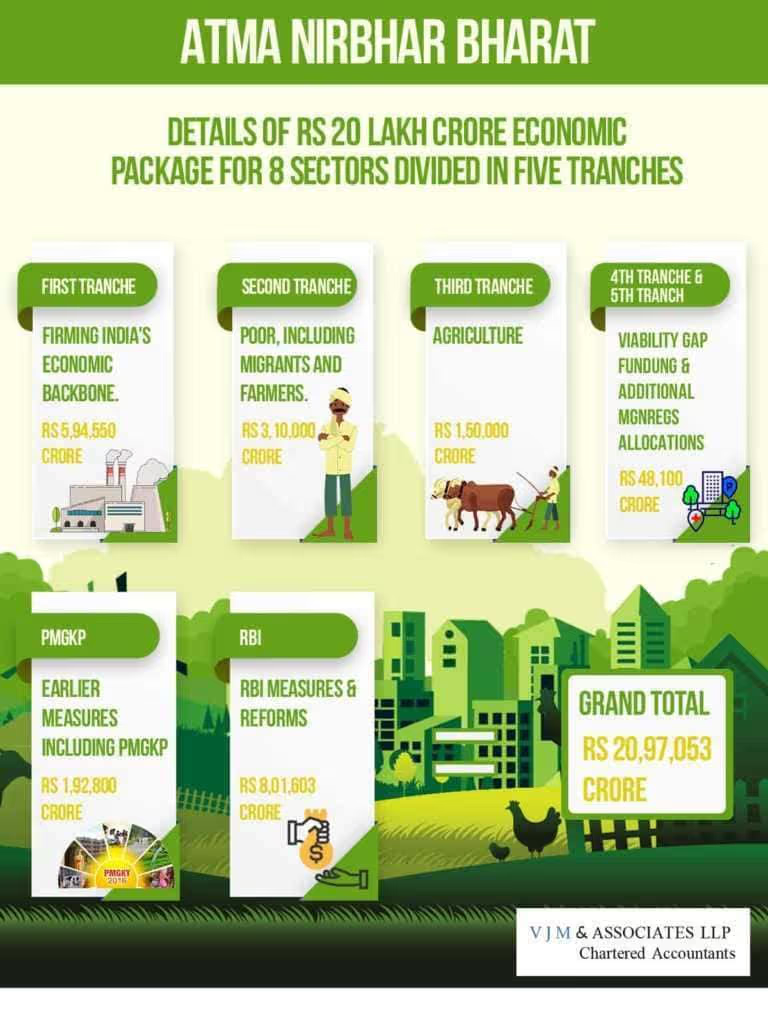
The fourth and fifth tranches have an equivalent value of Rs 48,100 crore including the additional figure of Rs 40,000 crore for MNREGA to create job facilities amid the nationwide lockdown. And Rs 8100 crore for viability gap funding.
The names of these important sectors and the respective schemes are listed below:
4.1 Coal and mining Commercialisation
Investment of Rs 50,000 crore in the coal and mining sector. The government will introduce an open market for coal industries. Privatisation in the coal industry will increase the competition amongst the private companies.
There’s a liberalisation in the coal bidding and selling market. Any party can bid for coal blocks without any norms.
4.2 Defense Production
Enhancing the defence productions to make India a self reliant country- Atma Nirbhar Bharat.
To make India self reliant in defence, the production of weapons and ammunition should be increased. Thus, the government is stopping the import of foreign defense weapons. A separate budget has been declared for domestic capital procurement.
The government has settled a Project Management Unit (PMU) to support the contract management. The FDI limit in defence productions is raised to 79% from 49%.
4.3 Minerals Sectors
Introduction of private companies in the mineral sectors. This will boost up the employment structure and bring state of the art-technology.
Transparent auction process, around 500 mining blocks would be offered in this process. Joint auction of bauxite, mineral blocks will increase competitiveness.
4.4. Air space management (Civil aviation, Airports and MRO)
For the betterment of the civil aviation sectors restrictions on the utilisation of the Indian Air Space will be reduced. There will be a profit margin of Rs1000 crore estimated from the aviation sectors. The ease of air space utilisation will reduce the air travel costs.
Increase the privatisation in aviation industry, new airports and optimal utilisation of airspace is required to develop the aviation sectors in India.
Reforming the Maintenance ,Repair and Overhaul (MRO) to make India a global hub of aircraft maintenance. The budget has been increased from Rs800 crore to Rs2000 crore for the maintenance and aircraft components repairs. For repairing facilities, the world’s major manufacturers are being appointed to set up the engine repair in India.
4.5 Distribution Companies In UTs (Power Distribution)
Distribution Companies to ensure the adequate power supply and reduced the load shedding issues.
Changes in the tariff policy reforms. Consumers won’t face any problems due to the inefficiency of DISCOMs.
Privatisation in power distribution groups in union territories. This will help the consumer to get better services and financial efficiency in distribution.
4.6 Social Infrastructure Development via Viability Gap Funding
Growth in private sectors is required to uplift the economic development in our country. Through viability gap funding scheme a total outlay of Rs 8100 crore is projected.
Social infrastructure projects need to be proposed by state ministry, central and statutory entities.
4.7 Space Sectors
The government will provide regulatory compliance to private associations. There will be access to private industries in the field of space activities.
New space projects, outer space travel and research will be open for private parties.
To improve the standard of space programs and activities private parties can work with ISRO.
4.8 Atomic Energy Reforms
For the welfare of humanity through affordable health treatment against cancer and other major diseases, the government is likely to establish the research reactor in PPP mode for the production of medical isotopes.
To develop the atomic power sectors, the technology cum incubation center will be set up with a collaboration of research facilities and tech entrepreneurs.
5. Fifth & Final Tranche (Rs40,000 Crore) For MGNREGA Fund
In the last and fifth tranche Finance Minister has announced an additional package of Rs 40,000 crore in seven steps namely for MGNREGA, health and education, decriminalization of Companies Act, Ease of Doing Business, state government funds and others.
To overcome the economic crisis of the state governments the Central Ministry has allocated Rs 46,038 crore for the State governments respectively.
The government has increased the advance limit by 60% for every state government for emergency purposes. Rs 4,113 crore fund released from the Health Ministry in favour of state government for Covid-19 activities.
Sl.No
Schemes
Amount (Crores)
1
Viability Gap Funding
8,100
2
Additional MGNREGA Fund
40,000
Total
48,100
6. Oters Measurements
6.1 RBI Monetary Fund & Policies
The Reserve Bank Of India has previously announced a monetary policy to combat against the poor economic condition of the country. Rs 8,01,063 crore fund is allocated as a liquidity measure to deal with the downfall of economic situation for Covid-19 pandemic since March.
Before the covid-19 pandemic situation the Central government has already announced a relief fund for the socio-economic poor and unprivileged citizens of the country. A fund of Rs 1,92,800 crore as a part of the Pradhan Mantri Garib Kalyan Yojana has been approved by the government to provide sufficient food and grains to these poor people.
As per the analysis, the financial support of Rs 52,608 crore has been provided to the Gramin people around 41crore people successfully received the package under PMGKY.
End Note
The covid-19 pandemic has changed the economic and social infrastructure of India and other countries. The world is now standing at the verge of a heavy economical breakdown. Where India is already going through an economic downturn at the same time announcing 10% of the GDP is a tough decision. Many sectors have already gained the relief funds and other measures will be in action soon to the respective sectors. But it depends on time, how these measures and schemes of Atma Nirbhar Bharat will draw a rising curve in India’s economic growth line.